Why Balance Wobbles When Reaching Up for a Shelf After 60

Quick Answer: Reaching overhead makes balance harder because it moves your center of mass up and away from your base of support, and after 60 the systems that keep you steady, from inner-ear signals to ankle strength, respond more slowly. You can improve it with practice: stand near a counter, reach slowly in small arcs, and build up single-leg and reach drills over three to four weeks. If you’ve lost your balance and fallen, or feel dizzy when you look up, talk to your doctor.
You’re reaching for the spice jar on the top shelf. You get it, but your foot slides a little on the tile, and for a second you grab the counter with both hands. Nothing happened. But it’s the third time this month.
This moment is common, and it’s easy to brush off. It’s also useful information about where your balance needs attention.

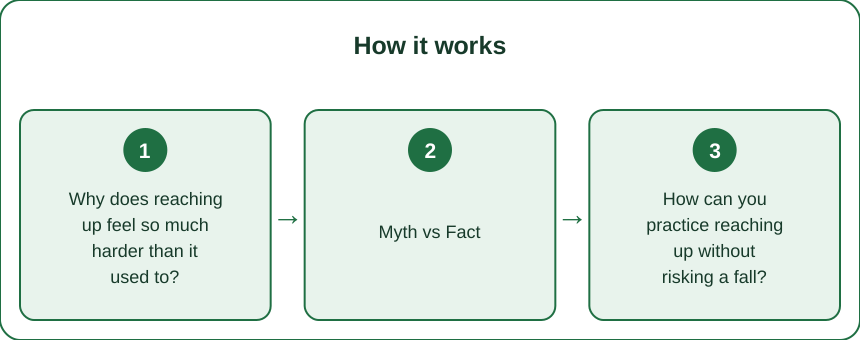
Why does reaching up feel so much harder than it used to?
Balance depends on three systems working together: your eyes, your inner ear, and the sensors in your feet and joints that tell your brain where your body is. When you reach up, your center of mass shifts higher and forward, and your body has to make small corrections in the ankles and hips to stay over your feet.
After 60, those corrections often arrive a fraction later. Vision can change, the inner-ear signals can be less crisp, and muscles around the ankles and hips may be weaker from years of sitting. None of these things is dramatic on its own. Together they make a reach that once took no thought take a little more effort.
The good news is that these systems respond well to practice. Balance is a skill, and skills improve with repetition.
Myth vs Fact: Does balance training only help if you already feel unsteady?
Myth: if you feel fine most of the time, balance work isn’t needed.
Fact: balance problems often show up only in specific moments, like reaching overhead, turning quickly or stepping off a curb. Training the exact movement that feels shaky is the most useful work you can do, even if you otherwise feel steady.

How can you practice reaching up without risking a fall?
Practice near something sturdy, like a kitchen counter, and keep the reach small at first.
- Two-hand counter reach: stand with both hands on the counter, lift one arm up slowly to shoulder height, hold for 3 seconds, lower. Do 8 reps per side.
- Slow overhead arc: holding the counter with one hand, reach the other arm up in a slow arc to just above your head and back, 6 times.
- Single-leg stand: stand on one foot near the counter for 10 seconds, then switch. Build to 30 seconds.
- Heel-to-toe walk: walk 10 steps placing one foot directly in front of the other, using the counter if you need it.
Do these 3 to 4 times a week. Within a few weeks most people find the reach feels more settled.
What Nobody Tells You About Looking Up and Dizziness
Many people notice a light-headed feeling when they tilt their head back to look up. That can be a sign of a vision or blood pressure issue, or of how the inner ear responds to head position. It’s not something to ignore.
Try this instead: turn your whole body to face the shelf, keep your head more level, and reach with your eyes following your hand. If you still feel dizzy or your vision goes gray, stop and sit down, then mention it to your doctor. Dizziness that comes with a fall, slurred speech, weakness on one side, or chest pain is an emergency, so call for help right away.
FAQ: Balance and Reaching Overhead, Answered
Do I need to use a stepstool?
A sturdy step stool with a handrail can reduce risk for many people, especially if the top shelf is above shoulder height. Store items you use daily at waist to chest height, and keep only rarely used things high up.
Can balance really improve after 60?
Yes. Studies on balance training in older adults show measurable gains in steadiness with regular practice over a few months. Consistency matters more than intensity.
When should I see a professional?
See your doctor if you’ve fallen, nearly fallen several times, or feel unsteady when standing or walking. A physical therapist can design a balance program that fits your health history.
This is general information, not medical advice.
TL;DR:
- Reaching overhead challenges balance because it raises and shifts your center of mass, and the body’s small corrections can be slower after 60.
- Balance is a skill. Practice the movement that feels shaky, not just general exercise.
- Use a counter for support and do two-hand reaches, slow overhead arcs, single-leg stands and heel-to-toe walks 3 to 4 times a week.
- Store daily items at chest height, and get checked if you’ve fallen, feel dizzy looking up, or notice new unsteadiness.
The goal isn’t to become a gymnast. It’s to reach for the things you need without the second grab at the counter. Start small, stay near something solid, and give it a few weeks. This is general information, not medical advice.
Keep Reading
This article is for general informational and styling purposes only. Fit, sizing, and product availability may vary.