Why Does Knee Pain Flare Up When Temperatures Drop After 60?

Quick Answer: Knee pain that worsens with cold weather after 60 usually isn’t one single cause — it’s typically several small factors stacking together: possible barometric pressure shifts, thicker and less lubricating synovial fluid in colder joints, reduced day-to-day activity, muscle stiffness reducing shock absorption, and even changes in footwear and layering habits that shift how weight moves through your knee. Understanding which factors apply to you can help you target the fix instead of just accepting the flare-up as inevitable.
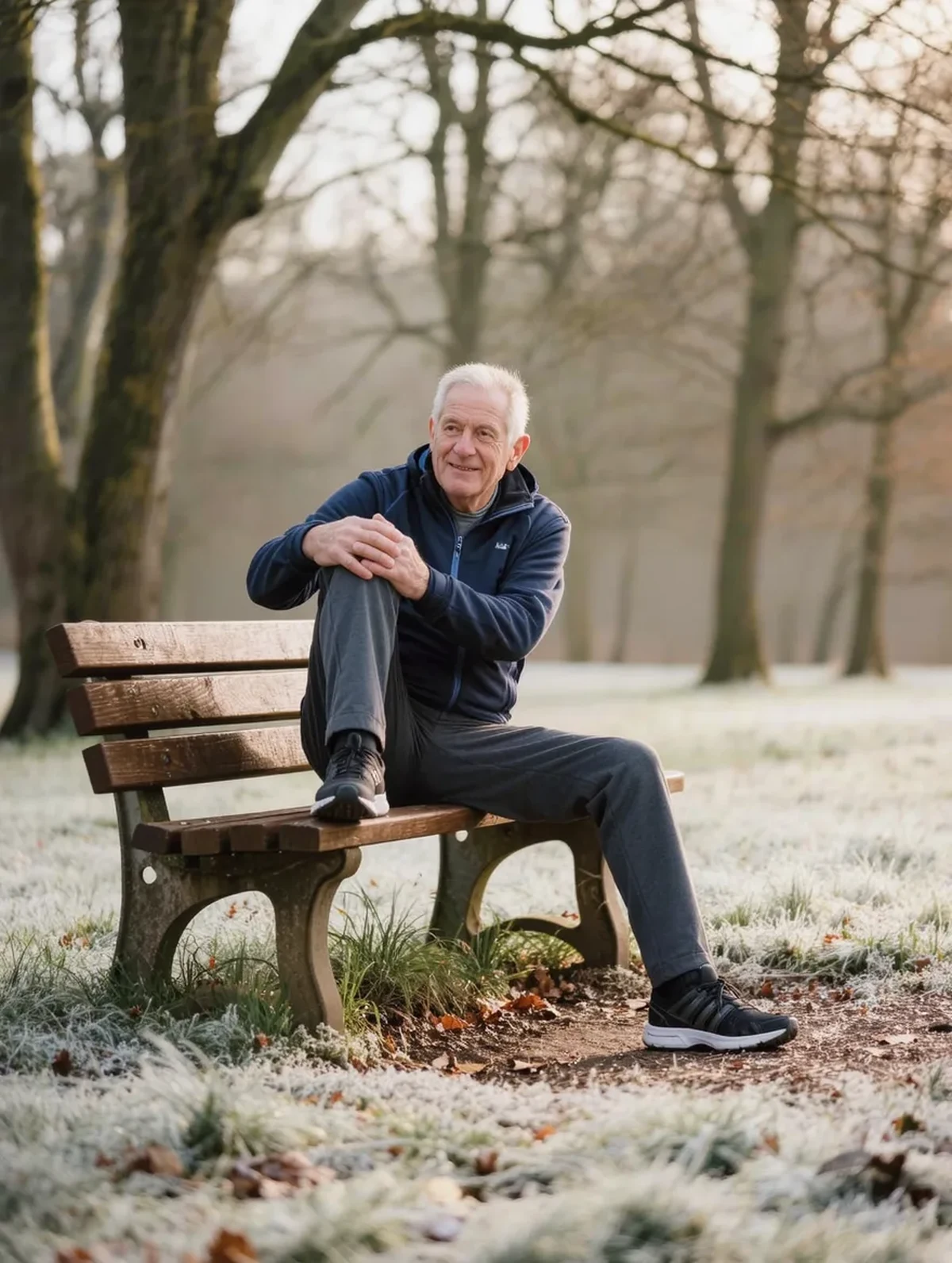
Ask around and you’ll find no shortage of people over 60 who swear they can predict a cold front by how their knees feel. It’s such a common experience that it’s tempting to dismiss it as folklore — but there’s real, if still evolving, science behind several of the mechanisms involved, plus some very fixable behavioral factors that tend to sneak in right alongside the weather change.
This is general information, not medical advice.

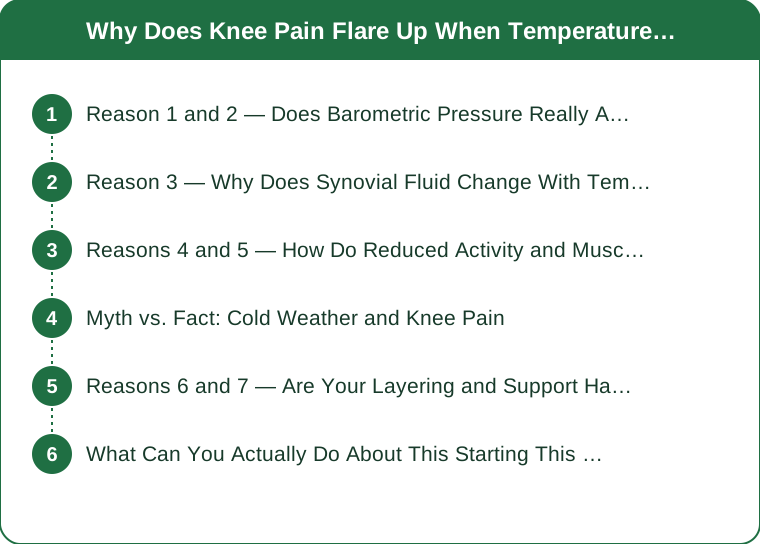
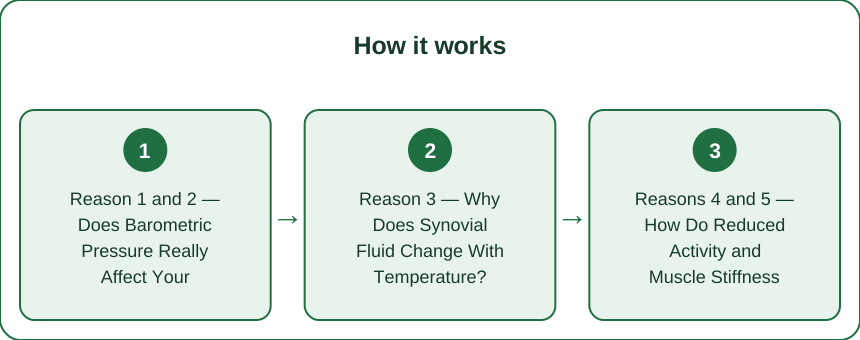
Reason 1 and 2 — Does Barometric Pressure Really Affect Your Knees?
The barometric pressure theory is the most talked-about explanation, and it’s genuinely plausible even though research findings have been mixed. The idea: as atmospheric pressure drops before a cold front or storm, the reduced outside pressure allows tissues around the joint — including any inflamed or swollen tissue in an arthritic knee — to expand slightly, which can increase pressure on surrounding nerves and produce a sensation of aching or stiffness. Some studies have found a measurable association between pressure drops and reported joint pain in people with osteoarthritis, while others have found no significant link — so consider this a reasonable, partially supported theory rather than settled fact.
Closely related is falling temperature itself, independent of pressure. Cold reduces blood flow to peripheral tissues, including the tissue surrounding your knee joint, as your body prioritizes circulation to your core. Less blood flow to the area can mean less warmth and more perceived stiffness, particularly in a joint that already has some degree of cartilage wear or inflammation.
Together, these two weather-related mechanisms are the ones most people mean when they say they can “feel a cold front coming” — and while the exact biological pathway is still debated among researchers, the reported pattern itself is consistent enough across studies and patient experience that it’s worth taking seriously rather than dismissing.
Reason 3 — Why Does Synovial Fluid Change With Temperature?
Your knee joint is lubricated by synovial fluid, a viscous substance that reduces friction between cartilage surfaces during movement. Like most fluids, its viscosity is temperature-sensitive — it thickens slightly in colder conditions, similar to how motor oil thickens in a cold engine. Thicker synovial fluid provides less smooth, less efficient lubrication during the first several minutes of movement, which can translate directly into the feeling of a “stiff,” less mobile knee first thing on a cold morning.
This effect is usually temporary and improves as you move and generate warmth in the joint, which is part of why knee stiffness in cold weather often eases somewhat after 10 to 15 minutes of walking, compared to how it felt getting out of a chair.
For a knee with existing cartilage wear, this matters more, because there’s already reduced natural cushioning — asking thicker, less effective fluid to compensate for that on top of the cold is a bigger ask than it would be for a fully healthy joint. This is one reason a proper warm-up matters more in cold months than it might in summer, even for the exact same activity level.
Reasons 4 and 5 — How Do Reduced Activity and Muscle Stiffness Make It Worse?
Cold, dark, shorter days reliably reduce how much most people move — fewer walks, more time seated, less incidental activity overall. This matters for your knees specifically because movement itself helps circulate synovial fluid and keep surrounding muscles warm and pliable. Less movement means the joint spends more time in the “thick fluid, cold, stiff” state described above, creating a cycle where reduced activity worsens stiffness, which then further discourages activity.
At the same time, the muscles surrounding your knee — particularly your quadriceps and hamstrings — act as shock absorbers, taking pressure off the joint itself during walking, stair climbing, and standing. Cold weather stiffens these muscles too, reducing their ability to absorb impact efficiently, which shifts more direct load onto the knee joint itself rather than the surrounding musculature.
This combination — a stiffer joint working with less-effective natural shock absorption, moving less overall — is a significant, and often underestimated, contributor to why cold-weather knee pain feels worse than the temperature change alone would explain. The fix isn’t complicated, but it does require intentionally counteracting the natural pull toward less movement that colder months create.
Myth vs. Fact: Cold Weather and Knee Pain
Myth: Cold weather causes arthritis. Fact: Cold weather doesn’t cause arthritis or create new joint damage — it can intensify the symptoms of existing joint wear, but it isn’t a root cause of the underlying condition.
Myth: If your knee hurts more in winter, you should rest it completely. Fact: Complete rest often worsens cold-weather knee pain by reducing the circulation and synovial fluid movement that help ease stiffness. Gentle, consistent movement is generally more helpful than inactivity.
Myth: Compression sleeves and warm layers are just about comfort, not function. Fact: Keeping the joint warm can genuinely help maintain more favorable synovial fluid viscosity and blood flow, giving compression and warmth a real, if modest, functional role — not just a psychological one.
Myth: Barometric pressure’s effect on joints is fully proven science. Fact: It’s a plausible, partially supported theory with mixed research results — real for many people’s experience, but not a settled biological mechanism.
Reasons 6 and 7 — Are Your Layering and Support Habits Working Against You?
Cold-weather clothing changes how you move in subtle ways that add up. Bulkier winter footwear — heavier boots, thicker soles, sometimes worn without the same attention to fit and support as your regular shoes — can alter your gait mechanics and how weight transfers through your knee with every step. If those shoes lack proper arch support or have a different heel height than what you’re used to, the resulting change in alignment can place uneven stress directly on the knee joint.
Similarly, restrictive layering — heavy pants, long coats, multiple layers — can subtly limit your natural range of motion during walking, causing you to unconsciously shorten your stride or alter how you bend your knee through each step. Over weeks of cold-weather dressing, these small compensations can contribute to knee discomfort that has more to do with your outerwear than with the joint itself.
The fix here is genuinely simple: prioritize the same supportive, well-fitted footwear in winter that you’d wear the rest of the year, even if that means adding grip traction devices for ice rather than switching to an entirely different boot. And where possible, choose flexible, insulated layers over bulky ones that restrict knee bend — a well-fitted pair of insulated leggings under looser pants often preserves more natural movement than a single heavy pair of jeans.
What Can You Actually Do About This Starting This Week?
Start with warmth and warm-up: a longer warm-up before any activity in cold weather — 8 to 10 minutes of gentle marching, ankle circles, and knee bends — gives your synovial fluid time to thin out and your surrounding muscles time to loosen before you ask more of the joint.
Keep moving through the season rather than retreating indoors entirely: even a 15 to 20 minute daily walk, indoors if needed, helps maintain the circulation that keeps stiffness from compounding. Pair this with quadriceps and hamstring strengthening two to three times a week — stronger surrounding muscles take pressure directly off the knee joint, partially offsetting the reduced natural shock absorption that cold weather causes.
Consider a knee sleeve or light compression wear during outdoor activity in cold months, which many people find genuinely helps with both warmth and joint stability. And do an honest check of your winter footwear — worn-out support or a mismatched heel height compared to your regular shoes is a fixable, often-overlooked contributor.
If pain is severe, sudden, accompanied by swelling, or doesn’t improve with these adjustments over a couple of weeks, that’s worth a conversation with a doctor rather than continuing to self-manage.
TL;DR:
- Barometric pressure drops and falling temperatures are plausible, partially research-supported contributors to cold-weather knee pain.
- Synovial fluid thickens in cold conditions, reducing joint lubrication, especially in the first minutes of movement.
- Reduced activity and stiffer surrounding muscles shift more direct load onto the knee joint itself.
- Winter footwear and heavier layering can subtly alter gait and add uneven stress on the knee.
Cold-weather knee pain is rarely one single cause — but because most of the seven factors above are fixable with warm-up, movement, strengthening, and better gear choices, a flare-up doesn’t have to mean settling in for a long winter of discomfort.
Keep Reading
This article is for general informational and styling purposes only. Fit, sizing, and product availability may vary.