Why Does Grip Strength Predict Fall Risk After 60?

Quick Answer: Grip strength isn’t really about your hands — it’s a stand-in measurement for your whole-body muscle mass, nerve signaling speed, and overall physical resilience. Large population studies have found that lower grip strength tracks closely with slower gait speed, more falls, and higher frailty risk in adults over 60. The good news is that grip strength responds quickly to simple, low-equipment training. Adding two or three short sessions a week can improve both your hand strength and the broader muscle recruitment that keeps you steady on your feet.
If you’ve ever had a doctor squeeze a dynamometer into your hand during a checkup, you may have wondered what your handshake has to do with your health. It turns out: quite a lot. Grip strength has become one of the most studied “vital signs” in aging research, precisely because it’s cheap to measure and surprisingly predictive of what’s happening everywhere else in your body — including your risk of falling.
This is general information, not medical advice.
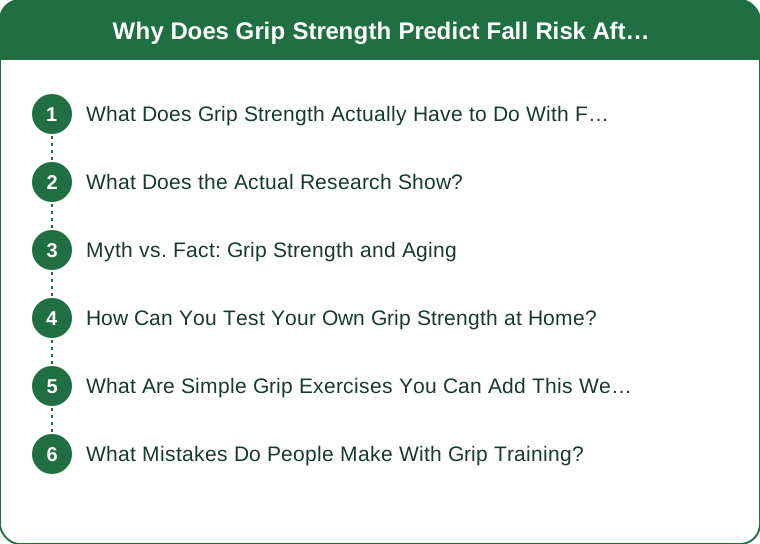
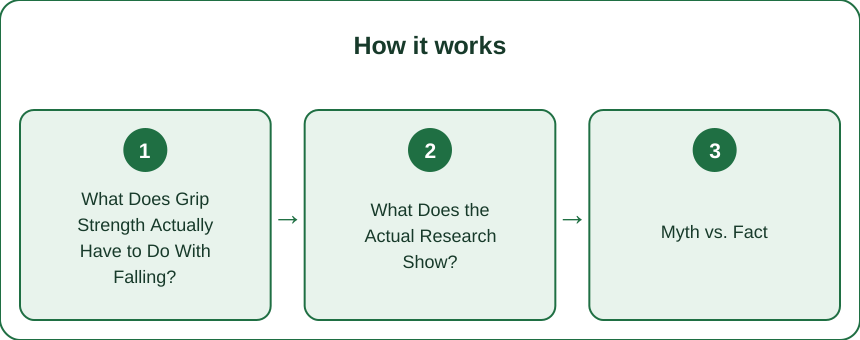
What Does Grip Strength Actually Have to Do With Falling?
Your hands aren’t isolated from the rest of your muscular system. Grip strength depends on the same fast-twitch muscle fibers that also control quick, reactive movements elsewhere in your body — the kind you need when you trip on a curb and have to catch yourself in a fraction of a second. When those fibers weaken or shrink with age (a process called sarcopenia), the decline tends to show up in your grip at roughly the same rate it shows up in your thighs, hips, and core.
Grip strength is also a rough proxy for nerve conduction speed. As we age, the signals traveling from brain to muscle slow down slightly, and this slowdown affects fine motor control in the hands at a similar pace to how it affects the quick postural corrections your ankles and hips make when your balance shifts. Researchers use grip strength partly because it’s easy to test with a handheld dynamometer, but also because the hand is a sensitive early indicator — weakness tends to show up there before it becomes obvious in bigger muscle groups.
There’s a third piece: grip strength correlates with overall lean muscle mass. People with more total muscle tend to have stronger grips, and more total muscle means more stability reserve when something unexpected happens — a slippery step, an uneven sidewalk, a dog that suddenly lunges on its leash. Muscle mass isn’t just about looking strong; it’s your body’s shock-absorption and correction system.
So when a grip test comes back weak, it’s not flagging a hand problem. It’s flagging a whole-body pattern that also affects the muscles actually responsible for keeping you upright.
What Does the Actual Research Show?
The connection isn’t a hunch — it’s been tracked across very large populations. One frequently cited study followed more than 140,000 adults across 17 countries and found that every 5-kilogram decrease in grip strength was associated with meaningfully higher risk of all-cause mortality and cardiovascular events, independent of other risk factors. While that study focused on survival broadly, follow-up research narrowing in on older adults has repeatedly found the same pattern applies to falls specifically: weaker grip correlates with slower walking speed, longer “time to stand” from a chair, and a higher rate of reported falls in the following year.
Clinically, grip strength is one of the five criteria used to diagnose sarcopenia under the widely used EWGSOP2 framework, alongside muscle mass and physical performance. The commonly cited thresholds are below about 27 kilograms for men and 16 kilograms for women, though your doctor may use slightly different cutoffs depending on the tool.
What makes this useful for you isn’t the exact numbers — it’s the takeaway: grip strength is one of the earliest, easiest-to-measure signals that your broader strength reserve is shrinking. And because it declines at roughly 1 to 2 kilograms per decade starting around age 50, with the pace often picking up after 60, catching the trend early gives you a real window to intervene before it shows up as an actual fall.
Myth vs. Fact: Grip Strength and Aging
Myth: If my hands feel fine, my grip strength is fine. Fact: Day-to-day tasks like opening a jar or turning a doorknob use far less force than a real grip strength test measures. You can complete every normal task in your day and still have grip strength well below what’s protective for fall risk — it only becomes obvious once it’s tested directly.
Myth: Grip strength training only helps your hands and forearms. Fact: Because grip strength shares underlying muscle fiber types and neural pathways with the rest of your body, training it produces some spillover benefit to overall neuromuscular responsiveness — though it won’t replace leg or core strength work.
Myth: Weak grip is just a normal, unavoidable part of getting older. Fact: Some decline is typical, but the rate of decline is highly modifiable. Studies on resistance training in adults 60 and older consistently show measurable grip strength gains within 8 to 12 weeks of consistent training — this is not a one-way street.
Myth: You need gym equipment to train grip strength. Fact: A $10 hand gripper, a rubber resistance band, or even squeezing a rolled towel provides enough resistance to produce real strength gains for most people starting from a baseline of age-related decline.
How Can You Test Your Own Grip Strength at Home?
You don’t need a clinical dynamometer to get a useful read on where you stand, though an inexpensive hand dynamometer (often $15 to $25 online) gives you an actual number you can track over time. If you want a rough, no-equipment estimate, try this: squeeze a rolled-up bath towel as hard as you can with one hand and hold for 10 seconds. If you notice your grip fatiguing or shaking well before the 10 seconds are up, or if one hand is dramatically weaker than the other, that’s worth mentioning at your next checkup.
A more functional test many physical therapists use is the 30-second sit-to-stand test combined with a grip check — because the two tend to move together. If you’re struggling to rise from a chair without using your hands and your grip also feels weak, that combination is a stronger fall-risk signal than either measure alone.
Track your number every few weeks rather than obsessing over a single test. Grip strength can vary by a kilogram or two based on time of day, hydration, and how recently you’ve eaten, so a trend over a month tells you far more than one reading.
What Are Simple Grip Exercises You Can Add This Week?
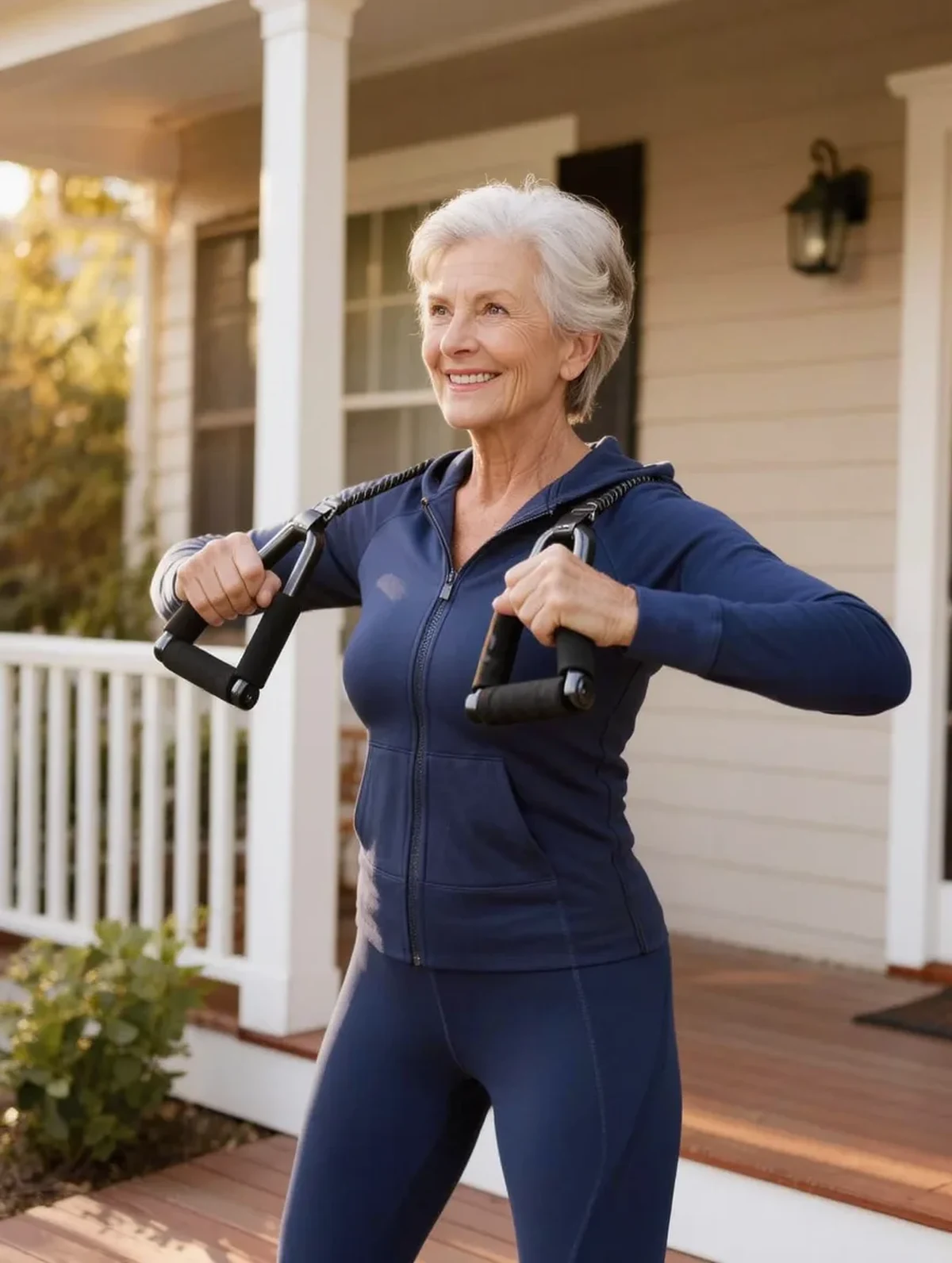
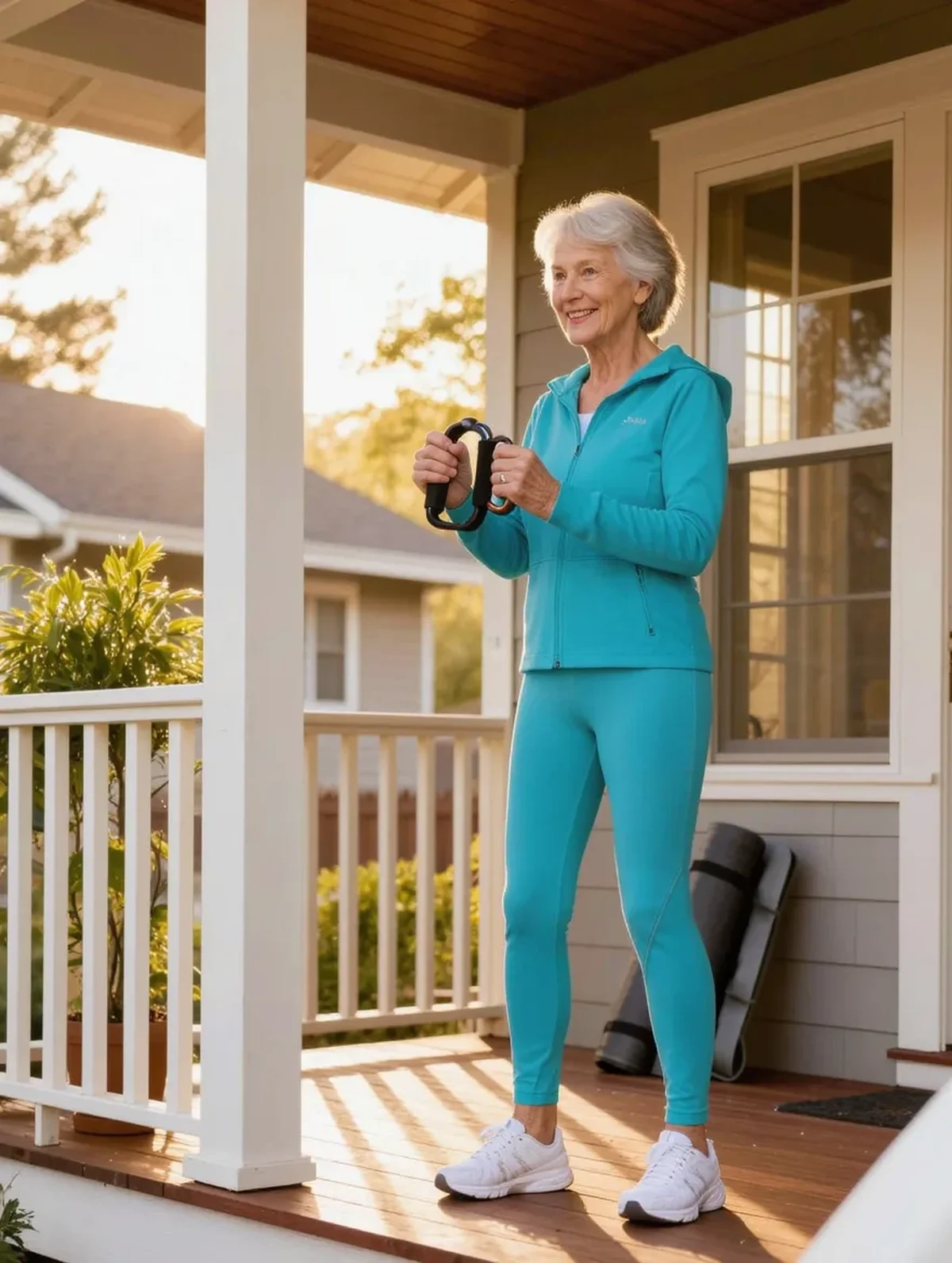
You don’t need a dedicated gym routine — grip work fits easily into a few minutes, a few times a week. Start with a spring-loaded hand gripper, doing 2 to 3 sets of 10 to 15 squeezes per hand, resting about a minute between sets. If a gripper isn’t available, a stress ball or rolled towel works nearly as well for beginners.
Farmer’s carries are one of the most effective full-body-plus-grip exercises available: pick up a moderately heavy object in each hand — a filled water jug or a grocery bag works fine — and walk 20 to 30 steps while keeping your shoulders back and core engaged. This trains grip endurance while also reinforcing the posture and gait mechanics tied to fall prevention.
Dead hangs from a sturdy bar (even a doorway pull-up bar) for 10 to 20 seconds build both grip and shoulder stability, though check with your doctor first if you have shoulder issues. Finally, simple wrist curls with a light dumbbell or resistance band, 2 sets of 12 reps, round out a well-balanced grip routine.
Two to three sessions a week is enough to see measurable change within about two months — this isn’t a high-volume commitment, just a consistent one.
What Mistakes Do People Make With Grip Training?
1. Going too heavy, too fast. Jumping straight to the stiffest hand gripper available often causes tendon irritation in the wrist and forearm rather than building strength. Start light and progress gradually.
2. Training only one hand. It’s common to unconsciously favor a dominant hand, but asymmetry itself is a fall-risk marker. Train both hands equally, and pay closer attention to the weaker side.
3. Skipping the wrist and forearm entirely. Grip strength isn’t just finger flexors — the muscles running up your forearm do much of the work. Wrist curls and extensions round out the training that a hand gripper alone misses.
4. Expecting overnight results. Grip strength typically improves over 8 to 12 weeks of consistent work, not days. Give it a fair trial before deciding it isn’t working.
5. Treating it as a replacement for leg and core training. Grip strength is a useful early signal and a helpful add-on, but it doesn’t substitute for the squats, step-ups, and balance work that more directly protect you from falling. Use it alongside a broader strength routine, not instead of one.
TL;DR:
- Grip strength is a proxy for whole-body muscle mass and nerve signaling speed, which is why it tracks with fall risk.
- Large studies link every 5kg drop in grip strength to meaningfully higher health risks, including patterns tied to falls and frailty.
- A simple towel-squeeze test or inexpensive hand dynamometer can give you a useful baseline today.
- Two to three short sessions a week with a hand gripper, farmer’s carries, or wrist curls can produce measurable gains in 8 to 12 weeks.
Grip strength won’t catch you when you trip, but it’s one of the clearest early warnings that your whole-body strength reserve needs attention — and it’s one of the easiest things on this list to actually start training tonight.
Keep Reading
This article is for general informational and styling purposes only. Fit, sizing, and product availability may vary.