Why Does Balance Training Need to Move Indoors Once It Gets Dark Early?

Quick Answer: Outdoor walking does more for your balance than most people realize — uneven sidewalks, curbs, grass, and gravel constantly force small corrective adjustments that train your balance system without you noticing. When daylight saving time and colder weather cut those walks short, that training disappears unless you replace it with something intentional indoors. A short, targeted indoor routine using unstable surfaces, single-leg holds, and head-turn challenges can preserve — and even improve — the balance gains your walks were quietly giving you.
Every fall, right around the time the clocks change and the sidewalks get icy, something breaks in a lot of people’s routines: the daily walk that was quietly doing double duty as balance training disappears. It’s easy to think of that walk as just cardio, but the constantly varying terrain was training a skill that a treadmill or living room never demands on its own.
This is general information, not medical advice.
Why Does an Outdoor Walk Count as Balance Training?
Flat, predictable ground barely challenges your balance system. But real sidewalks aren’t flat — they slope toward the street for drainage, buckle from tree roots, transition abruptly at curb cuts, and shift underfoot on grass or gravel. Every one of those small variations forces your vestibular system (inner ear), proprioception (your body’s sense of joint position), and visual system to work together, making dozens of tiny corrective adjustments per minute without you consciously noticing.
This is sometimes called “incidental balance training” — you get the benefit without doing a single formal exercise. Research on fall prevention has consistently found that varied terrain and unpredictable surface challenges are more effective at building real-world balance resilience than walking on a perfectly flat, predictable surface, because falls in daily life almost never happen on flat, predictable ground.
There’s also a reactive component outdoor walking builds that’s harder to replicate indoors: stepping around another pedestrian, adjusting stride length for a curb, or catching yourself on uneven pavement all train your ability to recover from an unexpected balance disruption — which is precisely the skill most relevant to preventing a fall.
When the days shorten and temperatures drop, that walk often gets replaced with nothing, or with indoor walking on flat, carpeted, perfectly even floors — which offers cardio benefit but almost none of the balance-training stimulus the outdoor route was providing. That’s the real gap that needs filling before winter sets in.
What Exactly Are You Losing When the Walks Stop?
The most immediate loss is the varied surface exposure described above — but there’s a secondary effect worth knowing about. Balance is a “use it or lose it” system: research on detraining shows that balance-specific gains can begin fading within roughly two to three weeks of stopping the activity that built them, faster than strength typically declines from inactivity. That means a switch straight from daily outdoor walks to a sedentary indoor winter can produce a measurable balance decline well before spring.
There’s also a confidence factor. People who stop challenging their balance regularly often become more fearful of uneven ground, which paradoxically increases fall risk — fear of falling causes people to walk with shorter, more cautious steps and less hip rotation, both of which actually reduce stability rather than protect it.
Finally, outdoor walking often provided incidental lower-body strength work — inclines, curbs, and longer distances all load your legs more than most indoor routines do by default. Losing the walk can mean losing strength stimulus at the same time as balance stimulus, which compounds the risk if nothing replaces it.
The fix isn’t to force outdoor walking through ice and darkness — it’s recognizing what the walk was actually providing so you can replace it deliberately rather than just letting it lapse.
Myth vs. Fact: Indoor Balance Training
Myth: A treadmill walk gives you the same balance benefit as an outdoor walk. Fact: A treadmill’s flat, consistent belt removes almost all the surface variability that made the outdoor walk effective for balance — it’s good cardio, but it isn’t a balance substitute.
Myth: Balance exercises are only necessary if you’ve already had a fall. Fact: Balance training is most effective as prevention, before a fall occurs. Waiting for a fall to “prove” you need the training means training after the highest-risk event has already happened.
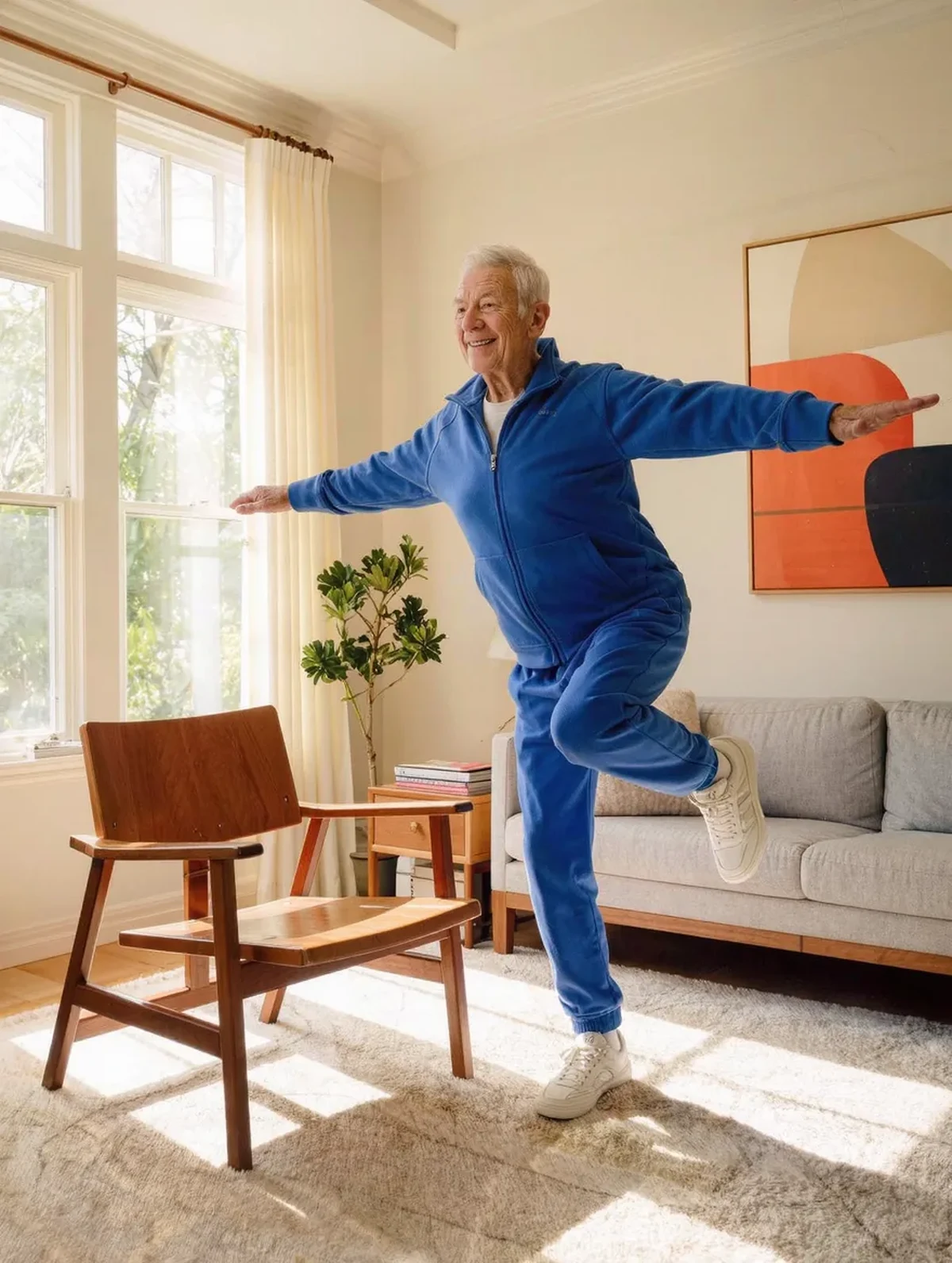
Myth: You need a wobble board or expensive equipment to train balance indoors. Fact: A sturdy chair for support, a rolled towel or folded blanket to stand on, and open floor space are enough for an effective home balance routine.
Myth: Balance exercises are only for your legs and feet. Fact: Balance training also engages your core, hip stabilizers, and even your eyes and inner ear — a comprehensive routine involves head turns and visual tracking, not just standing on one foot.
What Indoor Routine Actually Replaces the Walk?
Build your indoor session around three elements: unstable surfaces, single-leg work, and head/visual challenges — the same three things outdoor terrain was providing.
For surface variability, stand on a folded towel, thin cushion, or foam pad (near a wall or countertop for safety) while doing simple movements like weight shifts or marching in place. This recreates some of the instability that grass and uneven pavement provided.
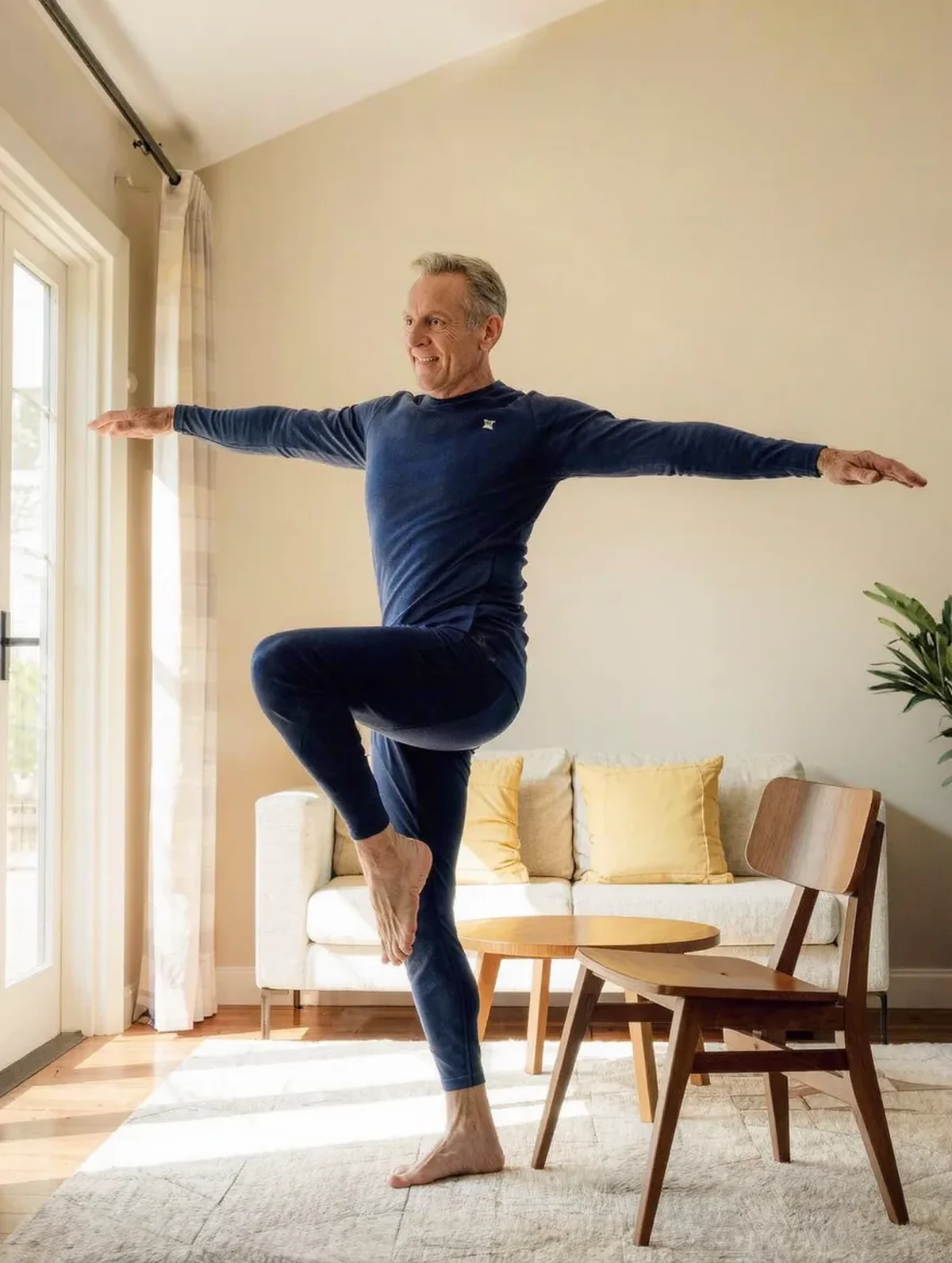
For single-leg work, hold onto a chair back and lift one foot slightly off the ground, aiming to build from 10 seconds up to 30 seconds per side over a few weeks. Progress by lightening your hand support before removing it entirely, and only once it’s genuinely comfortable.
For the reactive, “catching yourself” element that outdoor walking builds, try heel-to-toe walking across a room (like walking a tightrope) or gentle side-stepping with resistance from a light band around your ankles. Adding head turns — looking left and right while walking a straight line — reintroduces the visual and vestibular coordination challenge that scanning your surroundings outdoors naturally provided.
Ten to fifteen minutes, four to five times a week, is a reasonable target — enough to maintain the balance stimulus your walks used to supply without turning it into a major time commitment.
What Mistakes Do People Make Moving Balance Work Indoors?
1. Skipping it because it “feels less like exercise.” Balance work doesn’t raise your heart rate the way a brisk walk does, which makes it easy to deprioritize — but it’s addressing a different, equally important system.
2. Practicing without any support nearby. Especially for single-leg and unstable-surface work, always have a wall, counter, or sturdy chair within reach until a movement feels fully secure.
3. Doing the exact same routine every session. Balance training benefits from variety — the same three exercises repeated for months stop challenging your system in new ways. Rotate in new surfaces or stances every few weeks.
4. Only training while standing still. Real falls usually happen while moving. Include walking-based balance drills, not just static holds, to better match real-world demands.
5. Waiting for spring instead of starting now. The gap between when outdoor walks stop and when they resume can be four to five months in colder climates — long enough for real detraining. Start the indoor routine before the walks stop, not after.
TL;DR:
- Outdoor walking trains balance incidentally through uneven, varied terrain that flat indoor surfaces don’t replicate.
- Balance-specific gains can start fading within two to three weeks of losing that stimulus, faster than strength typically declines.
- An effective indoor routine needs three elements: unstable surfaces, single-leg holds, and head-turn or visual challenges.
- Ten to fifteen minutes, four to five times a week, done near a wall or chair for support, is enough to maintain what your walks were providing.
Don’t wait for the first icy sidewalk to figure this out — start the indoor routine now, while the outdoor walks are still an option, so there’s no gap for your balance to slip through.
Keep Reading
This article is for general informational and styling purposes only. Fit, sizing, and product availability may vary.