Strength Training Over 60: Why It's Never Too Late

Quick Answer: Yes — muscles respond to strength training at every age, with documented gains in people in their 80s and 90s. Start with 2 sessions a week of bodyweight and light resistance: chair squats, wall push-ups, band rows, 2 sets of 8–12 reps. Progress slowly, and clear it with your doctor first if you have existing conditions.
“I’ve left it too late.”
It’s the single most common sentence people say before starting, and it’s the one thing in this article the research is genuinely unambiguous about.
Your muscles haven’t stopped listening. They’re waiting for a signal nobody’s been sending them.

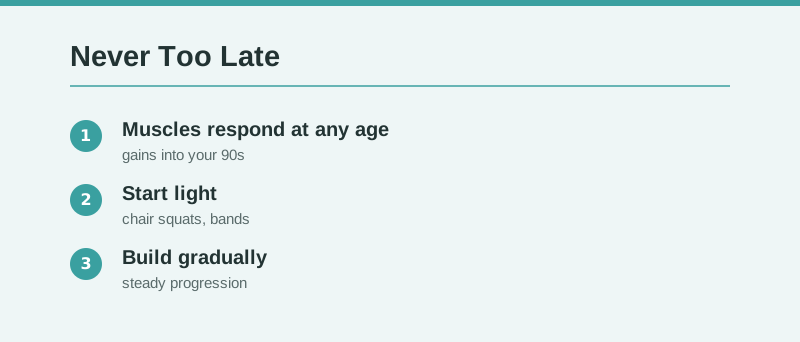
Can you really build muscle after 60?
Yes, and the evidence isn’t marginal.
Studies in nursing-home populations — people in their 80s and 90s, some using walking aids — have repeatedly shown meaningful gains in strength and mobility after a few weeks of supervised resistance training. If that group responds, so does a healthy 62-year-old.
Two things worth knowing about how the gains arrive. The first several weeks bring largely neurological improvement: your nervous system gets better at recruiting the muscle you already have. That’s why people often feel noticeably stronger before anything looks different. Actual muscle growth follows, more slowly, over months.
The rate of gain is somewhat slower than at 25. The direction is identical. Building muscle after 60 isn’t a consolation prize — it’s the same process on a slightly longer timeline.
How should you start?
Light, and with more patience than feels necessary.
Week 1–4: learn the movements. Bodyweight and very light resistance, 2 sessions a week, focusing entirely on form.
- Chair squats — stand up from a chair and sit back down slowly. 2 sets of 8.
- Wall push-ups — hands on the wall, body at an angle. 2 sets of 8.
- Resistance-band rows — band around a door handle, pull to your ribs. 2 sets of 10.
- Heel raises — holding a counter for balance. 2 sets of 10.
- Sit-to-stands without hands, if you can do them safely.
Week 5–12: add load, slowly. Once 12 reps feel manageable, add a small amount of weight or move to a harder variation. A 10% increase at a time is plenty. Rest 60–90 seconds between sets.
Week 12 onward: two or three sessions a week, indefinitely. That’s the whole program. It doesn’t need to get more complicated than this.

What Nobody Tells You About Starting After 60
The balance improvement arrives first, and it matters most. Strength work reduces fall risk substantially, and falls — not muscle size — are what actually threaten independence. Most people notice steadier movement on stairs within a month.
Protein matters more than it used to. Older muscle is less responsive to a given amount of protein, so a bit more, spread across meals, helps the training work. Roughly 25–30g per meal is a common target — worth discussing with your doctor, particularly if you have kidney concerns.
Soreness in week one is not injury. Delayed muscle soreness peaks around 48 hours and fades. Sharp pain, joint pain, or anything that gets worse rather than better is different — stop and get it looked at.
Bone responds too. Resistance training and weight-bearing movement help maintain bone density, which matters considerably if osteoporosis is a concern. This is one of the few things that genuinely does both jobs at once.
Two sessions beat five. The most common failure isn’t doing too little — it’s an enthusiastic first fortnight, followed by exhaustion, followed by stopping. A modest routine you keep is worth more than an ambitious one you abandon in March.
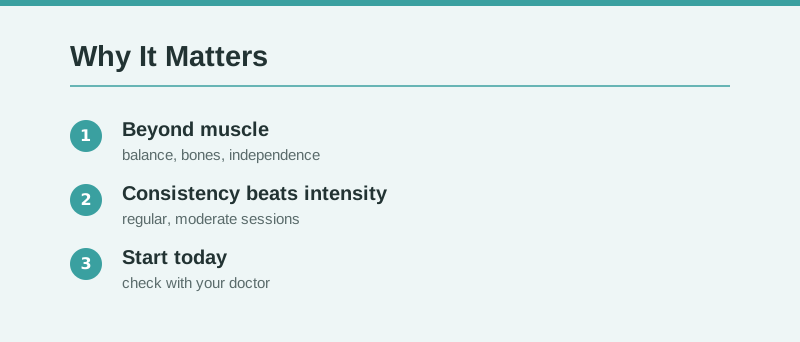
What does strength training actually give you?
Beyond muscle, quite a lot:
- Better balance and lower fall risk — the single biggest quality-of-life return.
- Stronger bones, supporting resistance against osteoporotic fracture.
- Easier daily tasks — stairs, shopping, getting off the floor, standing up from low chairs.
- Better blood-sugar handling and metabolic health, since muscle is where glucose gets used.
- Independence, which is the whole point. Not aesthetics — capability.
Before you begin: check with your doctor, especially if you have heart conditions, high blood pressure, osteoporosis, joint replacements, or you’ve been inactive for a long stretch. A physiotherapist or a trainer experienced with older adults is worth a few sessions to get form right at the start. This article is general information rather than personal medical advice.
FAQ
How many times a week should I strength train after 60?
Two sessions is the effective minimum and works well; three is ideal. Leave at least one rest day between sessions — muscle is built during recovery, not during the workout.
Do I need a gym?
No. Bodyweight movements, resistance bands and a couple of light dumbbells cover everything in this article. A gym helps once you want to load more heavily, but it isn’t the entry requirement.
Is it safe if I have arthritis?
Often yes, and strength training frequently reduces joint pain by supporting the joint better. Work in a pain-free range and get guidance from a physio on which variations suit your specific joints.
TL;DR:
- Muscles respond at any age — documented gains in people in their 80s and 90s.
- Start with 2 sessions a week: chair squats, wall push-ups, band rows, heel raises, 2 sets of 8–12.
- First weeks bring neurological gains; visible change follows over months.
- Balance and fall-risk improvement is the biggest real-world return.
- Two consistent sessions beat five ambitious ones. Check with your doctor first.
Start light, stay consistent, add a little each month. The only genuine mistake here is the belief that it’s too late — and that one’s been thoroughly disproved.
Keep Reading
This article is for general informational and styling purposes only. Fit, sizing, and product availability may vary.