7 Things That Change When Strength Training Moves Indoors After 60

Quick Answer: Moving strength work indoors for the cold season changes seven practical things: warm ups need to be longer, grip and footwear behave differently on hard floors, balance training loses the uneven ground that was doing half the work, sessions get shorter, vitamin D and daylight drop, social accountability disappears, and progress becomes harder to see. Each has a short fix, and the ones that matter most are the warm up and replacing the balance challenge you lose.
Every autumn the same shift happens. The park sessions, the garden, the walking group in daylight — they all quietly stop, and what replaces them is a rug in the living room. The routine looks the same on paper. It is not the same, and knowing exactly what changed is the difference between a winter that holds your strength and a winter that costs you six months.
This is general information, not medical advice.

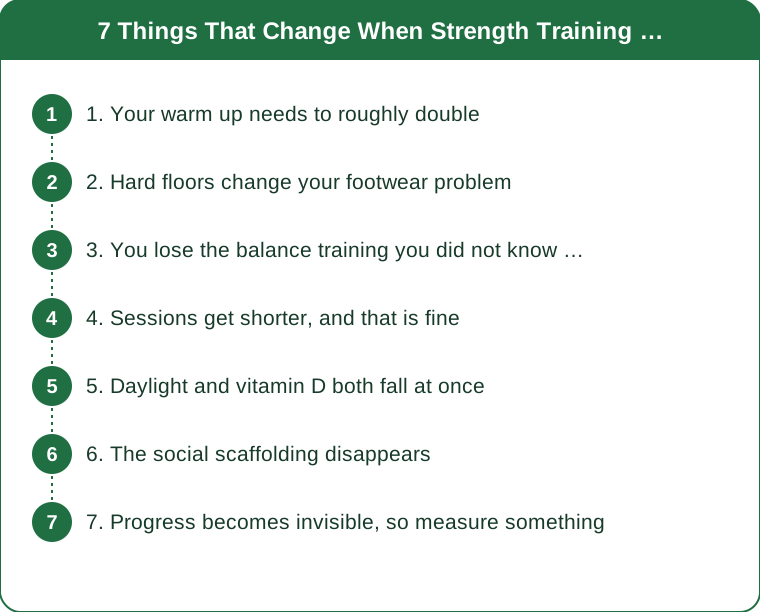
1. Your warm up needs to roughly double
Cooler tissue is stiffer tissue. Tendons and fascia are viscoelastic, so the same shoulder that reached overhead easily in July will feel short and grippy in a sixteen-degree living room in November, at exactly the same actual range of motion.
After 60 this matters more, because tendon stiffness is already higher and warms more slowly than it did at 40. The result is that the first two sets of everything feel bad, people read that as decline, and some of them stop.
Fix: ten minutes of movement before anything loaded. Marching on the spot, slow sit-to-stands from a chair, arm circles, ankle rocks, shoulder rolls. Movement, not holds — a static stretch does not raise tissue temperature, and warmth is the entire point. If you feel warm and slightly out of breath, you are ready.
2. Hard floors change your footwear problem
Grass and gravel are forgiving. Laminate, tile and a rug over floorboards are not, and the shoes that were fine outdoors are often the wrong ones inside.
Two failure modes. Thick cushioned trainers on a soft rug give you an unstable base for squats and split squats, which makes balance work feel worse than it is. Socks on a smooth floor slide, which is genuinely how falls happen at home.
Fix: train in flat, thin-soled shoes with grip, or barefoot on a surface you trust. Move the rug rather than working on its edge. And check the floor is dry before single-leg work — the kitchen is where most home training happens and the kitchen is where the floor is wet.
3. You lose the balance training you did not know you were doing
This is the big one, and it is invisible.
Walking on uneven ground — grass, kerbs, slopes, the uneven path to the shops — is continuous, low-level balance training. It is proprioceptive work at a volume no exercise programme matches, and it is what keeps ankle and hip reactions sharp. When outdoor walking drops from an hour a day to fifteen minutes, that stimulus largely disappears, and balance measurably declines over a winter.
Most people do not notice until spring, when the first proper walk feels unsteady.
Fix: put balance in the indoor routine deliberately. Two minutes a day is enough: stand on one leg near a counter, thirty seconds a side, twice. Progress it by turning your head side to side, then by closing your eyes with a hand lightly on the counter. Add heel-to-toe walking along a hallway. It is the cheapest insurance in the whole routine.
4. Sessions get shorter, and that is fine
Winter sessions shrink. Darkness, cold, illness in the family, and the general friction of the season mean the forty-five minute session becomes twenty-five.
The mistake is treating that as not worth doing. The evidence on strength maintenance is reassuring here: maintaining strength takes substantially less work than building it, and a much reduced volume — as little as one third — will hold gains for months in older adults, provided intensity stays reasonable.
Fix: cut sets, not effort. Two working sets of four movements, twice a week, is a genuine maintenance programme. Squat or sit-to-stand, a hinge, a press, and a carry. Twenty minutes. Hold that through to March and you arrive at spring where you left off in October, which is a better outcome than almost anyone achieves.
5. Daylight and vitamin D both fall at once
From October onwards, at northern latitudes, sunlight is too weak for meaningful vitamin D synthesis, and the average person’s outdoor time collapses at the same moment. Vitamin D matters for muscle function and falls risk in older adults, not just for bone.
The daylight side matters independently: morning light anchors sleep timing, and sleep quality after 60 is already more fragile.
Fix: talk to your GP or pharmacist about a vitamin D supplement through the winter — in the UK this is standard public health advice for everyone from October to March, and specifically recommended for older adults year-round. And get outside within a couple of hours of waking, even for ten minutes under cloud. Outdoor light on a grey day is still far brighter than any indoor room.
6. The social scaffolding disappears
The walking group, the class, the neighbour you met at the same time each morning — indoor training is usually solo training, and solo training has a much higher dropout rate.
This is not a willpower problem. Attendance-based routines survive because someone notices when you are missing. Home routines have no such mechanism, which is why January is when they end.
Fix: build one in. An indoor class at the leisure centre once a week, even if the other session is at home. A standing phone call with a friend who is also training. A paper calendar on the fridge with a tick per session — crude, visible, and surprisingly effective. Pick whichever one you would actually not want to break.
7. Progress becomes invisible, so measure something
Outdoors you had natural benchmarks: the hill that got easier, the walk that took less time. Indoors, three months can pass with no obvious feedback at all, and without feedback people assume nothing is happening and drift off.
Fix: pick two simple tests and record them on the first of each month. The thirty-second sit-to-stand — how many times you can stand from a chair in thirty seconds, arms crossed — is the standard one and needs nothing but a chair and a timer. Add a single-leg stand held for time, and grip if you have a way to measure it.
Three numbers, once a month, on the same sheet of paper. When February comes and it feels like the winter has been pointless, the sheet will usually say otherwise. And in the case where the numbers really are falling, you will know in weeks rather than in spring, which is exactly when it is easiest to fix.
If any of these numbers drop sharply rather than drift, or you have new dizziness, chest symptoms or a fall, that is a conversation with your doctor rather than a training adjustment.
FAQ: Indoor Training After 60, Answered
Is twice a week really enough over winter? For maintaining what you already have, yes — maintenance requires considerably less volume than building does, as long as you are still working hard enough on the sets you do. Twice a week with two solid sets per movement holds strength well. Building new strength is a spring project.
I have no equipment at home. Is bodyweight enough after 60? It is enough to maintain, particularly if you use tempo and range rather than reps: slow sit-to-stands, split squats holding a counter, wall or counter push-ups, and carries using shopping bags or water bottles. A set of resistance bands costs very little and widens the options considerably.
My balance feels worse than it did in the summer. Is that normal? It is extremely common and it is mostly a use-it-or-lose-it effect from less uneven-ground walking, which is reversible within a few weeks of deliberate balance practice. If the change was sudden rather than gradual, or comes with dizziness, get it checked promptly rather than training through it.
TL;DR:
- Double the warm up to ten minutes of movement — most cold-season aches are the cost of starting cold.
- Check footwear and floor surface; socks on smooth floors are a real hazard for single-leg work.
- Replace the balance training you lose with outdoor walking: two minutes a day of single-leg standing is enough.
- Shorter sessions maintain strength fine. Cut sets, not effort, and hold two sessions a week through to spring.
- Sort out vitamin D and morning light, build in one social commitment, and record the thirty-second sit-to-stand monthly so progress stays visible.
The winters that cost people ground are rarely the ones where the training got hard. They are the ones where the training quietly got smaller and nobody was measuring. Keep two sessions, two balance minutes, and one number on a sheet of paper, and the season becomes something you pass through rather than something you recover from.
Keep Reading
This article is for general informational and styling purposes only. Fit, sizing, and product availability may vary.