7 Strength Training Mistakes After 60 That Quietly Stall Progress

Quick Answer: The most common progress-stalling mistakes after 60 are training too light, avoiding leg work, skipping progressive overload, doing cardio first, under-eating protein, resting too little between sets, and stopping the moment something feels hard. Of these, training too light is by far the most prevalent — most people over 60 could safely double their working weight and would see change within six weeks.
Here is the frustrating pattern. You train consistently for four months, you feel better, and then nothing else happens. The weights stay the same, the reps stay the same, and so does everything else.
Consistency was never the problem. Seven specific errors account for nearly every stalled programme in this age group, and most people are making two or three of them at once.
The fourth one is the one that surprises even people who have been training for years.

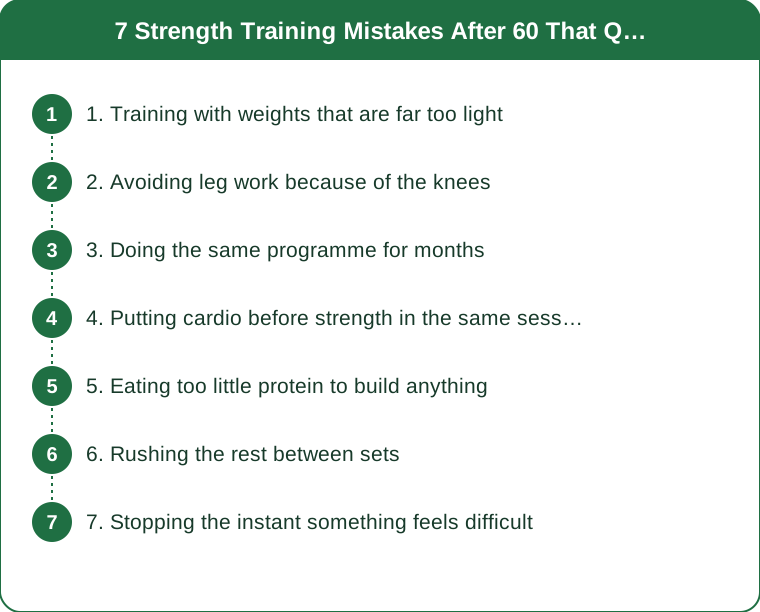
1. Training with weights that are far too light
This is the big one, and it is close to universal.
If you can comfortably do 20 repetitions, the weight is not building strength. It is building endurance, which is worth having and is not what most people over 60 need. The muscle changes that matter for independence, bone density and fall prevention require meaningful load.
The workable target is a weight that gets genuinely hard by rep 8 to 12, where the last two reps are slow and require real effort. That will feel alarming the first time if you have been using 3lb dumbbells.
Progress in small steps rather than jumps. Move up by the smallest increment available — often 2 to 5lb — and hold the new weight for two sessions before judging it. Most people find they were training at roughly half of what they could handle, and the change shows up within six weeks.
2. Avoiding leg work because of the knees
Knees that hurt are a reason to change the exercise, not to skip the muscle group.
Legs are where the functional stakes are highest. Getting out of a chair, climbing stairs and catching yourself after a stumble are all leg strength, and they are the abilities that determine independence more than any other.
If squats hurt, the options are numerous: sit-to-stand from a higher chair, split squats with a hand on the counter, leg press with a reduced range, step-ups onto a low step, or hip thrusts which load the glutes with almost no knee involvement.
The thing to avoid is the substitution most people make, which is seated leg extensions alone. They load the knee joint at its least favourable angle and do little for the movements that matter. If your knees limit you, a physiotherapist can usually find three exercises you can do comfortably in one appointment — considerably better value than years of avoidance.
3. Doing the same programme for months
Progressive overload is not optional, and doing the same thing repeatedly is the definition of not applying it.
The body adapts to a stimulus and then stops responding to it. Something has to increase over time — weight, repetitions, sets, or how close you go to failure. Doing three sets of ten with 8lb every week for a year produces the first month’s result and then nothing.
The simplest system: keep the same exercises, and each week try to add either one repetition per set or the smallest weight increment. When you reach the top of a rep range, add weight and drop back down the range.
Write it down. A programme you cannot remember the numbers from is a programme you cannot progress, and this is the single most common reason people plateau without noticing. A notebook and a pencil beat any app if the app is not actually being opened.

4. Putting cardio before strength in the same session
This is the one that catches experienced trainers.
If you do 30 minutes of cardio and then lift, you lift with pre-fatigued legs and a depleted nervous system. The strength work — which is the part with the highest return after 60 — gets your worst effort.
Reverse the order. Strength first, while you are fresh, then cardio afterwards or on a separate day. The cardio loses very little from being done tired; the strength work loses a great deal.
If you go to a class-based facility and the order is fixed, consider doing your strength work on the days you do not attend. The alternative — accepting a permanent 20 percent reduction in your most valuable training — is a poor trade.
Warming up is a different matter and should stay. Five to ten minutes of easy movement before lifting is preparation, not cardio, and it belongs at the start.
5. Eating too little protein to build anything
You cannot build muscle from a calorie deficit of protein, and older adults need more of it than younger ones, not less.
Anabolic resistance is the well-documented reduction in how efficiently older muscle responds to protein. The practical consequence is that the amount that worked at 40 does not produce the same result at 65.
General guidance for older adults engaged in strength training sits around 1.2 to 1.6g of protein per kg of body weight per day, spread across meals rather than concentrated in one. For a 70kg person that is roughly 85 to 110g daily.
The distribution matters as much as the total. Aim for 25 to 30g at each main meal rather than 10g at breakfast and 60g at dinner. Breakfast is where most people fall short — toast and tea is close to zero, while eggs, Greek yoghurt or a protein shake changes the whole day’s figure.
Speak to your doctor before significantly increasing protein if you have any kidney condition. This is general information, not medical advice.
6. Rushing the rest between sets
Short rests feel productive and quietly cap how much you can lift.
Strength requires 90 seconds to three minutes of rest between working sets. Anything less and the second set is limited by fatigue rather than by strength, which means you train with lighter weight than you are capable of and get the endurance adaptation instead.
Most people rest between 30 and 45 seconds because standing still feels like wasting time. It is not — the rest is part of the prescription, in the same way that the weight is.
Time it rather than estimating. Thirty seconds and ninety seconds feel almost identical when you are slightly out of breath, and almost everyone underestimates. A phone timer removes the guesswork.
A useful side effect: proper rest makes the session feel much more manageable, which improves adherence. A 40-minute session with real rests is more sustainable than a 25-minute one that leaves you flattened.
7. Stopping the instant something feels difficult
There is an important distinction between hard and wrong, and conflating them ends progress.
Hard feels like effort in the muscle, slowing repetitions, and breathing hard. Wrong feels like sharp pain, joint pain, or pain that is worse the next day. The first is the training effect. The second is a signal to stop and change something.
After 60 many people have been advised, often vaguely, to be careful. That advice gets internalised as stopping at the first sensation of effort, which removes the stimulus entirely.
The practical version: leave one or two repetitions in reserve on your working sets. That means stopping when you believe you could do two more, not when it starts to feel like work. That is challenging enough to drive adaptation and conservative enough to be safe.
If you are unsure where the line is, two or three sessions with a qualified trainer who works with older adults will calibrate it faster than a year of guessing. It is the best money in this entire list.
TL;DR:
- Train heavier. If 20 reps is comfortable, you are building endurance rather than strength — aim for genuinely hard by rep 8 to 12.
- Do not skip legs; change the exercise instead. Sit-to-stands, step-ups and hip thrusts work around most knees.
- Progress something every week and write the numbers down.
- Strength before cardio, always, in a combined session.
- 1.2 to 1.6g protein per kg daily, with 25 to 30g at each meal — breakfast is where most people fall short.
- Rest 90 seconds to three minutes between working sets, timed rather than estimated.
- Leave one to two reps in reserve rather than stopping at the first sign of effort.
None of these require a new programme. Six of the seven can be corrected in your next session, and the most common one — the weight on the bar — is the one that changes the most.
Keep Reading
This article is for general informational and styling purposes only. Fit, sizing, and product availability may vary.