7 Signs Your Balance Is Slipping - and the Fix for Each One

Quick Answer: The earliest signs of declining balance are behavioural rather than dramatic - reaching for walls, widening your stance, avoiding uneven ground, needing to stop walking to talk, taking stairs one at a time, struggling to stand on one leg for ten seconds, and feeling briefly unsteady when turning your head. Each has a specific, trainable fix, and catching them early is far easier than recovering later.
Nobody notices balance leaving. What people notice, years later, is that they stopped doing things - and every one of those small avoidances started as a sensible adjustment to something they had just begun to feel.
Signs 1 and 2: What are your hands and feet already doing?
1. You reach for the wall or furniture without deciding to
This is usually the very first sign, and it is almost never conscious.
Watch your hand next time you walk down a hallway, get up from a low chair, or step into the shower. If it drifts to a surface automatically, your nervous system has already decided it wants a second reference point.
Why it happens: balance uses three inputs - vision, the inner ear, and sensation from your feet and joints. When one weakens, the system recruits touch as a substitute. A fingertip on a wall provides remarkably accurate spatial information.
The fix: practise the same movements with your hand hovering close to the surface but not touching. Ten repetitions of standing up from a chair without pushing off, twice a day. Keep the surface within reach - the point is to reduce reliance, not to remove the safety net.
2. Your feet have quietly moved further apart
Stance width is one of the most reliable early indicators, and it changes so gradually that nobody notices.
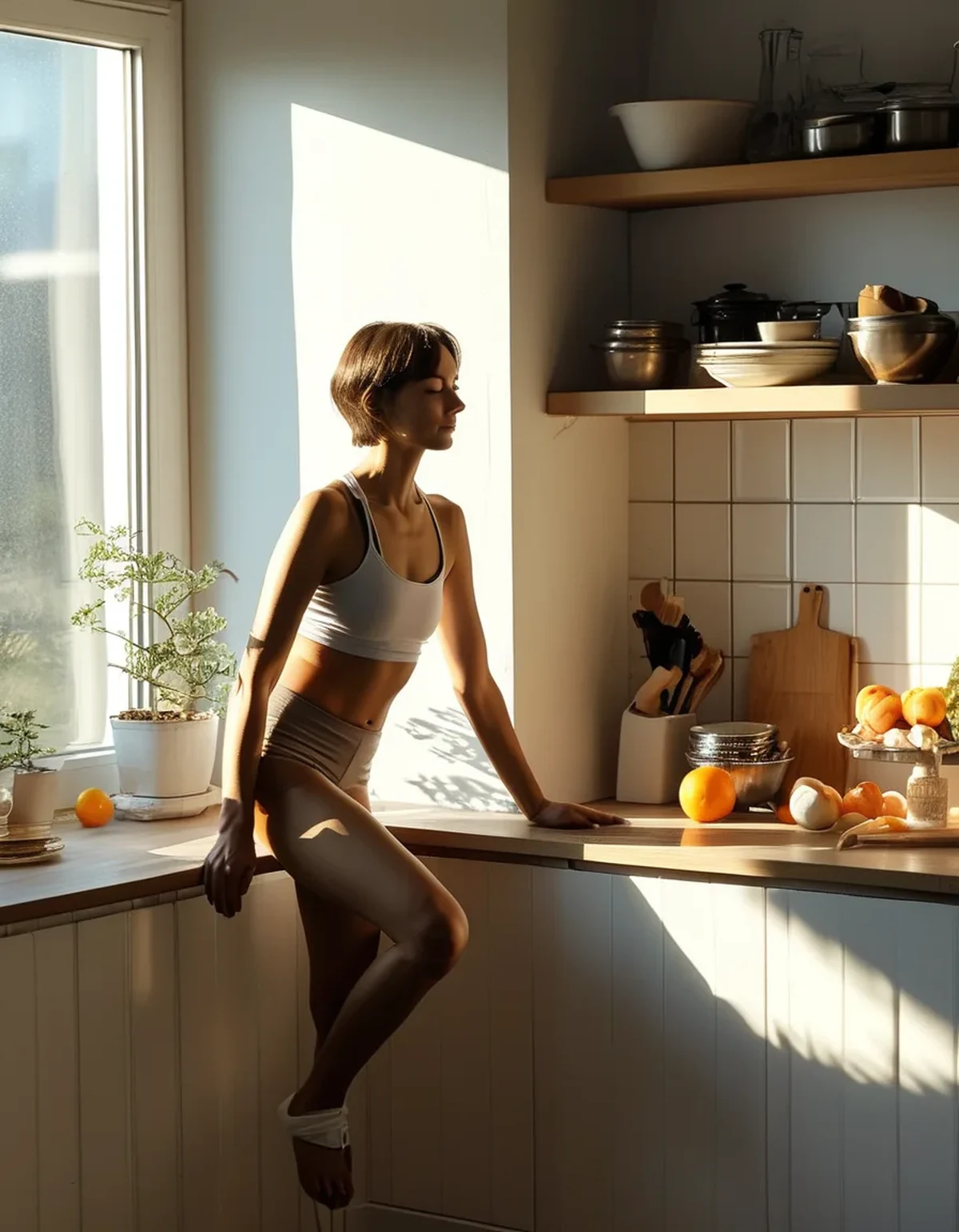
Stand at the kitchen counter as you normally would and look down. If your feet are noticeably wider than hip width, your body has widened your base to buy stability - the same way a stepladder is more stable than a pole.
Why it happens: a wider base compensates for reduced ability to control sway. It works, which is exactly why it goes unquestioned for years.
The fix: narrow-stance holds. Stand with feet hip-width, hands near a counter, and hold 30 seconds. Progress to feet together, then to one foot slightly in front of the other, then to a full heel-to-toe stance. Two minutes a day is enough to hold ground, and the progression is easy to feel.
Signs 3 and 4: What has changed about how you move through the day?
3. You stop walking when someone asks you a question
This one has a name in the research world - people call it stops walking when talking - and it is a meaningful signal.
Walking is not automatic. It requires ongoing attention, and when balance demands more of your attention than it used to, there is less left over for conversation. So you stop, answer, and start again. It feels polite. It is actually informative.
Why it matters: it indicates that walking has moved from a background task to a foreground one, which is a genuine change in how much reserve you have.
The fix: deliberate dual-task practice, always somewhere safe. Walk a hallway while counting backwards from 100 by threes, or while naming animals alphabetically. Two minutes, a few times a week. This trains the specific capacity that has narrowed, and improvement usually comes faster than people expect.
4. You avoid grass, gravel, and uneven pavement
Notice which route you take to the shops now compared with five years ago. If you have started choosing the paved path over the grass, or crossing the road to avoid a broken kerb, your system is telling you something.
Why it happens: uneven ground demands rapid ankle adjustments driven by sensation from the feet. Foot sensitivity commonly declines with age, and footwear with thick, stiff soles reduces it further.
The fix: two things. First, spend a few minutes daily standing and walking barefoot on varied surfaces at home - a folded towel, a cushion, a doormat. Second, do deliberate short walks on grass or a park path, starting with someone alongside you. Avoidance shrinks the skill; graded exposure rebuilds it.
5. Stairs have become one step at a time
Specifically, leading with the same foot every time and bringing the other to meet it, rather than alternating.
This is a strength signal as much as a balance one. Alternating stairs requires you to support your entire body weight briefly on one leg while it lowers or lifts you. If single-leg strength has dropped, the step-to pattern is the sensible adaptation.
Why it matters: stairs are the everyday test of single-leg strength, and single-leg strength is one of the strongest predictors of continued independence.
The fix: step-ups. Use the bottom stair with a firm handrail. Step up with one foot, bring the other up, step down under control. Eight to ten per leg, two or three times a week. Progress to a higher step, then to fewer fingers on the rail. Do not skip the controlled lowering - that is where most of the benefit is.

6. You cannot stand on one leg for ten seconds
This is the most objective item on the list, and it is worth doing properly.
Stand near a counter, hands ready but not touching. Lift one foot a few inches off the floor. Time it. Do both legs.
Rough interpretation: comfortably over 20 seconds per side is a good place to be. Ten to 20 seconds is workable but worth training. Under 10 seconds on either side is the clearest signal on this list that dedicated balance work should start now rather than later. A large difference between sides is also worth noting.
The fix: the training is the test. Practise single-leg holds by the counter, 3 attempts per leg, daily. Once you can hold 30 seconds comfortably, progress by turning your head slowly side to side while holding, then by closing your eyes with a hand near the counter. Daily beats intense - this adapts through frequency.
7. Turning your head makes you feel briefly unsteady
Looking up at a high shelf, checking over your shoulder while reversing the car, or turning quickly toward a voice - and there is a half-second of wobble.
Why it happens: the vestibular system in the inner ear handles head movement, and it needs to coordinate with vision. That coordination can become less efficient with age or after periods of reduced activity, so quick head movements briefly outrun the system.
The fix: gentle gaze stabilisation. Hold a card with a letter on it at arm’s length. Keeping your eyes fixed on the letter, turn your head slowly side to side for 20 seconds. Rest. Repeat two or three times, then do it nodding up and down. Do it seated at first.
Important: if head turns cause genuine spinning, nausea, or a sensation that the room is moving, stop and see a healthcare professional. That pattern is different from mild unsteadiness and often has a specific, very treatable cause.
What Nobody Tells You About Balance Training
It improves faster than strength does. Much of balance is nervous system coordination rather than tissue change, so people commonly notice real improvement within two to four weeks. That is unusually fast feedback for anything fitness-related.
It has to be slightly uncomfortable to work. Balance training done entirely within your comfort zone maintains rather than improves. You need to be at the edge of steady - which is exactly why you do it beside a counter, so the edge is safe.
Medication is a common and overlooked factor. Several classes of common medication affect balance, and interactions matter. A medication review with your pharmacist or doctor is one of the highest-value, lowest-effort things on this entire list.
Vision and footwear are part of the system. An out-of-date glasses prescription, or new varifocals, genuinely change balance. So do worn-out shoes and slippers without backs.
And the item most people underestimate is number three. Needing to stop walking to talk sounds trivial and social. It is one of the more meaningful signals here, and it responds well to a few minutes of dual-task practice.
FAQ: Balance Questions, Answered
How often should I train balance?
Short and daily beats long and occasional. Five to ten minutes most days produces better results than a single long weekly session, because balance is a nervous system skill built through repetition.
Is it too late to start in my seventies or eighties?
No. Balance responds to training at every age studied, and improvements have been demonstrated well into the eighties and nineties. Starting later means starting more carefully, not not starting.
Should I use a walking stick if I feel unsteady?
That is a decision to make with a professional who can assess you. Used appropriately, an aid keeps you active and independent. Used as a substitute for training that would have helped, it can accelerate the decline. It is not an either-or.
Do balance boards and wobble cushions help?
They can, once you have a solid base. Starting with unstable surfaces before you can hold a steady single-leg stance on the floor usually just means holding on tightly, which trains your arms rather than your balance.
When should I see a doctor about this?
Any fall, any near-fall you cannot explain, spinning or room-moving sensations, new numbness in the feet, or a sudden change in balance all warrant a professional opinion. This is general information, not medical advice.
TL;DR:
- Reaching for walls and widening your stance are the earliest, quietest signals
- Stopping walking to talk means balance now demands conscious attention
- Avoiding uneven ground and taking stairs one at a time are adaptations worth reversing
- Under 10 seconds on one leg is the clearest sign to start dedicated work now
- Balance improves in weeks, not months - five to ten minutes daily, beside a counter
- Review medications, glasses, and footwear; they are part of the balance system
Every item on this list is a small, sensible adaptation to something real. The trouble is that each one narrows the range of what you do, and a narrower range weakens the system further. Catch them while they are still small, train the specific thing each one points to, and you keep the range instead of slowly trading it away. This is general information, not medical advice.
Keep Reading
This article is for general informational and styling purposes only. Fit, sizing, and product availability may vary.