7 Signs Your Strength Routine Is Actually Working After 60 (Even If the Scale Hasn't Moved)

Quick Answer: After 60, the clearest signs strength training is working are functional, not visual — easier stairs, steadier balance, better grip, and less next-day soreness are more reliable progress markers than the scale, which often barely moves even with real strength gains.
You’ve been lifting twice a week for two months. The scale says the same number it said in week one, and it’s tempting to read that as no progress. It almost certainly isn’t. Strength adaptations show up in daily function long before — and sometimes instead of — anything a scale can measure.

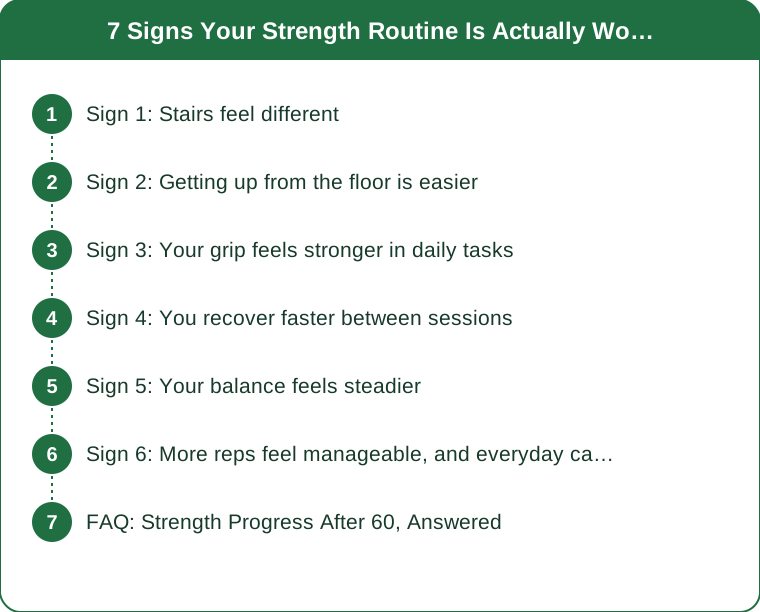
Sign 1: Stairs feel different
Carrying groceries or laundry up a flight used to mean a pause halfway. If that pause has shortened or disappeared, that’s your leg and core strength doing real, measurable work — this is one of the fastest functional improvements people notice, often within 4-6 weeks.
Sign 2: Getting up from the floor is easier
The sit-to-stand-from-floor movement is a well-known marker of overall strength and mobility in older adults. If you’re using fewer hands, or no hands, to get up compared to when you started, your hip and core strength has genuinely improved.
Sign 3: Your grip feels stronger in daily tasks
Opening jars, carrying bags with handles, gripping a railing — these are grip strength in action, and grip strength is one of the most studied markers of overall health in aging research. Noticeable improvement here reflects real neuromuscular adaptation, not imagination.

Sign 4: You recover faster between sessions
Early on, two strength sessions a week might leave you sore for 3-4 days. As your body adapts, that soreness window shortens to a day or less. Faster recovery is a direct sign your muscles and connective tissue are adapting to the training load.
Sign 5: Your balance feels steadier
Strength training, especially single-leg and core work, improves the neuromuscular coordination behind balance, not just muscle size. If you’re wobbling less putting on shoes standing up, or catching yourself less on uneven ground, that’s balance-specific improvement, a major fall-risk factor.
Sign 6: More reps feel manageable, and everyday carrying feels lighter
The clearest strength-specific sign: if the same exercise that felt maximal at 8 reps now feels manageable at 10, or the same weight feels lighter, your nervous system and muscles have adapted, even if nothing about your appearance has changed.
That same adaptation shows up outside the gym too — groceries, a suitcase, a grandchild. The ability to carry real-world loads without strain is one of the most meaningful strength outcomes after 60, because it directly protects independence, which is a bigger goal than the scale ever was.
FAQ: Strength Progress After 60, Answered
How long does it take to notice strength gains after 60?
Many functional improvements, like easier stairs or steadier balance, show up within 4-8 weeks of consistent training, often before any visible physical change.
Should I be worried if the scale hasn’t moved?
Not necessarily. Strength training can increase muscle while body composition shifts in ways the scale doesn’t capture well. Function-based markers are more reliable at this stage of life.
What if I don’t notice any of these signs after 2 months?
Check consistency and intensity first — training needs to be challenging enough to prompt adaptation. If effort and consistency are solid and nothing has shifted, it may be worth discussing with a trainer or physical therapist familiar with older adults.
TL;DR:
- The scale is a weak progress marker after 60 — function is the better measure
- Easier stairs, steadier balance, and stronger grip often show up in 4-8 weeks
- Faster recovery between sessions is itself a sign of real adaptation
- Carrying real-world loads with less strain is the outcome that matters most for independence
Track how your week feels, not just what the scale says — that’s where strength training after 60 actually shows up first.
Keep Reading
This article is for general informational and styling purposes only. Fit, sizing, and product availability may vary.