7 Signs Your Strength Program Is Working After 60 (That Have Nothing to Do With the Mirror)

Quick Answer: After 60, the most meaningful signs of progress are functional: getting out of a chair without hands, carrying groceries in one trip, climbing stairs without the handrail, better balance, easier sleep, faster recovery between sessions, and less joint stiffness in the morning. These change well before body composition does, and they matter more.
If you judge a strength programme after 60 by what the mirror says, you’ll quit before the results that actually change your life arrive. Here are the seven to watch instead.

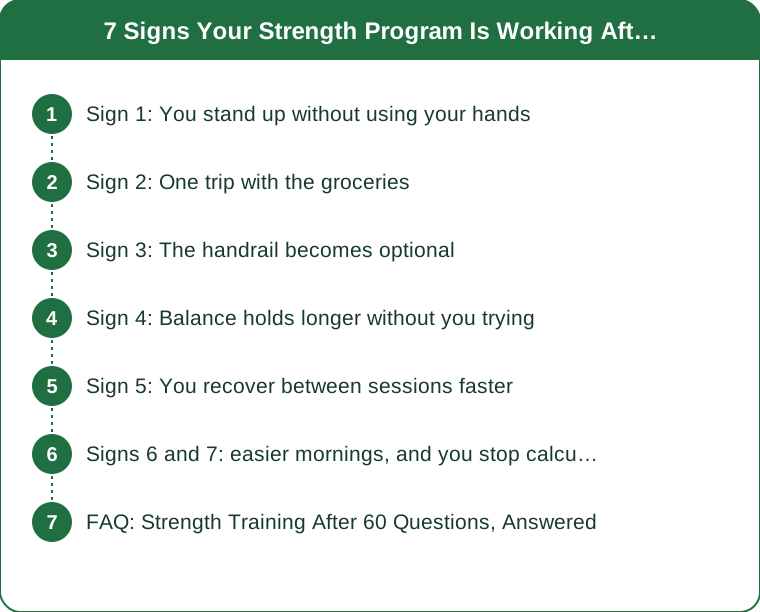
Sign 1: You stand up without using your hands
The sit-to-stand is the single most practical strength marker after 60, and it changes quickly.
Most people start a programme pushing off armrests or knees without noticing they do it. Within six to eight weeks of consistent lower body work, that push disappears.
Test it monthly: sit in a standard dining chair, arms crossed over your chest, and stand up. Then count how many times you can do it in 30 seconds. This is a widely used functional assessment, and improvements of two or three repetitions over a couple of months are common and meaningful.
Why it matters more than a scale number: it’s a direct measure of the leg strength that predicts independence, and it’s the exact capability people lose first.
Sign 2: One trip with the groceries
Carrying capacity is grip strength plus trunk stability plus leg strength working together, and it improves noticeably within a couple of months.
The tell is behavioural rather than measured: you stop planning around how much you can carry. Two bags instead of one. Up the front steps without setting them down. The laundry basket taken up in one go.
Grip strength specifically is worth caring about - it’s one of the more consistently studied markers associated with functional capacity and general health in older adults, and it’s trainable at any age.
If you want a number, note how far you can carry a moderately heavy bag in each hand before you need to set it down, and retest in six weeks.
Sign 3: The handrail becomes optional
Stairs are a single-leg strength task disguised as a daily chore, and they respond well to training.
Watch for two changes: you stop reaching for the handrail automatically, and you stop leading with the same leg every time. Both indicate improved single-leg strength and confidence.
A useful marker: whether you can descend stairs at a normal pace without controlling yourself with your arms. Descending is harder than ascending because it’s an eccentric, controlled-lowering task - which is exactly the quality that fades first and rebuilds well with training.
Use the handrail whenever you want to. The sign of progress is that it’s a choice rather than a requirement.

Sign 4: Balance holds longer without you trying
Balance improvement is one of the least visible and most consequential outcomes of strength work after 60, because it’s the direct route to fall risk.
Test it safely: stand near a counter you can grab, feet together, eyes open, and time it. Then try one foot in front of the other in a straight line. Improvements over eight to twelve weeks are typical when lower body strength and dedicated balance drills are both in the programme.
The real-world version shows up first: turning quickly without a wobble, putting on trousers standing up, reaching up into a cupboard without steadying yourself.
Balance training carries the strongest practical argument of anything on this list, and it takes about five minutes a session.
Sign 5: You recover between sessions faster
Early in a programme, a session leaves you sore for three days. Two months in, the same session leaves you sore for one, or not at all.
This is a genuine adaptation - the repeated bout effect - and it’s one of the earliest reliable signs that training is working even when nothing else has visibly changed.
What it means practically: you can train more often, which accelerates everything else. Many people can move from two sessions a week to three around this point without adding fatigue.
What it doesn’t mean: that soreness was the goal. Progress and soreness aren’t proportional, and a session that leaves you wrecked isn’t better than one that doesn’t.
Signs 6 and 7: easier mornings, and you stop calculating
Sign 6 is that mornings are less stiff. Morning stiffness is one of the most common complaints after 60, and regular resistance training frequently reduces it - which surprises people who assume exercise would make it worse.
The mechanism is partly circulation, partly maintained joint range, and partly muscle supporting joints more effectively. Watch for less time between getting up and moving normally, fewer stiff first steps, and easier first stairs of the day.
This is also the sign most likely to be interrupted by a week off, which makes it a useful early warning that consistency has slipped. If morning stiffness is severe, lasts more than an hour, or comes with swelling, that’s worth raising with a doctor rather than training through. This is general information, not medical advice.
Sign 7 is the one nobody measures and everyone recognises.
Early on, activities come with a calculation: is that too far, too heavy, too many stairs, too long standing. As strength returns, the calculation stops happening. You accept the invitation, take the stairs, carry the thing, and only notice afterwards that you didn’t hesitate.
This confidence effect is well documented in exercise research for older adults and it feeds a loop - more confidence means more activity, more activity means more capability.
It’s also the sign that arrives last, usually somewhere in month three or four, which is precisely why the first six signs matter. They’re the evidence that keeps you training long enough to reach this one.
Track two or three of these, not all seven. Pick the ones that matter most in your week, note them monthly on a calendar, and let the mirror do whatever it wants.
FAQ: Strength Training After 60 Questions, Answered
How long before any of this shows up?
Neural strength gains begin within two to three weeks. The functional signs above generally appear between weeks six and twelve of consistent training.
How many days a week is enough?
Two full-body sessions a week produces meaningful results for most people starting out. Three is better once recovery allows it.
Is it safe to lift heavy after 60?
Progressive resistance training is well supported for older adults, including at meaningful loads, when technique and progression are managed. Start with professional guidance if you’re new to it, and clear any specific medical conditions with your doctor first.
What if I have arthritis?
Strength training is commonly recommended alongside arthritis management rather than avoided, though the specifics depend on which joints and how severe. That’s a conversation with your doctor or a physiotherapist, not an article.
TL;DR:
- Judge progress functionally: sit-to-stand, carrying, stairs, balance, recovery, morning stiffness, confidence
- The 30-second sit-to-stand test is the single best monthly check
- Faster recovery between sessions is the earliest reliable sign training is working
- Balance improvement is the outcome with the biggest real-world consequence
- Pick two or three signs to track; the mirror is the slowest and least useful measure
The programme is working long before it looks like it’s working. These seven tell you so.
Keep Reading
This article is for general informational and styling purposes only. Fit, sizing, and product availability may vary.