7 Reasons Your Warm-Up Needs to Get Longer After 60 - and What to Add

Quick Answer: After 60 a warm-up needs roughly 10 to 12 minutes rather than 5, and the extra time should go into joint-specific movement rather than more cardio. Synovial fluid takes longer to thin and distribute, tendons are stiffer at rest, and blood flow redistributes to working muscle more slowly. The practical version: 3 minutes of easy walking or cycling, 4 minutes of controlled joint circles at the ankles, hips, and shoulders, and 3 to 5 minutes of ramp-up sets at 40 to 60 percent of your working load.
The warm-up you have been doing since your forties has not stopped working because you got worse at exercising. It stopped covering the same ground because several separate things changed at once - and each one has a specific fix.

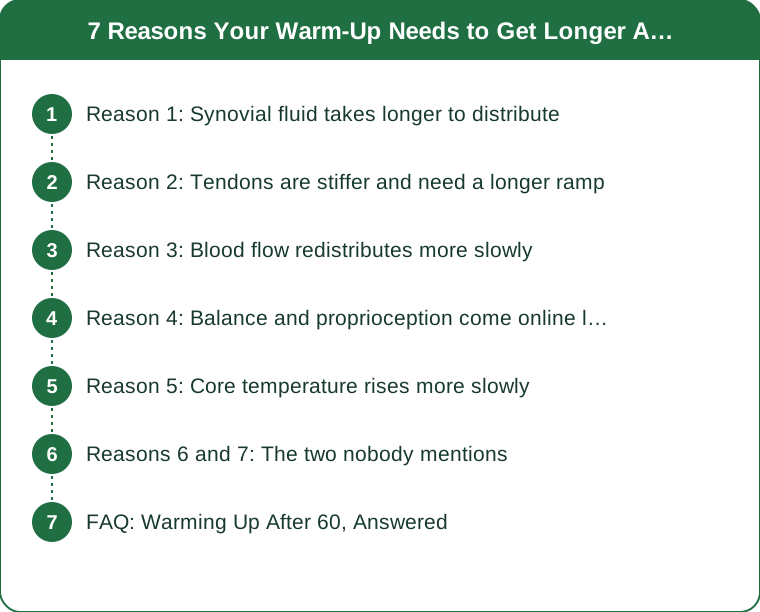
Reason 1: Synovial fluid takes longer to distribute
Joint fluid is thick at rest and thins with movement. That process - technically a drop in viscosity under shear - is what makes the tenth rep of a movement feel smoother than the first. It still happens after 60, but it takes longer, and the starting viscosity is higher.
This is why the first set of anything feels stiff and slightly noisy, and why a knee that clicks at rep two is silent by rep fifteen. It is not damage announcing itself. It is a lubrication system that needs more warning.
What to add: 20 to 30 slow, unloaded reps through the full range of the joints you are about to load. For a squat day that means ankle rocks and bodyweight partial squats. For a press day, shoulder circles and wall slides. Slow and full-range beats fast and short - you are trying to move fluid across the whole joint surface, not raise your heart rate.
Give this 2 to 3 minutes on its own. It is the single highest-return addition on this list, and it is the one most often skipped because it does not feel like exercise.
Reason 2: Tendons are stiffer and need a longer ramp
Tendon stiffness increases with age, and a stiffer tendon transmits force differently in the first few contractions. The tissue is perfectly capable of handling load - it just does not want to go from cold to heavy in one step.
The visible symptom is that your first working set feels disproportionately harder than the second and third, and that the difference is bigger than it used to be. People often read this as a bad day and cut the session short, when it is just an incomplete ramp.
What to add: two ramp sets instead of one. If your working weight is 20kg, do 5 reps at 8kg, then 3 reps at 14kg, then start. That is maybe 90 seconds, and it typically makes the first working set feel like a normal set instead of a warning.
The same logic applies to walking and cardio. Add 3 minutes of genuinely easy pace at the front rather than starting at your usual effort - the first mile of a walk should feel too easy.
Reason 3: Blood flow redistributes more slowly
At the start of exercise, blood is diverted from the gut and skin toward working muscle. That redistribution is driven by vascular responsiveness, which declines gradually with age. The result is a longer lag between starting to move and feeling like you can actually work.
This is the reason that after 60 many people feel genuinely poor for the first 8 minutes of any session and then noticeably better. If your warm-up is 5 minutes, you finish it right at the low point and start your real work in the trough.
What to add: extend the light aerobic portion to 5 minutes minimum, and use something that involves the legs - walking, cycling, marching in place. The legs hold the largest muscle mass and the biggest vascular bed, so they drive the redistribution fastest.
A useful check: you should be warm enough that you would take a layer off before you start your first working set. If you are still cool, the warm-up has not done its job regardless of how many minutes are on the clock.

Reason 4: Balance and proprioception come online later
Position sense - knowing where your limbs are without looking - is slower to sharpen after a period of stillness. Sitting for an hour before training leaves proprioception noticeably duller than it will be ten minutes in.
This matters most for anything with a balance component, which after 60 is most useful training. A single-leg movement attempted cold feels far more precarious than the same movement attempted after some preparation, and that difference is often misread as declining balance.
What to add: 60 to 90 seconds of low-stakes balance work at the end of the warm-up, with a hand near support. Ten slow weight shifts side to side, then five seconds standing on each leg. Do it near a counter or a wall.
This also serves as a daily calibration check. If today’s version feels markedly worse than usual, that is useful information about sleep, hydration, or a medication change - and a reason to keep support closer during the session rather than to skip it.
Reason 5: Core temperature rises more slowly
Muscle contracts and relaxes faster when it is warm, and the temperature rise at the start of exercise is slower after 60 - partly because of lower resting muscle mass and partly because of reduced skin blood flow response.
The practical effect shows up in the first heavy or fast movement. Power output, which relies on rapid contraction, is disproportionately affected by muscle temperature. A cold muscle is not just tighter - it is genuinely slower to produce force.
What to add: if your session includes anything explosive - a fast step-up, a medicine ball throw, a brisk hill - put it after everything else in the warm-up, not at the start. And in a cold room or a cold morning, add 2 to 3 minutes and keep a layer on for the whole warm-up.
This is also the reason autumn and winter mornings warrant a longer preparation than summer ones. It is the same body, in a colder room, starting further from where it needs to be.
Reasons 6 and 7: The two nobody mentions
Reason 6: Medication timing changes how you start
Several common medications after 60 affect exercise onset. Beta blockers blunt the heart rate rise, so the usual internal cue of feeling your heart pick up arrives late or not at all. Diuretics affect fluid balance and can make the first few minutes feel heavier. Statins occasionally produce muscle stiffness that is worse before movement than during it.
What to add: stop using heart rate as your warm-up completion signal if you take anything that blunts it. Use breathing rate and how warm you feel instead. And if you always train at the same point relative to your morning medications, note it - varying that timing is a common hidden cause of days that feel inexplicably bad.
Reason 7: You are probably training after more sitting
Retirement, or a change in work pattern, often means the hour before training is now seated rather than active. In your forties you may have arrived at a session already partly warm from a working day. Now you may arrive from a chair.
What to add: 2 minutes of walking before the warm-up officially starts. Around the house, up and down the stairs once, out to the letterbox and back. It is not part of the program, it is just getting you to the starting line that you used to arrive at automatically.
And if you have joint pain that gets worse rather than better as you warm up, that pattern is worth mentioning to your doctor - it points somewhere different than ordinary stiffness. This is general information, not medical advice.
FAQ: Warming Up After 60, Answered
Does a longer warm-up mean I have to train for longer overall?
No. Take the extra 5 to 7 minutes out of your working sets rather than adding it to the session. Three well-warmed working sets produce more than five poorly-warmed ones, and the total time stays the same.
Should I stretch as part of the warm-up?
Move through range rather than holding stretches. Controlled full-range movement prepares tissue for load; long static holds before lifting do not help and can slightly reduce force output for a short period afterwards. Save the long holds for after the session or a separate time of day.
How do I know my warm-up was long enough?
Three signals: you are warm enough to remove a layer, your first working set feels like a normal set rather than a shock, and a single-leg stand feels steadier than it did when you started. If any of those is missing, add 3 minutes rather than pushing on.
TL;DR:
- Aim for 10 to 12 minutes rather than 5 - the extra time goes into joint movement and ramp sets, not more cardio.
- Slow full-range joint circles distribute synovial fluid, which thins more slowly after 60.
- Use two ramp sets instead of one so stiffer tendons are not asked to go cold to heavy.
- Extend easy aerobic work to 5 minutes and use the legs, because blood redistribution is slower.
- Add 60 to 90 seconds of supported balance work as both preparation and a daily calibration check.
- If you take heart-rate-blunting medication, judge readiness by warmth and breathing instead.
None of this is a sign that training is becoming inappropriate. It is the opposite - a longer runway is what lets you keep loading properly for another twenty years.
Keep Reading
This article is for general informational and styling purposes only. Fit, sizing, and product availability may vary.