7 Reasons Your Grip Feels Weaker in the Morning After 60

Quick Answer: Morning grip weakness after 60 usually comes from overnight fluid settling in the hands, joint stiffness after hours of immobility, and sleeping positions that compress the nerves at the wrist or elbow — not from losing strength overnight. Most people recover full grip within 30 to 60 minutes of moving. Weakness that persists past midday, or that only affects one hand, is a different question and worth getting looked at.
You reach for the kettle and it feels heavier than it did last night. The jar you opened on Sunday defeats you on Monday morning. By ten o’clock you’re fine.
That pattern — weak early, normal later — is telling you something specific. Here are the seven usual reasons, and what actually helps with each.

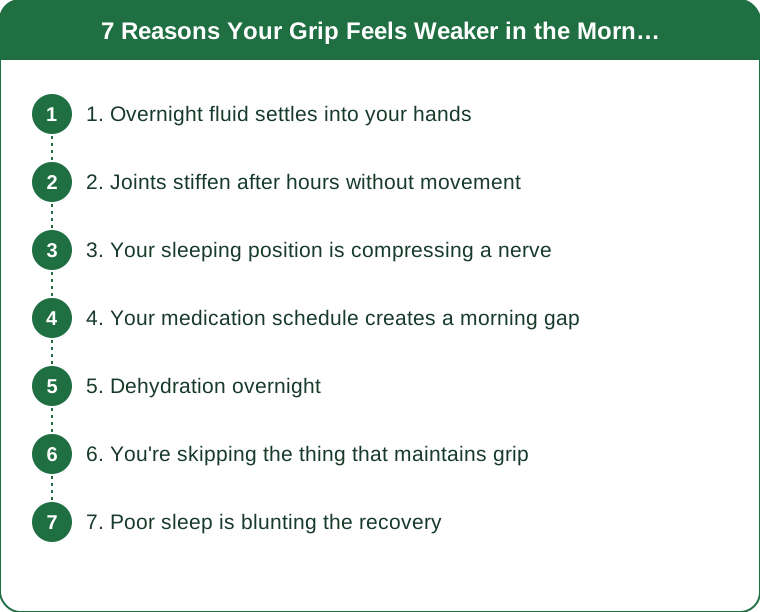
1. Overnight fluid settles into your hands
When you lie flat for seven hours, fluid that gravity normally keeps in your legs redistributes. Some of it ends up in your hands, and the resulting mild swelling reduces how far your fingers can flex before the tissue runs out of room.
You’re not weaker. You have less available range, and the grip feels correspondingly worse. This is why rings feel tight at 6am and loose at 6pm, and it’s the single most common explanation for the pattern.
What helps: thirty seconds of opening and closing your hands before you get out of bed, then holding them above your head for a slow count of twenty. Both move the fluid out mechanically. Most people notice a difference within a minute, which is also a useful diagnostic — if it responds that fast, fluid was the cause.
2. Joints stiffen after hours without movement
Joint cartilage has no blood supply. It’s fed by movement — compression pushes fluid out, release draws it back in, and that cycle is how nutrients get in and waste gets out. Seven hours of stillness means seven hours without that pump running.
The result is the classic morning stiffness that eases as you use the joint. In the hands, where you have well over twenty joints working together, even a small amount of stiffness in each adds up to a noticeably worse grip.
What helps: warmth and motion, in that order. Run your hands under warm water for a minute, then make ten slow full fists and ten full spreads. If the stiffness reliably lasts longer than 30 minutes, that’s worth mentioning to your doctor — prolonged morning stiffness is one of the markers used to distinguish inflammatory arthritis from ordinary wear.
3. Your sleeping position is compressing a nerve
Two positions cause most of this. Sleeping with your wrists curled compresses the median nerve at the carpal tunnel, which produces weakness and often tingling in the thumb, index, and middle fingers. Sleeping with your elbow bent tightly, often with a hand tucked under a pillow, compresses the ulnar nerve, which affects the ring and little fingers and the grip’s pinching strength.
The tell is which fingers are involved and whether tingling comes with it. Pure fluid or stiffness affects the whole hand fairly evenly. Nerve compression picks sides.
What helps: a wrist splint worn at night to hold the wrist straight is genuinely effective for the carpal tunnel version and is available without a prescription. For the elbow version, a loose towel wrapped around the elbow prevents deep bending. If it happens most nights, get it assessed — nerve compression left alone for months can cause lasting weakness.

4. Your medication schedule creates a morning gap
This one gets missed constantly. If you take something for pain or inflammation in the evening, its effect may be fading by 6am — you’re waking up at the low point of the dosing cycle, and morning symptoms are the result.
Diuretics have the opposite pattern and can contribute to overnight fluid redistribution. Some cholesterol medications list muscle aches and weakness as side effects. Statin-related muscle symptoms often show up first as a general sense that things are harder than they should be, rather than as obvious pain.
What helps: don’t change anything on your own, but do bring the timing question to your pharmacist or doctor. A dose moved a few hours can change the morning entirely, and pharmacists are both very good at this and easy to reach. Take a written list of everything you take, including supplements.
5. Dehydration overnight
Most people go eight hours without fluid, and after 60 the thirst signal is genuinely less reliable — you can be measurably dehydrated without feeling thirsty. Muscle contraction depends on fluid and electrolyte balance, and mild dehydration reduces force output before you notice any other symptom.
It compounds if you deliberately stop drinking in the evening to avoid getting up at night, which a lot of people do.
What helps: a full glass of water first thing, before coffee, and check whether the grip improves within the hour. If it does, that’s your answer. The better long-term fix is front-loading fluid earlier in the day — most of your intake before 6pm — rather than restricting it, so you’re not choosing between sleep and hydration.
6. You’re skipping the thing that maintains grip
Grip strength declines with age, but far more slowly in people who regularly load their hands. The decline most people experience is largely a disuse curve, and disuse shows up first as poor performance in the hardest conditions — which, for grip, is first thing in the morning.
In other words, morning weakness can be an early warning that your baseline is drifting down, even if your afternoon grip still feels fine.
What helps: carrying things. Not a gadget — carrying. Two loaded shopping bags, walked for 60 seconds, three times through, twice a week builds grip more effectively than most hand exercisers because it trains the sustained hold your daily life actually asks for. Add a dead hang from a bar if you have one and it’s safe for your shoulders. Grip responds quickly to training at any age, often within four to six weeks.
7. Poor sleep is blunting the recovery
Muscle repair happens largely during deep sleep. Broken or shallow sleep means less of it, and the effect shows up as morning weakness and a general sense that you haven’t reset overnight.
After 60 this is extremely common — deep sleep naturally declines, and the things that fragment it (a warm bedroom, an evening drink, waking to use the bathroom) accumulate.
What helps: the boring, effective ones. A bedroom around 65°F, no alcohol within three hours of bed, and a consistent wake time even on weekends. Alcohol is the most underestimated item here — it gets you to sleep faster and then reliably strips deep sleep from the second half of the night.
If you’re waking more than twice a night regularly, that’s worth raising with a doctor. Sleep apnea is common, underdiagnosed in women, and produces exactly this kind of unrefreshed morning weakness.
TL;DR:
- Morning grip weakness after 60 is usually fluid, stiffness, or nerve compression from sleeping position — not real strength loss.
- Test it: if hand pumps and warm water fix it in under a minute, it was fluid.
- Stiffness lasting over 30 minutes or one-sided weakness with tingling deserves a medical opinion.
- Ask a pharmacist about medication timing — an evening dose fading by dawn explains a lot of morning symptoms.
- Carrying loaded bags twice a week rebuilds grip faster than any gadget, at any age.
- Fix sleep temperature and evening alcohol before assuming the weakness is age.
Grip strength is one of the most trainable things you have, and it responds within weeks. A weak morning is information, not a verdict. This is general information, not medical advice — bring anything persistent or one-sided to a professional.
Keep Reading
This article is for general informational and styling purposes only. Fit, sizing, and product availability may vary.