7 Reasons Going Down Stairs Feels Worse Than Going Up After 60

Quick Answer: Going down stairs loads your quadriceps eccentrically - lengthening under tension - while balancing on one leg with your body weight moving forward and downward. That combination is more demanding than climbing, and eccentric control, single-leg stability, and depth perception all decline earlier than general strength does. The reassuring part is that descent responds quickly to training: eight weeks of step-downs and single-leg work produces clear improvement for most people.
Up is fine. Down is the one where you find yourself reaching for the rail, taking it one step at a time, and wondering when that started.

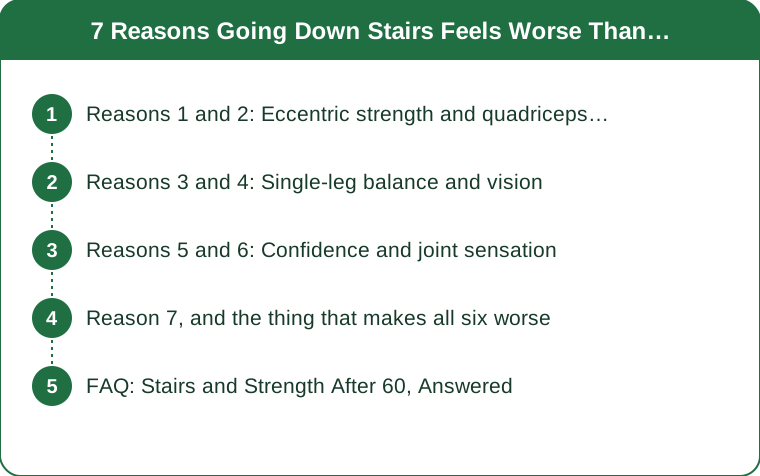
Reasons 1 and 2: Eccentric strength and quadriceps decline
1. Descent is eccentric work, and eccentric control declines faster than strength
Going down means lowering yourself under control. Your front thigh muscle is lengthening while resisting your body weight, which is called eccentric contraction. It is what stops the step becoming a drop, and it is a different capacity from the concentric strength that pushes you up.
Eccentric control involves a large coordination component, not just muscle size, and it tends to be under-trained in ordinary daily life. Walking on the flat, cycling, and swimming barely challenge it. So it quietly declines while everything else feels acceptable, and the first place you notice is a staircase.
The specific sensation is a knee that feels like it might give. That is usually not the joint - it is the muscle unable to control the lowering smoothly, so the last part of the step happens faster than you intended.
2. The quadriceps lose size and power disproportionately
Age-related muscle loss does not fall evenly across the body. The quadriceps and the muscles around the hip are among the earlier and more affected groups, and power - force produced quickly - declines faster than maximum strength does.
Descent needs power, not just strength, because you have to control a moving load in under a second per step. Someone who can still rise from a chair perfectly well may not be able to decelerate their body weight on one leg at speed, and those are genuinely different capacities.
This is why the gym leg press can look fine while stairs do not. A seated machine trains strength in a supported position; stairs demand controlled single-leg lowering with your whole body weight above one knee.
Reasons 3 and 4: Single-leg balance and vision
3. Every stair is a single-leg balance task
There is a moment on every descending step where all your weight is on one leg while the other reaches into space for a surface it cannot see well. Single-leg standing time declines measurably with age, and it is one of the better predictors of fall risk.
Going up has a shorter single-leg phase and a more forgiving one, because your weight is moving toward a step you can see and your foot is placed before it is loaded. Descending reverses that - the foot is loaded almost as it arrives.
If you have noticed you can no longer stand on one leg to put on socks, that is the same capacity that stairs are asking for, and it is trainable.
4. Depth perception and contrast sensitivity change
Judging the edge of a step depends on depth perception and on contrast, and both change with age. Contrast sensitivity - the ability to distinguish an edge from its background - declines notably and is often not picked up in a standard vision test that measures letters on a chart.
Patterned or uniformly coloured stair carpet is genuinely harder to read than stairs with a distinct edge. So is a staircase in dim light, and so is the transition from a bright room to a shaded stairwell where your eyes need time to adapt.
Bifocals and varifocals add a specific problem. Looking down through the reading portion of the lens blurs the stair edge, which is a well-recognised hazard. Many people find single-vision distance glasses for stairs solve a problem they had attributed to their legs.

Reasons 5 and 6: Confidence and joint sensation
5. Fear changes how you move, and the change makes it worse
After one stumble, most people adopt a cautious pattern: stiffer knees, a slower descent, a tight grip on the rail, and eyes fixed down. That pattern feels safer and is mechanically worse - a stiff leg cannot absorb load smoothly, and looking straight down narrows the visual information you use to plan the next step.
Fear of falling independently predicts falls, partly through this mechanism and partly through activity avoidance. Taking stairs less often reduces the exposure that maintains the capacity, and the capacity declines further.
The way out is graded exposure with support, not avoidance - using the rail deliberately while continuing to descend normally, rather than stopping.
6. Knee sensation and arthritis change the feedback
Descent loads the kneecap joint more than climbing does, which is why people with kneecap-related arthritis report stairs down as their worst activity while stairs up feel manageable.
Pain also alters proprioception - the joint’s sense of its own position - which degrades the fine control descent requires. So pain does not only hurt, it makes the movement less accurate.
Strengthening usually helps rather than harms here. Guidelines for knee osteoarthritis consistently recommend exercise as a first-line treatment, and quadriceps strengthening is among the better-supported components. If a joint is painful, an assessment first is sensible - this is general information rather than medical advice.
Reason 7, and the thing that makes all six worse
7. You stopped descending stairs regularly
This is the reason that amplifies every other one. A lift at the shops, a bungalow, a hand rail used two-handed, one flight instead of three - each is reasonable on its own, and together they remove the only regular training stimulus most people ever gave this capacity.
Descent is a use-it-or-lose-it skill more than most. It is specific enough that walking, cycling, and even general strength work do not maintain it. Six months of avoiding stairs produces a noticeable change; two years produces a large one.
And the decline is quiet, because avoidance hides it. You do not experience losing the ability; you experience the stairs being steeper than they used to be, and the two feel identical from the inside.
The reversal is faster than the decline was. Eccentric and balance training produce measurable change in six to eight weeks in older adults, and stair descent specifically improves quickly because it is a trained skill rather than a fixed limitation.
The training that fixes it
Step-downs, which are the single most specific exercise. Stand on the bottom step, hold the rail, and lower one foot slowly toward the floor over three seconds, tapping the heel without transferring weight, then return. Two sets of six each leg, three times a week. Slow is the entire point - speed removes the eccentric demand.
Sit-to-stand, controlled on the way down. Take three seconds to lower into the chair. Two sets of eight. This is eccentric quadriceps work available anywhere, and most people do it far too fast.
Single-leg stands, progressing to eyes closed. Thirty seconds each side at a kitchen counter, hands close but not gripping. Add eyes closed only once open-eyed is comfortable.
Practise the stairs themselves, deliberately. One extra flight a day, descending at a normal pace with a hand near the rail rather than gripping it. Skill-specific practice matters, and stairs are the skill.
And fix the environment while you train. Good lighting at the top and bottom, a contrasting edge on each step, both rails secure, and single-vision distance glasses if you wear varifocals. These are cheap and they remove real risk while the strength work is still catching up.
FAQ: Stairs and Strength After 60, Answered
Why is going down stairs harder than going up?
Descending requires eccentric control - your quadriceps lengthening under load to stop you dropping - on one leg at a time, while judging a step edge you can only partly see. Eccentric control, power, single-leg balance, and contrast sensitivity all decline earlier than general strength, so descent is where the change appears first.
How can I improve going down stairs?
Slow step-downs from the bottom step, three seconds per repetition, two sets of six per leg three times weekly, plus controlled sit-to-stands and single-leg stands. Most people notice a clear difference within six to eight weeks. Keep descending real stairs regularly - the skill is specific and avoiding it accelerates the loss.
Why do my knees hurt going down stairs but not up?
Descent places higher load on the kneecap joint than climbing, so kneecap-related arthritis and related conditions typically present as pain going down while going up stays comfortable. Quadriceps strengthening is well supported for knee osteoarthritis, but get a painful knee assessed before starting a program.
Should I use the handrail going down stairs?
Yes - keep a hand near or on it. Using a rail is sensible risk management, not a sign of decline. What is worth avoiding is gripping with both hands and locking the knees, because a stiff descent is less controlled; keep descending at a normal rhythm with the rail as backup.
TL;DR:
- Descent is eccentric, single-leg, and vision-dependent all at once, which is why it fails before climbing does.
- Quadriceps power and eccentric control decline earlier and faster than general strength - a good leg press does not mean good stairs.
- Single-leg balance time, depth perception, and contrast sensitivity all contribute; varifocals blur the step edge and are worth swapping for distance glasses on stairs.
- Fear produces a stiff, cautious pattern that is mechanically worse, and avoidance removes the only training stimulus most people get.
- Train it: three-second step-downs, slow sit-to-stands, single-leg stands, and one deliberate extra flight a day.
- Improvement typically shows in six to eight weeks; fix lighting, stair-edge contrast, and rails in the meantime.
Stairs going down are not a verdict on your age. They are a specific skill that stopped being practised, and they come back.
Keep Reading
This article is for general informational and styling purposes only. Fit, sizing, and product availability may vary.