7 Reasons Getting Out of a Low Chair Gets Harder Before Anything Else After 60

Quick Answer: Standing up from a low seat is the first everyday task to decline after 60 because it demands deep hip and knee range, fast force production, and forward trunk control all at once — a combination walking never tests. It is also one of the most trainable.
You notice it in a restaurant booth, or a friend’s deep sofa, or the passenger seat of a low car. Not pain. Not weakness exactly. Just a small negotiation that did not used to happen: hands find the armrests, and you rock forward once before you commit.

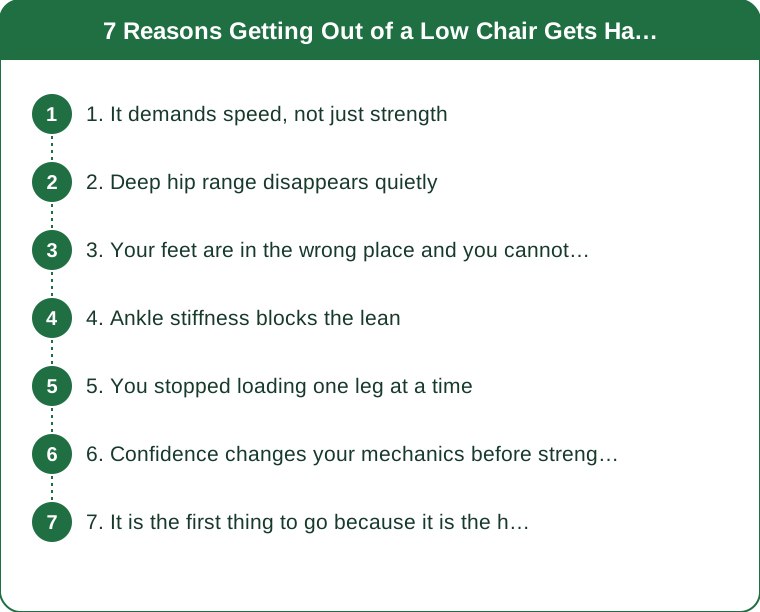
1. It demands speed, not just strength
Rising from a low chair is a power task, not a strength task. Power is force divided by time, and it declines roughly twice as fast as raw strength with age — often 3 to 4% per year after 60 versus 1 to 2% for strength.
Walking never asks for it. Neither does a slow machine leg press. But standing up requires you to generate most of your bodyweight’s worth of force in under a second, from a dead stop, with no momentum to borrow.
The fix is not heavier. It is faster. Take a normal chair, sit, then stand up as fast as you comfortably can and lower slowly over three seconds. 3 sets of 8, 90 seconds rest, twice a week. The lowering builds control; the standing builds the thing that is actually slipping.
2. Deep hip range disappears quietly
A standard dining chair puts your hip at roughly 90 degrees. A sofa or car seat puts it closer to 110 or 120. That extra range is where most people have quietly lost ground, because nothing in a normal week asks for it.
When the range is not available, your body substitutes: you slide forward to the edge, or throw your torso, or use your arms. All three work, and all three let the underlying range keep shrinking.
Test it honestly. Sit fully back in your deepest chair, feet flat, and try to stand without sliding forward first. If you cannot, that is a range problem masquerading as a strength problem — and stretching alone rarely fixes it. You need loaded range: slow sit-downs to progressively lower surfaces, 2 sets of 6, holding the bottom for two seconds.
3. Your feet are in the wrong place and you cannot see it
To stand, your center of mass has to travel over your feet. If your feet are out in front of you — which low seats encourage — you physically cannot get there without a big forward lurch.
Most people fix this unconsciously in a dining chair and completely fail to in a car seat, because the footwell puts their feet forward and there is nowhere to move them.
Drag your heels back until they are under or slightly behind your knees before you try to rise. It is a two-second adjustment and it removes a startling amount of the difficulty. Practise it deliberately in three different chairs this week so it becomes automatic rather than something you have to remember at the moment you need it.

4. Ankle stiffness blocks the lean
Your shin has to travel forward over your foot to get your weight where it needs to be. That is ankle dorsiflexion, and it stiffens with age, with less time barefoot, and with years of shoes that have a raised heel.
Quick test: kneel with one foot flat, and push that knee forward past your toes without lifting the heel. Under about 10 centimetres of forward travel and your ankle is likely part of the problem.
The fix is boring and works: knee-to-wall ankle rocks, 2 sets of 15 per side, daily. Most people gain visible range inside three weeks, and the sofa gets easier before their legs are any stronger.
5. You stopped loading one leg at a time
Standing up from a low seat is close to a single-leg task at the moment of transition, especially when you rise and step in one motion — which is what you actually do in real life.
Most strength routines after 60 are two-legged: leg press, chair squats, walking. All useful. None of them expose the side-to-side gap, and a gap of 15% or more between legs is common and completely invisible until something goes wrong.
Add split squats holding a counter, 2 sets of 6 per side, or simply do a few sit-to-stands leading with one foot slightly forward. The weaker side will announce itself in the first set.
6. Confidence changes your mechanics before strength does
This one gets dismissed and it should not be. Once a low chair has felt awkward two or three times, most people start pre-bracing — hands on the armrests before they need them, weight already shifted, a small hesitation.
That protective pattern is sensible in the moment and expensive over months, because it removes exactly the stimulus that would maintain the ability. The chair gets harder because you have stopped practising it.
The way back is graded, not brave. Start with a chair you are confident in, hands hovering rather than gripping. Then a slightly lower one. Hovering hands are the whole trick — the safety is still there, the muscles still do the work.
7. It is the first thing to go because it is the hardest thing you do
Here is the reframe that changes how people train it. Rising from a low seat is not an early warning of decline in general. It is simply the most demanding thing most people over 60 do in a normal day — more demanding than stairs, walking, or carrying groceries.
Systems fail at their hardest task first. That is not ominous; it is arithmetic. And it means the chair is a genuinely good early sensor, worth checking every couple of months rather than worrying about once a year.
A reasonable benchmark: the 30-second sit-to-stand test. Arms crossed on chest, standard chair, count full stands in 30 seconds. Below 12 for women aged 60 to 64, or below 10 for 70 to 74, is worth acting on. Above those numbers, keep doing what you are doing. This is general information, not medical advice — if standing up brings pain rather than effort, get it looked at before you train through it.
Does using my arms mean I am doing it wrong?
No, it means you are being practical. But test yourself hands-free monthly so you know whether the arms are a preference or a requirement.
How quickly can this improve?
Most people see a meaningful change in the 30-second test within 6 to 8 weeks of twice-weekly work. Ankle range often improves first, sometimes within three weeks.
TL;DR:
- Low chairs get hard first because they demand power, deep hip range, and forward trunk control at once — the hardest combination in a normal day.
- Power declines about twice as fast as strength after 60, so train fast stands and slow lowers, not just heavier legs.
- Two free fixes with immediate payoff: pull your heels back under your knees, and work on ankle dorsiflexion daily.
- Test with the 30-second sit-to-stand every couple of months; it is a better early sensor than anything else you can do at home.
The reason this task matters is not that it predicts something grim. It matters because it is the one thing you do every day that sits right at the edge of your capacity, which makes it both the first to slip and the fastest to respond. Pick one chair in your house, test yourself hands-free this week, and write the number down. Six weeks of twice-weekly work usually moves it more than people expect.
Keep Reading
This article is for general informational and styling purposes only. Fit, sizing, and product availability may vary.