7 Reasons Climbing Stairs Gets Harder After 60 and How to Fix Each One

Quick Answer: Climbing stairs gets harder after 60 mainly because muscular power — force produced quickly — declines faster than raw strength, and a stair is a power task. The other six contributors are reduced single-leg stability, ankle stiffness, a shift in breathing efficiency, hip extensor weakness from too much sitting, footwear, and avoidance itself. Each has a specific fix, and the power one responds the fastest.
A flight of stairs is a brutally honest test. It takes about twenty seconds, it cannot be paced, and it tells you more about lower body function than almost anything else you do in a day.
If it has got harder, that is information rather than a verdict — and the seven reasons below are in order of how much each one is usually costing.
This is general information, not medical advice.
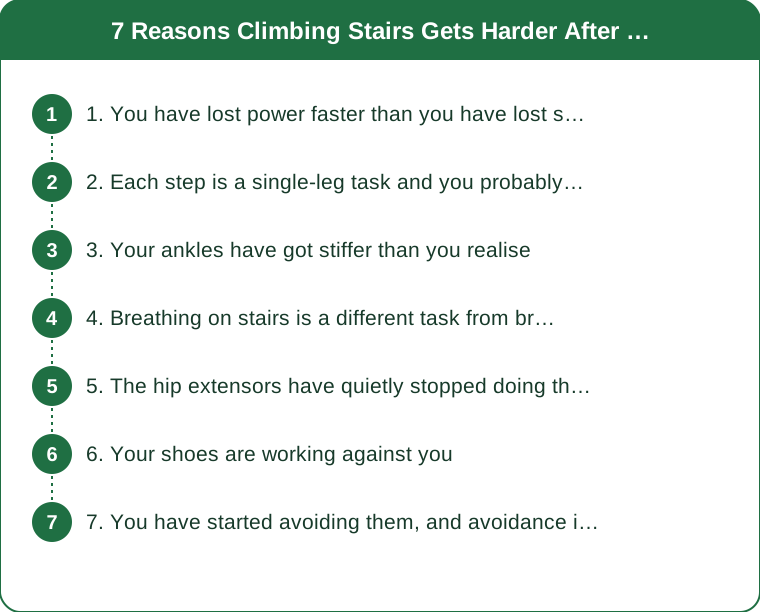
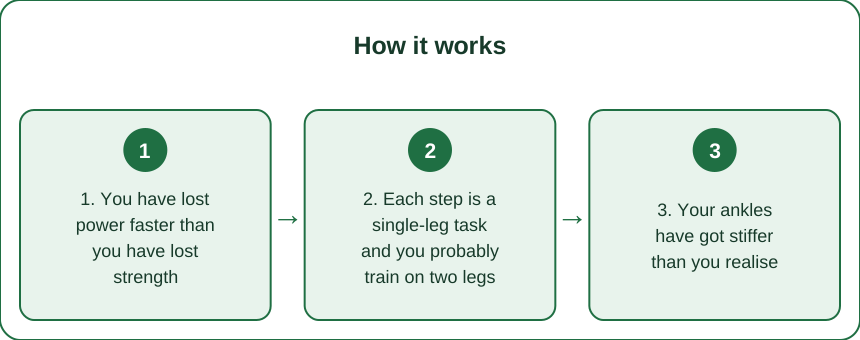
1. You have lost power faster than you have lost strength
This is the big one, and it is the one almost nobody trains for.
Strength is how much force you can produce. Power is how much force you can produce quickly. They are different qualities with different underlying machinery, and they decline at different rates. Power falls off considerably faster with age than maximum strength does, largely because the fast-twitch fibres and the speed of nerve signalling to them are hit hardest.
A stair is a power task. You have a fraction of a second to push your whole body weight up a step, and then the next step arrives. There is no slow grind available. So someone who can still do a respectable leg press — a strength test — can be badly out of breath at the top of one flight, and the two facts are entirely compatible.
Fix: add speed to something you already do. The simplest version is sit-to-stand from a chair performed fast on the way up and slow on the way down: five reps, three sets, twice a week, with the intent of standing up quickly rather than heaving. The intent is the active ingredient — you do not need to move fast so much as try to. Step-ups onto a low step with a deliberately brisk push are the next progression. Two or three weeks of this changes the stairs noticeably, which makes it the highest-return item on the list.
2. Each step is a single-leg task and you probably train on two legs
Look at what a stair actually demands. For a moment, all of your weight is on one leg, bent, with the other leg swinging through. There is no two-legged phase at all.
Almost all common lower-body exercise — walking aside — is double-legged. Sit-to-stands, leg press, the squat at a class. All useful, none of them rehearsing the thing a stair requires, which is stabilising a single hip while pushing.
The specific weakness is usually the gluteus medius, the muscle on the side of the hip that stops the pelvis dropping on the unsupported side. When it is weak, the pelvis dips with each step, the knee drifts inwards, and both the effort and the joint stress go up.
Fix: step-ups onto a step at stair height, holding a rail lightly, eight a side, twice a week. Then split squats with the back foot on a low surface. And a simple diagnostic you can do at home: stand on one leg in front of a mirror and watch the opposite hip. If it drops, that is your answer, and side-lying leg raises or standing band walks are worth adding for a month.
3. Your ankles have got stiffer than you realise
To climb a stair efficiently you need the shin to travel forward over the foot — ankle dorsiflexion. Around ten degrees of it, minimum, and more for a steep flight.
Ankle range reliably decreases with age, accelerated by years of shoes with a raised heel, by any period of reduced walking, and by simple disuse. When it is not there, the body finds a workaround: leaning the trunk further forward, turning the foot out, or pushing through the toes. All three make the climb harder and less stable.
Fix: the knee-to-wall drill. Stand facing a wall, foot a hand’s width back, and drive the knee forward to touch the wall keeping the heel down. If you cannot, move closer until you can, then work back. Ten slow reps a side, daily, takes ninety seconds. Range usually improves within a fortnight, and it improves the stairs specifically because stairs are one of the few daily tasks that demand the end of the range.
4. Breathing on stairs is a different task from breathing on the flat
Stairs elevate heart rate faster than any other everyday activity, and the demand arrives all at once rather than building.
Two age-related changes stack here. Maximum heart rate declines, which narrows the ceiling available for a sudden effort. And chest wall stiffness increases while respiratory muscle strength decreases, so the breathing response to a sudden demand is slower to arrive.
The practical result is that you reach the top before your breathing has caught up, and then spend thirty seconds recovering. That is a normal physiological picture, not necessarily a fitness failure.
Fix: pace deliberately for the first three or four steps rather than attacking the flight, and breathe out on the push rather than holding your breath — breath holding on stairs is extremely common and it spikes blood pressure. If you climb stairs regularly, using them as interval training works well: one flight, recover fully, repeat three times.
And the caveat that matters. Breathlessness that is new, that is out of proportion to the effort, or that comes with chest tightness, dizziness or unusual fatigue should be checked by a doctor rather than trained around. Stairs are often where a cardiac or respiratory issue first announces itself, precisely because they are the hardest thing most people do in a day.
5. The hip extensors have quietly stopped doing their share
The push up a step should come primarily from the glutes, with the quadriceps assisting. In a lot of people over 60 that ratio has inverted, and the quadriceps are doing nearly all of it.
The cause is usually accumulated sitting rather than age itself. Long periods in a chair keep the hip flexors short and the glutes lengthened and under-stimulated, and the pattern persists into standing tasks. The stairs then feel like a thigh-burning exercise, which is the giveaway — if you feel a stair climb entirely in the front of the thighs, the hips are not contributing.
Fix: two things. Glute bridges to restore the contraction — twelve reps, two sets, squeezing at the top for a second. And a cue on the stairs themselves: push the whole foot down into the step rather than pushing up with the toes, and think about driving the hip forward. It sounds like a small distinction and it changes which muscles fire.
A short standing hip flexor stretch after long sitting helps, but the strengthening is what changes the stairs.
6. Your shoes are working against you
Two common problems, opposite in nature.
Too much heel. Any shoe with a meaningful heel-to-toe drop — including a lot of cushioned trainers, not just dress shoes — eats into the ankle range you need for the climb and shifts you onto the forefoot. The stairs feel steeper than they are.
Too little grip or too much sole. Smooth soles on a carpeted stair edge, or a very thick soft sole that muffles the feedback from the step, both reduce the information your feet are giving your balance system. After 60 that sensory feedback matters more than it used to, because the other balance inputs are less reliable.
Fix: for stairs specifically, flatter and firmer with a defined grip pattern is better. And the small thing that matters more than the shoe: whatever you wear, look at the step, not at your feet and not at your phone. Vision does a large share of the stair-climbing work, and the most common stair fall is the last step of a flight when attention has already moved on.
7. You have started avoiding them, and avoidance is the fastest decline of all
This is the one that turns a manageable problem into a permanent one.
Stairs get harder, so the lift gets used. The lift gets used, so the only regular power stimulus in the week disappears. Power declines further, the stairs get harder still, and the loop closes. It can run in under a year, and it is entirely reversible at almost any point.
The same loop runs with every task that becomes slightly effortful — getting up from a low chair, carrying shopping in one trip, walking on a slope. Each avoidance removes the only training stimulus for the thing being avoided.
Fix: keep one flight a day, deliberately, even if you take the lift for the rest. One flight, unhurried, with the rail there if you want it. That is enough to maintain the capacity, and it is small enough to survive a bad week.
And know where the line is. Preserving capacity is the goal; doing it unsafely is not. If you have had a fall, if you feel unsteady on the way down, or if you get dizzy on exertion, get an assessment first. A physiotherapist can usually sort the balance component in a handful of sessions, and doing that before pushing the stairs is the right order.
TL;DR:
- Stairs are a power task, and power declines faster than strength after 60 — fast sit-to-stands and brisk step-ups fix more than anything else on this list, usually within three weeks.
- Every step is single-legged. Train step-ups and split squats, and check whether your hip drops when you stand on one leg.
- Ankle stiffness, breath holding, sleeping glutes and heeled shoes each take a slice, and each has a ninety-second fix.
- Avoidance is the real risk. Keep one flight a day and the capacity stays.
A staircase is one of the few honest tests left in an ordinary day, and the good news buried in all seven of these is that it is a trainable one. New or disproportionate breathlessness, dizziness or chest symptoms are a doctor’s job first. Everything else on this list responds to about ten minutes a week.
Keep Reading
This article is for general informational and styling purposes only. Fit, sizing, and product availability may vary.