7 Reasons Balance Training Gets Skipped After 60 — and Why Each One Is Fixable

Quick Answer: Balance training gets skipped after 60 mostly for 7 fixable reasons — it doesn’t feel like ‘real’ exercise, results are invisible, it’s not scheduled like strength or cardio, fear of falling during practice, boredom, lack of a simple starting point, and no one specifically prescribing it. Naming the reason makes it easier to fix.
Most people over 60 know balance matters. Almost as many skip it anyway — not from lack of caring, but because it quietly falls through 7 very specific, very ordinary cracks that strength and cardio routines don’t have.

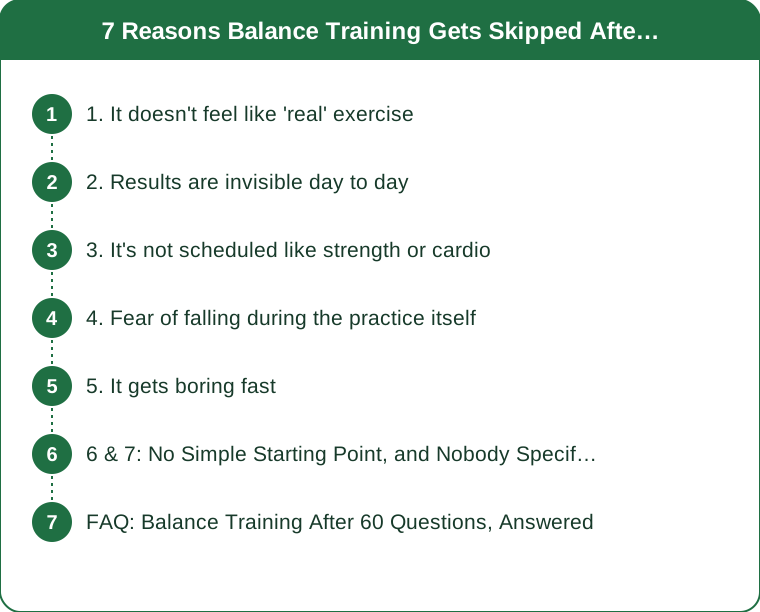
1. It doesn’t feel like ‘real’ exercise
Standing on one foot for 20 seconds doesn’t produce sweat or soreness, so it’s easy to mentally file it as optional compared to a ‘real’ workout.
Fix: Reframe it as fall-prevention training, not fitness — the payoff (staying independent, avoiding a hip fracture) is arguably higher-stakes than a cardio session, even though it feels smaller.
2. Results are invisible day to day
Strength gains show up on a scale or in a heavier weight; balance improvement mostly shows up as absence — the stumble that didn’t happen.
Fix: Track a concrete number, like seconds held in a single-leg stance, weekly. Invisible progress becomes visible progress once you’re measuring it.
3. It’s not scheduled like strength or cardio
Most fitness plans block time for strength days and cardio days, with balance mentioned as an afterthought or ‘if there’s time’ add-on.
Fix: Attach it to something already scheduled — brushing teeth, waiting for coffee to brew — so it doesn’t need its own calendar slot.

4. Fear of falling during the practice itself
This is the ironic one: fear of falling while training balance keeps people from doing the exact exercise that reduces fall risk.
Fix: Practice next to a stable counter or wall for the first several weeks — safety during practice isn’t cheating, it’s how you build confidence to eventually practice without support.
5. It gets boring fast
Standing still isn’t inherently engaging, and boredom kills consistency faster than difficulty does for most exercise habits.
Fix: Add a task — reading labels while balancing, or turning the head side to side — which also happens to make the exercise more functional, not just less boring.
6 & 7: No Simple Starting Point, and Nobody Specifically Prescribes It
6. No simple starting point
Some balance advice jumps straight to advanced single-leg work that feels unsafe or unrealistic for a true beginner, which discourages starting at all.
Fix: Start with feet staggered (one slightly in front of the other) near support before progressing to single-leg — a true beginner starting point most guides skip.
7. Nobody specifically prescribes it
Doctors and trainers often mention balance in passing while spending most of the actual session time on strength or cardio, so it never gets the structured attention those get.
Fix: Treat this article as the prescription — 2 minutes daily, tracked, is enough to start seeing real change within several weeks.
FAQ: Balance Training After 60 Questions, Answered
How much balance training is actually enough?
As little as 2-3 minutes daily, done consistently, is associated with meaningful improvement over several weeks — consistency matters more than duration here.
Is it normal to feel wobbly when starting balance exercises?
Yes, especially in the first 1-2 weeks; that wobble is exactly the stimulus the exercise is meant to provide, as long as it’s practiced safely near support.
Should balance training happen before or after strength training?
Either works, but some people find balance work when muscles are fresh (before strength) gives steadier results than doing it fatigued at the end of a session.
TL;DR:
- Balance training gets skipped for 7 specific, fixable reasons — not lack of caring
- Track a number (seconds held) to make invisible progress visible
- Practice near support to manage the fear-of-falling irony
- 2-3 minutes daily, attached to an existing habit, is enough to start
None of the 7 reasons are really about motivation — they’re about missing structure, and structure is easy to add once you see the actual gap.
Keep Reading
This article is for general informational and styling purposes only. Fit, sizing, and product availability may vary.