7 Protein Mistakes That Blunt Strength Gains After 60

Quick Answer: After 60 your muscles respond less strongly to the same amount of protein, a change usually called anabolic resistance. That means the total matters more, and so does how you spread it. Most people over 60 need roughly 1.2 to 1.6 grams per kilogram of body weight daily, with about 25 to 40 grams per meal, and the meal most often short is breakfast.
You are showing up. Two or three sessions a week, progressive, consistent for months. The strength is creeping rather than climbing, and the usual advice is to train harder - when the actual gap is often on the plate.

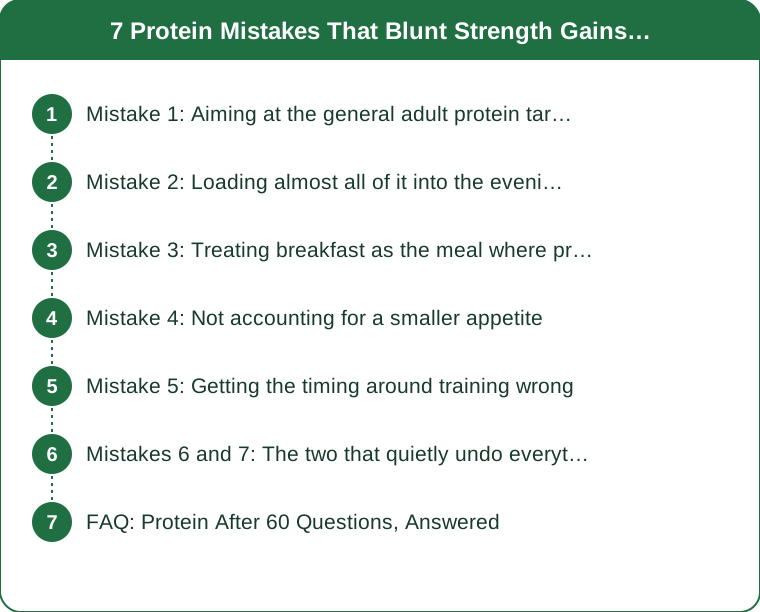
Mistake 1: Aiming at the general adult protein target
The commonly cited figure of 0.8 grams per kilogram of body weight is a minimum to prevent deficiency in the general adult population. It was never a target for building muscle, and it is particularly inadequate after 60.
Older muscle shows anabolic resistance - the same protein dose triggers less muscle protein synthesis than it would have at 30. To get the same signal, you need more.
Expert groups working on ageing and nutrition have converged on 1.0 to 1.2 g/kg as a floor for older adults, and 1.2 to 1.6 g/kg for those who are active or resistance training.
What that looks like in practice, for a 70kg woman:
- Old target at 0.8 g/kg: 56g a day
- Active older adult target at 1.4 g/kg: 98g a day
That is a difference of over 40 grams - roughly a large chicken breast, or two tubs of Greek yoghurt. Training hard on the lower figure and wondering why the strength stalls is an extremely common pattern.
The fix: work out your own number once. Body weight in kilograms multiplied by 1.4. Write it down. Everything else in this list is about hitting it.
Mistake 2: Loading almost all of it into the evening meal
A typical Western day looks like 10 grams at breakfast, 20 at lunch, 50 at dinner. The total might be adequate. The distribution wastes a large part of it.
Muscle protein synthesis works in response to a meal-sized dose and then returns to baseline. It does not bank the surplus for later. So a single 50-gram serving does not produce meaningfully more building than a 35-gram serving does, while the 10-gram breakfast is likely below the threshold to trigger a response at all.
That means one or two of your three daily opportunities are being spent without result.
The target is roughly 25 to 40 grams per meal, three times a day. For older adults the higher end of that range is generally more effective, because the threshold to trigger a response rises with age - the leucine trigger point is simply higher than it used to be.
The fix, for a 70kg woman aiming at around 98g:
- Breakfast: 30g
- Lunch: 30g
- Dinner: 35g
- Optional snack: 10 to 15g
Evenly spread beats back-loaded, even at an identical total. This one change alone often shifts results without any increase in food.
Mistake 3: Treating breakfast as the meal where protein does not apply
Breakfast is where the distribution problem lives. Toast, cereal, fruit, and tea land somewhere between 5 and 12 grams - well under the threshold.
This matters more after 60 for a second reason: overnight your body has been in a net breakdown state for eight or more hours. The first meal is a genuine opportunity, and skipping the protein in it means the first real signal of the day arrives at lunchtime.
What 30 grams at breakfast actually looks like:
- 170g Greek yoghurt (about 17g) + 30g mixed nuts and seeds (about 6g) + a scoop of milk powder or a small protein addition to close the gap
- Three eggs (about 18g) + a slice of wholegrain toast (4g) + 100g cottage cheese (11g)
- Porridge made with milk instead of water (about 12g) + 150g Greek yoghurt stirred in (15g)
- A protein shake with milk (25 to 30g) if appetite is low in the morning, which is very common
The fix: change one breakfast component permanently rather than redesigning the meal. Milk instead of water in porridge, yoghurt added to fruit, or eggs alongside the toast. A single swap repeated daily beats an ambitious plan that lasts a fortnight.

Mistake 4: Not accounting for a smaller appetite
Appetite tends to decline with age - a well-documented pattern sometimes called the anorexia of ageing - driven by changes in gut hormones, slower stomach emptying, medication effects, and reduced taste and smell.
The practical consequence: a target that is easy to hit at 40 can be genuinely hard at 70, on the same three meals. Being told to just eat more protein is not useful advice when you are already full.
What works when volume is the constraint:
- Choose denser sources. 100g of chicken breast gives about 31g of protein; 100g of Greek yoghurt gives about 10g. Same weight in the stomach, three times the protein.
- Drink some of it. Liquids are easier when appetite is low. Milk, a shake, or a fortified soup adds protein without much fullness.
- Fortify what you already eat. Skimmed milk powder into porridge, soups, and mashed potato adds 8 to 10 grams per generous tablespoon and is nearly undetectable.
- Front-load the day. Appetite is usually best in the morning and worst in the evening. If dinner is your smallest meal, put the biggest protein serving at breakfast instead.
The fix: pick the two densest changes rather than trying to eat larger meals. Volume is the constraint, so work around it rather than against it.
Mistake 5: Getting the timing around training wrong
Two separate errors show up here, and they pull in opposite directions.
Error one: training fasted and not eating after. A morning session followed by coffee and a delayed breakfast means the training stimulus arrives with nothing to build from. The muscle-building window is far wider than the old 30-minute rule suggested - several hours either side - but it is not infinite, and a session followed by four hours of nothing is a missed opportunity.
Error two: obsessing about the window while missing the daily total. Total daily protein matters more than precise timing. Perfect post-workout timing on a 60-gram day will lose to relaxed timing on a 100-gram day, every time.
The practical version:
- Get a 25 to 40 gram serving within a couple of hours after training. Not urgent to the minute.
- If you train early and fasted, make breakfast the post-workout meal and make sure it hits 30 grams.
- Spread the rest normally. No need for extra doses on training days beyond your usual distribution.
- A pre-bed serving of around 30 to 40 grams of a slower protein such as dairy is supported by reasonable evidence for older adults, particularly on training days.
The fix: anchor a proper protein serving to the meal that follows your session, and then stop thinking about timing.
Mistakes 6 and 7: The two that quietly undo everything else
Mistake 6: Assuming plant sources are interchangeable gram for gram
They are not, for two specific reasons - and this matters if you are eating less meat, which many people do after 60.
Lower leucine content. Leucine is the amino acid that most strongly triggers muscle protein synthesis, and the trigger threshold rises with age. Most plant proteins contain less leucine per gram than dairy, eggs, fish, or meat, so a 25-gram plant serving may not reach the threshold that a 25-gram dairy serving clears.
Lower digestibility. Plant proteins are generally less completely absorbed, partly due to fibre and antinutrients. The number on the label overstates what reaches your muscles.
This is not an argument against plant-based eating, which has real benefits. It is an argument for adjusting the target upwards if that is how you eat.
What to do:
- Aim for the higher end of the range - closer to 1.6 g/kg on a mostly plant-based diet
- Aim for 30 to 40 grams per meal rather than 25 to 30
- Combine sources in the same meal - legumes with grains, or soy with seeds - to improve the amino acid profile
- Favour the denser plant options: soy, tofu, tempeh, seitan, and lentils all carry more usable protein than most alternatives
- Consider fortifying with a soy or pea protein powder, which are among the better plant options for leucine
The fix: if you eat mostly plants, add roughly 20 percent to your target and lean on soy and legumes rather than nuts and grains for the bulk of it.
Mistake 7: Not eating enough total food to use the protein
This is the one nobody expects, and it undoes everything else.
If you are in a meaningful calorie deficit, a substantial share of the protein you eat is used for energy rather than for building muscle. Combine an aggressive deficit with resistance training after 60 and the common outcome is maintaining rather than gaining, no matter how well the protein is distributed.
There is a second version of the same problem: very low carbohydrate intake alongside heavy training, which similarly diverts protein towards energy and tends to leave sessions feeling flat.
What to do:
- If the goal is building strength and muscle, eat at roughly maintenance calories or slightly above. Gaining muscle in a deficit is possible for beginners but slow.
- If losing fat matters too, keep the deficit modest - around 300 to 500 calories - and keep protein at the top of the range, closer to 1.6 g/kg, to protect muscle.
- Do not do both aggressively at once. Alternate: a few months focused on building, then a period of gentle fat loss while maintaining strength work.
- Watch the scale and your lifts together. Weight stable and lifts climbing is a good outcome. Weight falling and lifts stalling means the deficit is too large.
The fix: decide which goal is primary this quarter. Trying to lose weight and build muscle simultaneously after 60 is the most common reason a well-designed programme produces nothing.
One general note: if you have kidney disease, are on a protein-restricted diet, or take medication affected by diet, discuss protein targets with your doctor or a dietitian before changing them. This is general information, not medical advice.
FAQ: Protein After 60 Questions, Answered
Is high protein bad for the kidneys after 60?
In people with healthy kidneys, intakes in the 1.2 to 1.6 g/kg range are generally considered safe and are what most expert groups on ageing recommend. If you have existing kidney disease, the picture is different and targets should be set with your doctor.
Do I need a protein powder?
No, but it is a practical tool when appetite is low or breakfast is hard. Whey and casein are effective and well tolerated by most people; soy is the strongest common plant option. Food first, powder to close the gap.
How long before I notice a difference?
If protein was the limiting factor, most people notice better session quality within two to three weeks and measurable strength change over eight to twelve. Muscle gain after 60 is real but slower than at 30 - patience is part of the method.
Does it matter if I eat protein without training?
Protein alone slows muscle loss but builds little. The resistance training is what creates the demand; the protein supplies the material. Both together is what changes strength, and neither substitutes for the other.
TL;DR:
- Aim for 1.2 to 1.6 g/kg daily after 60, not the general 0.8 g/kg minimum
- Spread it as 25 to 40g per meal - the same total, distributed evenly, works better
- Breakfast is the meal most often short; change one component permanently
- Work around a smaller appetite with denser sources, liquids, and fortification rather than bigger meals
- Add about 20 percent to the target on a mostly plant-based diet and lean on soy and legumes
- Do not chase fat loss and muscle gain aggressively at the same time - pick one per quarter
After 60 the training is usually not the weak link. Anabolic resistance means the same session needs more protein behind it than it did twenty years ago, and the most common gap is a 10-gram breakfast repeated 365 times a year. Fix the distribution first, then the total, and the sessions you are already doing start producing what they should.
Keep Reading
This article is for general informational and styling purposes only. Fit, sizing, and product availability may vary.