7 Footwear Habits Quietly Undermining Your Balance After 60

Quick Answer: The most common footwear mistakes after 60 are thick cushioned soles that dull ground feedback, backless slippers worn all day at home, and shoes worn long past the point their support collapsed. Firmer, thinner, well-fastened shoes usually improve balance within a couple of weeks.
You have done the balance drills. You stand on one leg at the sink. And you still feel less sure on your feet than you did five years ago.
Look down. Most falls happen at home, in ordinary footwear, on a floor you have crossed ten thousand times. The third habit on this list is the one that catches almost everybody.

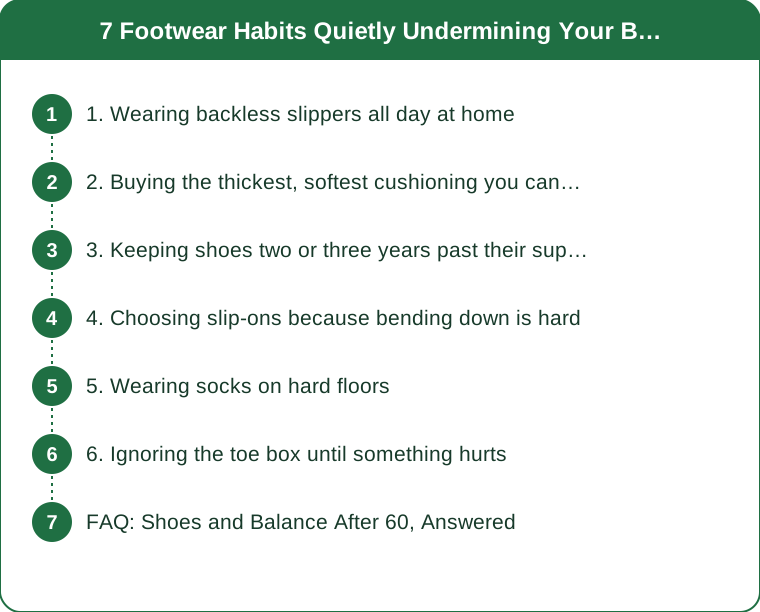
1. Wearing backless slippers all day at home
More than half of falls happen at home, and a striking share of them happen in slippers. Backless ones are the worst offender. To keep them on, your foot has to grip with the toes and shorten your stride, which is precisely the gait pattern associated with tripping.
Worn-out slippers compound it. The sole flattens, the sides collapse, and you are essentially walking on a floppy pad with no heel counter to stabilize your rearfoot.
The fix: an enclosed indoor shoe with a fixed back and a fastening, ideally a velcro strap you can adjust. It should be as easy to put on as the slipper, or you will not wear it. Keep the slippers for the ten minutes between bed and coffee, not the eight hours after.
2. Buying the thickest, softest cushioning you can find
Soft feels kind on tired feet. But the sole is your interface with the ground, and a thick foam midsole works exactly like a thick oven glove on your hands. It muffles information.
Your balance depends heavily on pressure receptors on the sole of the foot telling your brain where your weight sits. That signal already declines with age. Adding 35mm of soft foam on top of a reduced signal is a genuine trade-off, and studies of older adults consistently find thin, firm soles produce better balance performance than thick soft ones.
The fix: aim for a firmer midsole with a modest heel-to-toe drop, and a sole thin enough that you can feel a change in surface underfoot. Save the maximally cushioned pair for long walks on pavement, not for daily wear around the house and shops.
3. Keeping shoes two or three years past their support
This is the one nobody catches, because shoes fail invisibly. The upper looks fine. The tread still has pattern. Meanwhile the midsole foam has compressed, the heel counter has softened, and the sole has worn unevenly on the outside edge, tilting you slightly with every step.
A shoe you wear daily is done at roughly 400 to 500 miles, or about 8 to 12 months of ordinary walking. Most people keep them for three years.
The fix: two tests, done today. Put the shoe on a table at eye level and look from behind, if the heel tilts inward or outward rather than sitting vertical, it is finished. Then twist it like wringing a towel. If it wrings easily, the support is gone. Replace it and note the date inside the tongue with a marker.

4. Choosing slip-ons because bending down is hard
Completely understandable, and the wrong solution to a real problem. A shoe with no fastening has to be loose enough to slide on, which means your foot moves inside it. That movement delays every balance correction, because your foot shifts before the shoe does.
The fix: solve the bending problem instead of the shoe problem. A long-handled shoe horn costs very little. Elastic no-tie laces convert a lace-up into a slip-on that still holds the foot properly. Velcro straps adjust in one motion. Any of these give you a fastened shoe without the floor-level struggle. If bending has become genuinely difficult, that is also worth mentioning to your doctor or a physiotherapist, because hip and spine mobility is trainable.
5. Wearing socks on hard floors
Socks on wood, tile, or laminate have almost no friction, and the moment your foot slides even slightly, the balance recovery you need is faster than most people over 60 can produce. Grip socks are better, but only the ones with real full-coverage rubber dots, not three token stripes.
The fix: indoor shoes, as in habit one. If you genuinely prefer bare feet at home, bare feet actually beat socks on hard floors for grip and ground feel, though they leave you unprotected against stubbed toes and dropped objects. Socks alone on a slick floor is the combination with no advantages at all.
6. Ignoring the toe box until something hurts
Feet spread with age. Ligaments loosen, arches lower, and most people go up nearly a full size between 50 and 75 without ever remeasuring. A narrow toe box crowds the toes, and your toes are a significant part of how you stop yourself from pitching forward.
Bunions, hammertoes and thickened nails all make this worse, and all make people quietly avoid walking.
The fix: get measured, standing, in the afternoon when feet are at their largest. Buy for the wider foot. There should be a thumbnail of space in front of your longest toe and the widest part of your foot should sit at the widest part of the shoe. Comfort at the shop counter is a requirement, not a bonus. A shoe does not break in.
7. Wearing the same shoe for every surface all autumn
Autumn is the season the ground changes character. Wet leaves, early frost, damp decking, and the first slick morning of the year is always a surprise. A smooth-soled shoe that was fine in July is genuinely hazardous in October.
The fix: look at the tread, not the brand. You want a pattern with defined lugs and open channels for water to escape, and a sole compound that stays flexible in the cold. Take shorter steps and land more flat-footed on wet leaves rather than heel-striking. If you live where ice is likely, slip-on traction cleats cost about the same as a takeaway and take five seconds to fit at the door. Keep them in your coat pocket from November.
FAQ: Shoes and Balance After 60, Answered
What kind of shoe is best for balance in older adults?
The research points consistently in one direction: a shoe with a firm, relatively thin sole, a low heel, a supportive heel counter, a secure fastening, and a slip-resistant tread. Walking shoes and trainers designed for stability generally fit this description. Thick soft cushioning, high heels and backless styles all reduce balance performance in testing.
Is barefoot better for balance at home?
On carpet or a warm, clean, uncluttered floor, barefoot gives excellent sensory feedback and beats socks comfortably. The downsides are real though: no protection from knocks, no support if you have painful arches or diabetes-related foot issues, and cold feet in winter. Most people do best with a proper indoor shoe, using barefoot time deliberately as sensory practice rather than as the default.
How often should I replace my everyday walking shoes?
About every 8 to 12 months for daily wear, or 400 to 500 miles if you track your walking. Check earlier if you see uneven wear on the outer heel, if the shoe twists easily when wrung, or if the heel tilts when viewed from behind on a flat surface. Write the purchase month inside the tongue so you are not guessing next year.
TL;DR:
- Swap all-day backless slippers for an enclosed indoor shoe with a fixed back and a fastening.
- Choose firmer, thinner soles over maximum cushioning so your feet can actually read the ground.
- Replace daily shoes every 8 to 12 months, and use the twist test and heel-tilt check to catch dead ones.
- Get remeasured standing, and match your tread to autumn surfaces rather than wearing one shoe all year.
None of these changes require a program or a gym. They require one honest look at what is by the front door. Pick the single habit on this list you recognized most, fix that one this week, and give it a fortnight before you judge the difference. Balance training works far better on a foundation that is sending accurate information upward.
Keep Reading
This article is for general informational and styling purposes only. Fit, sizing, and product availability may vary.