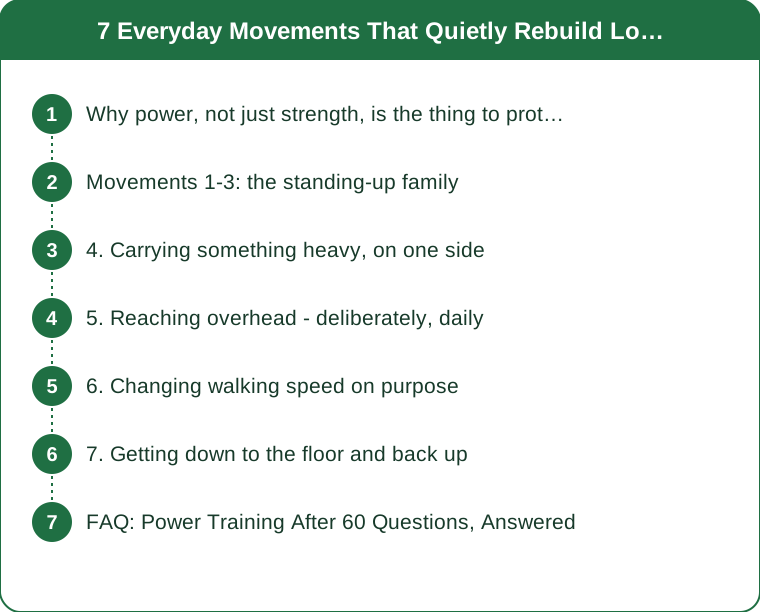
7 Everyday Movements That Quietly Rebuild Lower-Body Power After 60
Quick Answer: After 60, muscle power - the ability to produce force quickly - declines roughly twice as fast as raw strength, and it’s what actually prevents falls and keeps stairs and curbs manageable. Seven ordinary daily movements, done with slightly more speed and intention, train power without any equipment: standing from a chair, stair climbing, stepping up, carrying, reaching overhead, walking transitions, and getting off the floor.
Strength training after 60 gets all the attention. Power - strength done quickly - gets almost none, despite being the quality that fades fastest and matters most for staying steady on your feet. The good news is that seven movements already in your day can train it.
Why power, not just strength, is the thing to protect
Strength is how much force you can produce. Power is how much force you can produce quickly - and the two decline at different rates.
After 60, power typically declines noticeably faster than strength, largely because the fast-twitch muscle fibres responsible for quick force production shrink and are lost more readily than slow-twitch fibres.
This matters enormously in practice. Catching yourself when you trip is a power event - you have a fraction of a second to produce force. Stepping onto a curb before the light changes is a power event. Standing up quickly when the phone rings is a power event.
A person can be reasonably strong in a slow, controlled test and still lack the quick force production that keeps them upright when their foot catches on a rug. Training power specifically means adding intent to move quickly on the effort phase - not moving recklessly, but not moving at the deliberate, slow pace most senior fitness advice defaults to.
The rest of this list is ordinary movements, done with that one change.
Movements 1-3: the standing-up family
1. Standing up from a chair - but faster on the way up
The single highest-value power movement available, and you already do it a dozen times a day.
How to train it: sit toward the front of a sturdy chair, feet flat, arms crossed over your chest if you can manage it. Stand up quickly - with real intent to move fast - then sit back down slowly, taking 3 full seconds on the descent.
That asymmetry is the whole method: fast up, slow down. The fast phase trains power; the slow phase trains control and adds time under tension.
Dose: 8-10 repetitions, 3 times a week. Add a set when 10 feels comfortable rather than adding weight.
Safety note: use a chair against a wall so it can’t slide, and keep a hand available if balance is uncertain. If standing without using your arms isn’t available yet, push off your thighs rather than skipping the exercise entirely.
2. Stair climbing, one flight, with intention
Stairs are a naturally loaded single-leg power exercise, and most people over 60 avoid them precisely when they’d benefit most.
How to train it: rather than plodding evenly, drive up through the leading leg with a quick, deliberate push. Use the handrail for balance, not for pulling yourself up - that shifts the work away from the legs.
One flight, done with intent, is worth more than three flights done slowly and passively.
Dose: 2-3 flights spread through the day, most days. This doesn’t need to be a workout; it needs to be a habit.
Common mistake: taking stairs two at a time to make it harder. This dramatically increases fall risk for minimal added benefit. Keep one step at a time and add speed instead.
3. Step-ups onto a low step
A more controllable version of stair climbing, with the advantage that you can pick the height.
How to train it: stand facing a step or low sturdy platform - 15-20cm is plenty to start. Step up with one foot, drive up quickly, step back down with control. Complete all reps on one leg, then switch.
Dose: 8 per leg, 2-3 times a week.
Progression: increase height before adding weight. A 25cm step is meaningfully harder than a 15cm one and requires no equipment purchase.
Why it earns its place: it’s single-leg, which mirrors how you actually move through the world. Both-legs-together exercises let the stronger side quietly compensate, hiding an asymmetry that matters for balance.
4. Carrying something heavy, on one side
Grip strength is one of the more commonly discussed markers associated with healthy ageing, and carrying trains it alongside the entire postural chain.
How to train it: pick up a moderately heavy bag, watering can, or shopping bag in one hand. Walk 20-30 metres, standing as tall as you can, resisting the pull that wants to tip you sideways. Switch hands and repeat.
Dose: 2-3 trips per side, 2-3 times a week. Groceries count. Watering the garden counts.
Load guidance: heavy enough that the last few steps require real attention, light enough that your posture doesn’t collapse. If you’re leaning noticeably, it’s too heavy.
Bonus: this is the rare exercise that trains grip, core, and posture simultaneously, and it happens to be something you were probably going to do anyway.
5. Reaching overhead - deliberately, daily
Overhead reach is one of the first ranges of motion people lose, and losing it changes what’s accessible in your own home.
How to train it: reach both arms fully overhead, as high as comfortable, and hold for 3 seconds. Then reach one arm at a time as if placing something on a high shelf - which is exactly what you’re training for.
Dose: 8-10 reaches, daily. Attach it to something you already do - putting away dishes is ideal.
Progression: add a light weight (a tin of beans works) once the unweighted version is easy.
Watch for: shoulder pain during the reach, which is worth getting assessed rather than working through. This is general information, not medical advice.
6. Changing walking speed on purpose
Walking at a single steady pace trains endurance. Changing pace trains power, and it’s the version that transfers to real situations - crossing before a light changes, keeping up with a grandchild.
How to train it: during any walk, pick a landmark 20-30 metres ahead. Walk briskly to it - not a jog, just clearly faster than your comfortable pace - then return to normal pace until you’ve fully recovered. Repeat 4-6 times.
Dose: twice a week, worked into walks you were doing anyway.
Why it matters: habitual walking speed is one of the more discussed functional markers in older adults, and pace variation is one of the more direct ways to work on it.
Start conservatively: on uneven ground or in poor lighting, skip the fast intervals entirely. Even, familiar surfaces only.
7. Getting down to the floor and back up
The movement most people quietly stop practising, and the one with the largest consequences if it becomes unavailable.
How to train it: lower yourself to the floor using whatever route works - hand on a chair, down to one knee, then to sitting. Then reverse it to stand. The route matters less than doing it regularly.
Dose: 2-3 times, twice a week. Near a sturdy chair or wall.
Progression: over time, reduce how much you rely on your hands. Going from two-hand support to one-hand support is a significant and worthwhile milestone.
Why it’s last but not least: the ability to get up from the floor independently is a meaningful marker of functional independence, and it’s a skill that degrades quickly without practice. If it’s currently difficult, that’s the strongest possible argument for practising it - with someone nearby the first few times.
Stop and get assessed if: you can’t get up from the floor at all, or you experience dizziness on standing. Both are worth a conversation with a doctor rather than repeated solo attempts.
FAQ: Power Training After 60 Questions, Answered
Isn’t moving quickly dangerous at my age?
Moving quickly with control, on a stable surface, within a range you already own is different from moving recklessly. The greater risk is losing the ability to move quickly at all, since that’s what catching a trip requires.
Do I still need traditional strength training?
Yes - power and strength complement each other. These seven movements work well alongside a basic resistance programme rather than replacing it.
How soon will I notice a difference?
Many people notice stairs and standing up feel easier within 4-6 weeks. Measurable power improvements typically take 8-12 weeks of consistency.
What if I have arthritis or joint pain?
Most of these can be modified - smaller range, lower step, lighter load. Pain during a movement is a signal to modify it rather than push through, and a physiotherapist can adapt the list to your joints. This is general information, not medical advice.
TL;DR:
- Power declines faster than strength after 60 and matters more for staying steady
- The key change is adding intent to move quickly on the effort phase
- Seven daily movements cover it: chair stands, stairs, step-ups, carries, overhead reach, pace changes, floor transfers
- Fast up, slow down is the governing pattern for most of them
- Expect stairs and standing to feel easier within 4-6 weeks
None of this requires equipment or a gym. It requires doing what you already do, slightly faster and on purpose. This is general information, not medical advice.
Keep Reading
This article is for general informational and styling purposes only. Fit, sizing, and product availability may vary.