7 Daily Habits That Protect Muscle After 60 (Most Take Under 5 Minutes)

Quick Answer: After 60, muscle is lost at roughly 1-2% per year without deliberate input, and strength faster than that. The seven habits that most reliably slow it are: protein at every meal, twice-weekly resistance work, daily loaded carrying, getting up and down from the floor, adequate vitamin D, protecting sleep, and eating properly around illness or hospital stays. Six of the seven take under five minutes a day.
The research on this is unusually clear and unusually encouraging: muscle after 60 responds to training much like muscle at 40, just more slowly. What it doesn’t tolerate is being left alone. Here are the seven inputs that matter most.

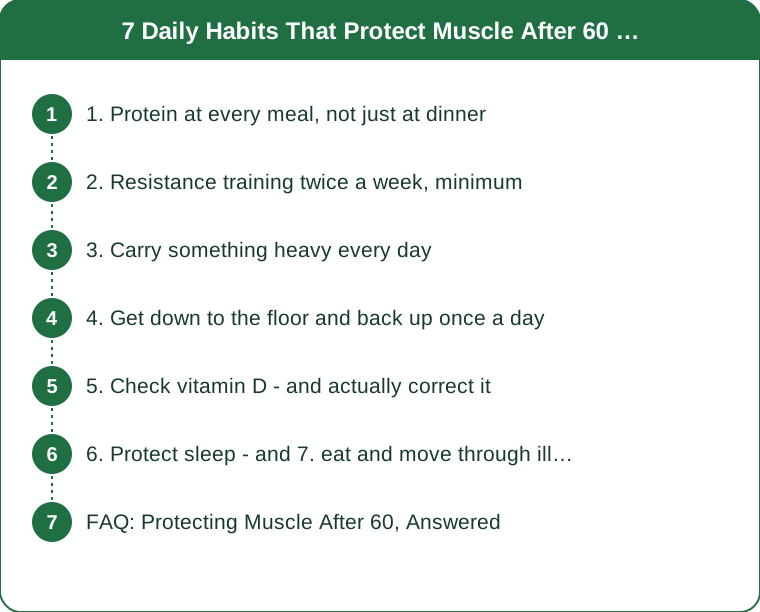
1. Protein at every meal, not just at dinner
This is the highest-return habit on the list, and it’s the one most commonly missed.
Older adults have what researchers call anabolic resistance - the same amount of protein produces less muscle-building response than it would in a younger person. The practical answer is more protein per sitting, distributed across the day.
The target most guidance converges on: roughly 25-30g of protein at each of three meals, rather than 10g at breakfast, 15g at lunch, and 60g at dinner. The total matters, but the distribution matters nearly as much, because each meal is a separate opportunity to trigger the response.
What 25-30g looks like:
- 3 eggs plus a slice of cheese
- A 120g chicken breast
- 200g of Greek yoghurt with a spoon of nut butter
- 150g of tofu with a handful of edamame
- A tin of tuna
The breakfast gap is the one to fix first. Tea and toast is roughly 5g. Adding two eggs or a pot of Greek yoghurt takes it to 25g and costs nothing in time.
If you have kidney disease, discuss protein targets with your doctor before increasing them - the general advice doesn’t apply universally.
2. Resistance training twice a week, minimum
Nothing else on this list substitutes for this one, and 20 minutes twice a week is enough to make a real difference.
The stimulus that preserves muscle is loaded, effortful contraction - lifting something heavy enough that the last two repetitions are genuinely hard. Walking, swimming, and cycling are excellent for other reasons and do not provide this stimulus.
A minimum effective routine, twice weekly:
- Sit-to-stand from a chair: 3 sets of 8-10. Add a hold on a weight when it gets easy
- A push: wall press-ups, progressing to counter height, then floor. 3 sets of 8
- A pull: band rows or dumbbell rows. 3 sets of 10
- A carry: two shopping bags, walk 20 metres. 3 rounds
- A hinge: hip hinge holding a weight, 3 sets of 8
The single most important variable is that it gets harder over time. The same three-kilo dumbbells for two years maintains almost nothing. When a set of 10 feels comfortable, add weight or add a set.
Starting at 60, 70, or 80 is not too late - meaningful strength gains have been documented in people in their nineties.
3. Carry something heavy every day
This is the habit that turns training into daily life, and it takes zero extra time.
Grip strength is one of the strongest single predictors of functional independence in older age, and carrying trains it alongside the trunk, shoulders, and hips.
How to build it in without adding a task:
- Don’t make two trips. Carry all the shopping in one go, deliberately, with good posture
- Carry the watering can full rather than half full
- Take the stairs holding the laundry basket rather than sliding it up
- Choose the basket over the trolley for small shops
The rule is simple: when you’re about to make something lighter or easier out of habit, don’t - unless it’s genuinely unsafe. Everyday convenience is quietly de-training.
If balance is a concern, keep one hand free or split the load evenly between both hands rather than loading one side.

4. Get down to the floor and back up once a day
The ability to get off the floor unassisted is one of the clearest markers of independent living, and it is a use-it-or-lose-it skill.
It combines hip strength, ankle mobility, balance, and the confidence to commit to the movement. All four degrade quickly without practice, and they degrade together.
How to practise safely:
- Do it beside a sturdy chair or against a wall
- Kneel first, then sit, then reverse. There’s no wrong technique
- Once a day, whether or not you need to. Feeding a pet, gardening, or a floor stretch all count
- If you can’t currently do it unassisted, practise the halfway version - kneeling to standing with a chair - and progress from there
A useful self-check: count how many points of support you need. Most people can improve from three or four supports to one or two within a couple of months of daily practice.
If you’ve had a fall, are unsteady, or have had a hip or knee replacement, get guidance from a physiotherapist before practising alone.
5. Check vitamin D - and actually correct it
Vitamin D deficiency is common after 60 and is associated with muscle weakness and increased fall risk. Skin synthesis from sunlight declines substantially with age, and time spent indoors increases.
Why it belongs on a muscle list: low vitamin D status is linked with reduced muscle function and higher fall rates, and correcting a genuine deficiency has been shown to improve both in deficient populations. It is not a performance supplement for people with normal levels.
The practical steps:
- Ask for a blood test rather than guessing, particularly if you’re indoors most days, have darker skin, or cover up outdoors
- Many national guidelines recommend a daily supplement through autumn and winter for older adults regardless of test results - check what yours says
- Take it with a meal containing fat; absorption is meaningfully better
Don’t take high-dose vitamin D without testing and medical advice. More is not better here, and very high doses have been associated with worse outcomes in some trials. This is general information, not medical advice.
6. Protect sleep - and 7. eat and move through illness
6. Protect sleep, because muscle repair happens there
Sleep is where the adaptation to training actually occurs, and sleep quality declines with age in ways that are partly fixable.
Short sleep is associated with reduced muscle protein synthesis and increased breakdown, and poor sleep also reduces the likelihood you’ll train at all the next day - a compounding effect.
The changes with the best return after 60:
- Consistent wake time, seven days a week. This anchors the whole rhythm and matters more than bedtime
- Morning daylight within an hour of waking, ten minutes outdoors. The strongest available signal for a drifting body clock
- Limit alcohol, which fragments sleep architecture significantly and increasingly so with age
- Cut caffeine after midday. Caffeine clearance slows with age, so the afternoon coffee that was fine at 40 may not be now
- Raise nighttime bathroom trips with a doctor rather than accepting them - they’re a common, treatable cause of fragmented sleep
Waking once in the night is normal at any age. Waking exhausted every day is not, and it’s worth investigating rather than tolerating.
7. Eat and move during illness - especially in hospital
This is the habit nobody lists, and it may protect more muscle than any of the others.
Muscle loss during bed rest is dramatic and fast. Studies of healthy older adults on strict bed rest have shown substantial leg muscle loss within a week or two - losses that can take months of training to recover. Illness, injury, and hospital stays are where most people lose the muscle they never get back.
What to do when illness strikes:
- Keep protein up even with a poor appetite. This is when protein intake typically collapses and when it matters most. Small, frequent, easy sources: yoghurt, milk, eggs, a supplement drink if needed
- Sit up rather than lie down, and get out of bed for meals if you’re able
- Walk the corridor if you’re in hospital and allowed to. Ask about it explicitly - mobility is often permitted but not prompted
- Ask about physiotherapy input during any stay longer than a couple of days
After discharge, assume you need to rebuild rather than resume. Restarting at your pre-illness training level is how people get injured; restarting at half and building over three to four weeks is how they get back.
A person who trains diligently for a year and then loses it all during a three-week illness has still come out ahead - but far less than one who ate and moved during those three weeks. Follow your medical team’s instructions first in any illness; this is general information, not medical advice.
FAQ: Protecting Muscle After 60, Answered
Is it too late to start at 75 or 80?
No. Strength gains have been documented in adults in their eighties and nineties. Progress is slower, the relative improvement is often larger, and the functional benefit is bigger because the starting point is closer to the threshold that matters.
Do I need protein supplements?
Only if you can’t hit 25-30g at meals from food, which is common at breakfast and during illness. Whey or a milk-based drink is the simplest option, but food first.
How quickly will I lose it if I stop?
Noticeable strength loss can begin within two to three weeks of complete inactivity, faster than at younger ages. Even a small amount of maintenance work during a break preserves most of it.
What if I have arthritis or joint pain?
Resistance training generally helps arthritic joints rather than harming them, but load and range need adapting. A physiotherapist can build a version that works around the painful joint rather than skipping training entirely.
TL;DR:
- 25-30g protein at each of three meals; fix breakfast first
- Resistance training twice a week, and make it progressively harder
- Carry something heavy daily - stop making things easier out of habit
- Practise getting to the floor and back up once a day
- Test and correct vitamin D; protect sleep with a fixed wake time and morning light
- Eat and move during illness - that’s where most muscle is permanently lost
Six of these take five minutes. The seventh takes forty, twice a week. That’s the entire cost of keeping the strength that decides what your eighties look like.
Keep Reading
This article is for general informational and styling purposes only. Fit, sizing, and product availability may vary.