Grip Strength: The Longevity Marker You Can Train at the Kitchen Counter

Quick Answer: Grip strength is one of the strongest simple predictors of independence and healthy aging, because it reflects whole-body muscle and nervous-system health. It also responds to training at any age. The best builder is loaded carries — walk 30–60 seconds holding grocery bags or water jugs, 3–4 rounds, 3 days a week.
The jar of pasta sauce that used to open on the first try now takes two goes and a tea towel.
Most people file that under “getting older” and move on.
It’s actually one of the most useful signals your body sends — and one of the easiest to answer.

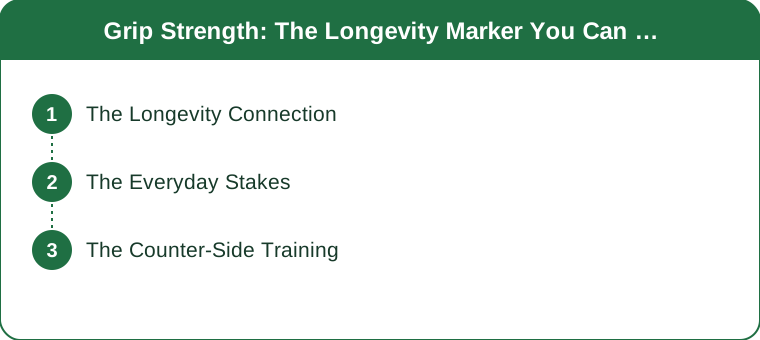
Why does grip strength predict how you’ll age?
Because your hand is a remarkably good window onto everything else.
Grip strength is associated in large population studies with overall strength, functional independence and longevity outcomes. It’s a researchers’ favourite precisely because it’s a 10-second test that correlates with things that take years to measure.
The reason it works as a proxy: grip reflects muscle mass and neuromuscular health, and those age hand-in-hand across the whole body. A declining grip is rarely a hand problem — it’s usually an early flag for a broader loss of muscle that hasn’t announced itself elsewhere yet.
There’s also a direct functional link. Grip is what catches a stair rail during a stumble, opens the jar, and carries the shopping in one trip. That’s not metaphor — that’s the literal infrastructure of living independently.
And the genuinely good news: grip responds to training at every age. It’s a trainable marker, not a fixed verdict.

What does grip strength affect day to day?
More than you’d guess before you start noticing.
- The independence tasks. Jar lids, stiff door handles, grocery bags, wringing out laundry, the car door in cold weather. Each of these turns into an “ask for help” moment when grip fades.
- The safety catches. Seizing a grab rail mid-stumble, catching a countertop. Grip is a genuine backstop in fall prevention, and it works in the fraction of a second when balance has already failed.
- Carrying capacity. The freedom to do it in one trip rather than three. Loaded carrying is gated almost entirely by grip, not by leg or back strength.
- The hobbies. Gardening tools, lifting a grandchild, kneading dough, opening the pickle jar in front of an audience. Small independences worth defending.
The prompt to act is simple: when something that used to be easy gets noticeably harder, that’s the moment it’s most addressable.
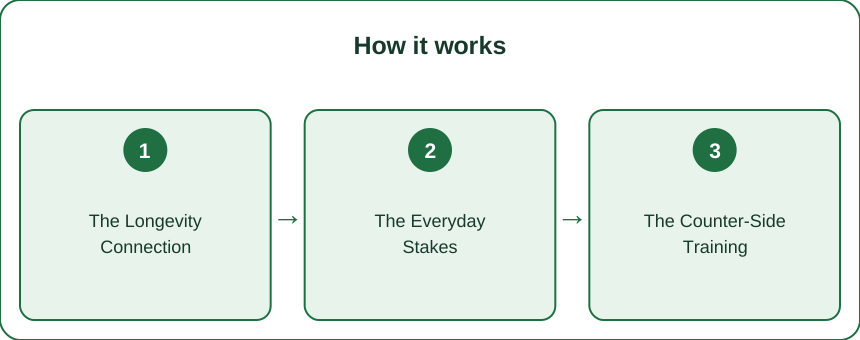
How do you train grip at home?
You barely need equipment, and the best exercise is the least glamorous.
1. Loaded carries — the single best builder. Pick up two grocery bags or two water jugs and walk. Aim for 30–60 seconds per round, 3–4 rounds, 3 days a week. Start with whatever you can hold comfortably for 20 seconds and build from there. Stand tall, shoulders down, breathe normally. This is a farmer’s carry with the gym removed.
2. Squeezes. A tennis ball, a rolled towel or a grip trainer while the kettle boils or during television. 10–15 squeezes of 3–5 seconds each, per hand, daily. Low effort, genuinely effective, easily forgotten — so attach it to something you already do.
3. Holds. A supported bar hold if you have somewhere safe, or simply holding a heavier bag stationary for 20–30 seconds. Progress by time before you progress by weight.
4. Everyday practice counts. Opening jars yourself rather than delegating, resistance-band pulls, kneading dough, wringing out a cloth. Life as gym is a legitimate framing at this end of training.
5. Therapy putty or grip rings if you like structure and something to measure.
Safety notes: if you have arthritis, carpal tunnel, a recent hand or wrist injury, or any neurological condition affecting your hands, talk to your doctor or a physiotherapist before starting — some grip work needs modifying, and a sudden unexplained drop in grip strength on one side is worth getting checked rather than training through. Sharp joint pain means stop; muscle fatigue is fine. This is general information, not medical advice.
FAQ
How do I measure my grip strength at home?
A hand dynamometer is inexpensive and gives you a number in kilograms to track. Without one, use a practical benchmark instead: how long you can carry a set weight, or how many seconds you can hold a bag off the floor. Retest monthly.
How quickly will grip improve?
Most people notice everyday improvement — jars, bags, doors — within 4 to 6 weeks of consistent work. Early gains come largely from the nervous system learning to recruit better, which is why they arrive faster than you’d expect.
Is grip strength only about the hand?
No, and that’s the key point. Forearm, shoulder and upper-back strength all contribute, which is exactly why grip works so well as a whole-body proxy — and why general strength training raises it too.
TL;DR:
- Grip strength predicts independence and longevity because it proxies whole-body muscle health.
- It’s trainable at any age — a flag, not a verdict.
- Best builder: loaded carries, 30–60 seconds × 3–4 rounds, 3 days a week.
- Add daily squeezes (10–15 per hand) and 20–30 second holds.
- Expect noticeable everyday improvement in 4–6 weeks; check with a doctor if you have hand conditions.
The jar that got harder is a question. Carry something heavy across the kitchen three times a week and you’ve answered it — grip trained while the kettle boils, independence defended.
Keep Reading
This article is for general informational and styling purposes only. Fit, sizing, and product availability may vary.