Gentle Yoga for Seniors: Start Here
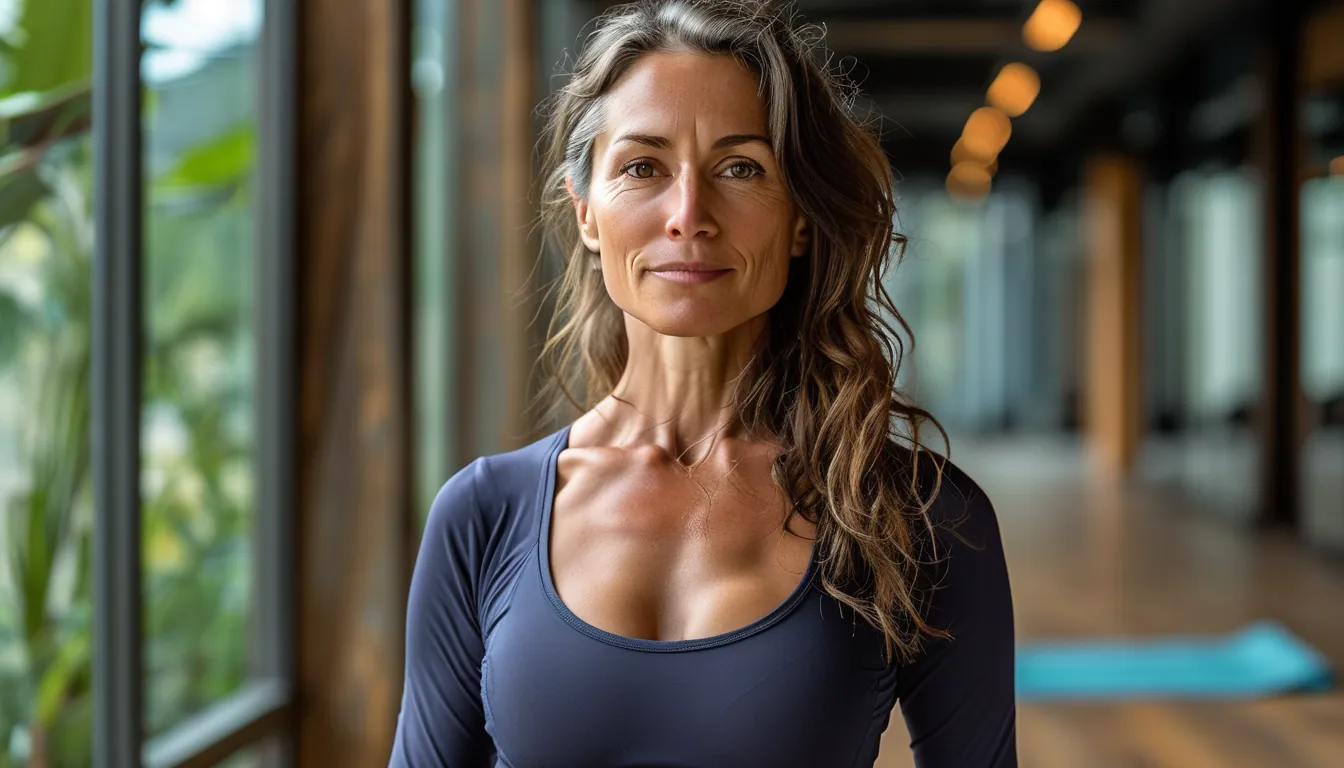
Quick Answer: You can get nearly all of yoga’s benefits — better balance, less stiffness, a calmer head — without ever getting down on the floor. Start with standing poses beside a sturdy chair, match each movement to a breath, and aim for 10 minutes daily rather than an hour once a week. Balance training in particular has strong evidence behind it for reducing fall risk in older adults.
Yoga has an image problem. The photos are all handstands and pretzel shapes, performed by twenty-somethings on a beach.
The actual practice is much simpler than its marketing: gentle movement, steady breathing, and paying attention to what your body is doing.
And for anyone over 60, a gentle version delivers three things that matter more each year — balance, mobility, and calm — with less strain than almost any other activity. You can start today, standing up, holding a chair.
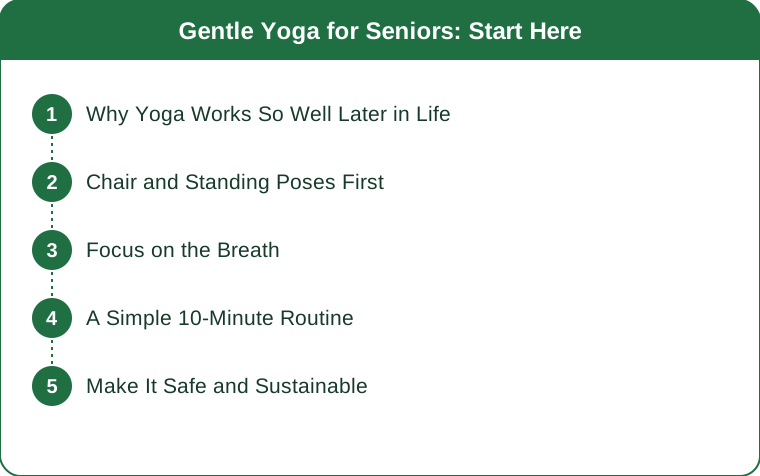
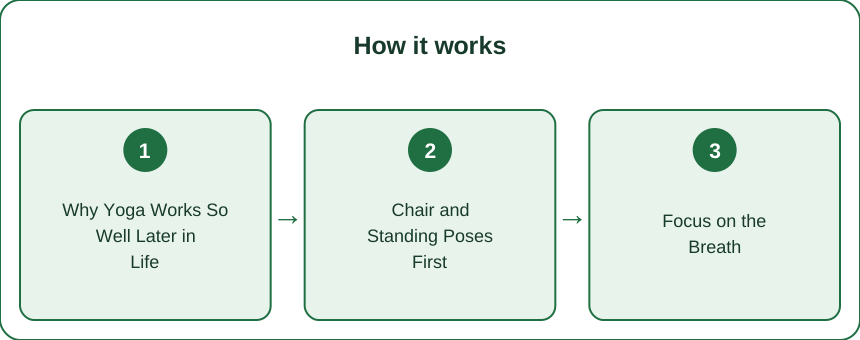
Why Does Yoga Work So Well Later in Life?
Because it trains the three things that quietly determine independence.
Balance. This is the big one. Falls are the leading cause of injury in adults over 65, and balance is highly trainable at any age — reviews of exercise programs consistently find meaningful reductions in fall risk from regular balance work. Yoga trains it in a controlled, supported way.
Mobility and flexibility. Stiffness isn’t only about ageing tissue; a lot of it is simply range of motion that hasn’t been asked for in years. Joints respond to being moved through their range, and they respond fairly quickly.
Body awareness. Knowing where your limbs are in space — proprioception — declines with age and is directly trainable. It’s what lets you catch yourself on an uneven kerb.
Plus the breathing, which shifts the nervous system toward rest and has measurable effects on blood pressure and stress.
Few activities give so much for so little strain.
What Poses Should You Start With?
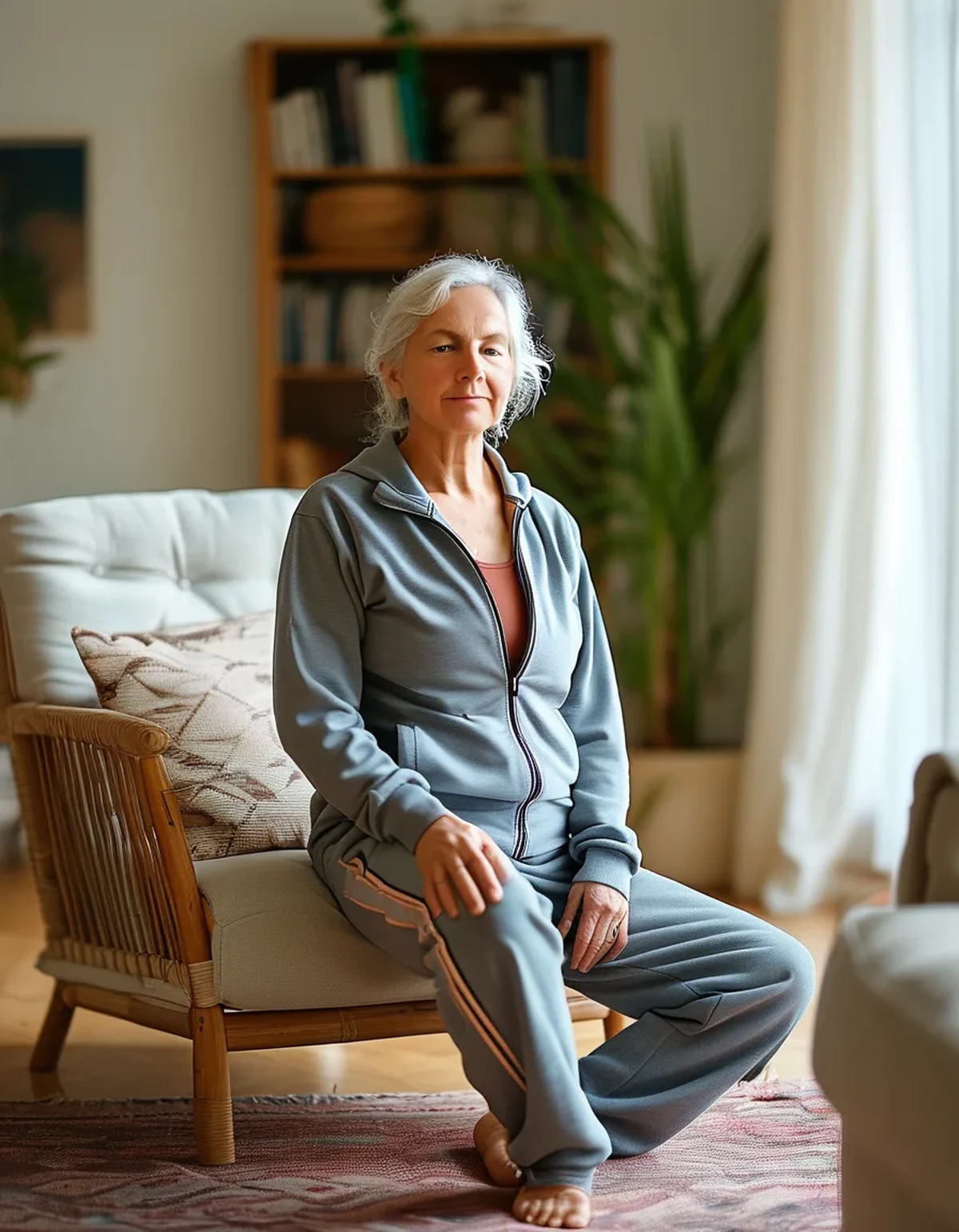
Chair and standing poses. The chair is a steady partner, not a compromise.
Use a sturdy dining chair without wheels, placed on a non-slip surface, and keep one hand on the back of it whenever balance feels uncertain.
Supported mountain pose. Stand tall behind the chair, feet hip-width, hands resting on the back. Lengthen through the crown of your head, soften the knees. Hold 5 slow breaths. This is the foundation for everything else and it’s doing more than it looks like.
Supported side stretch. One hand on the chair, the other arm reaching overhead and gently over. 3 breaths each side.
Gentle seated twist. Sitting tall on the chair, feet flat, turn your torso to one side and rest a hand on the chair back. Turn from the middle of the ribcage, not the neck. 3 breaths each side.
Chair-supported calf stretch. Hands on the chair back, one foot stepped behind, back heel pressing down. 20 seconds each side. Calves tighten with age and stiff calves change how you walk.
Seated cat–cow. On the chair, round the back on an exhale, open the chest on an inhale. 5 rounds. Best thing there is for a stiff morning spine.
How Important Is the Breathing?
It’s genuinely half of it, and it’s the part beginners skip.
Slow, even breathing steadies your balance — try standing on one foot while holding your breath, then again while breathing slowly, and you’ll feel the difference immediately. It also downshifts the nervous system, which is where the calm comes from.
The simple version: match each movement to a breath. Lengthening or opening movements go with the inhale; folding, twisting, or softening movements go with the exhale.
Aim for an exhale slightly longer than the inhale — in for 4, out for 6. Never hold your breath in a pose. If you notice you have, that’s the signal to ease off a little.
A Simple 10-Minute Daily Routine
About a minute each, breathing slowly throughout:
- Neck rolls — half circles only, ear toward shoulder and back. Don’t roll the head backwards.
- Shoulder circles — 8 backwards, 8 forwards.
- Seated cat–cow — 5 rounds.
- Supported side bend — 3 breaths each side.
- Gentle seated twist — 3 breaths each side.
- Supported mountain pose — 5 breaths.
- Calf stretch at the chair — 20 seconds each side.
- Single-leg balance — one hand on the chair, lift one foot slightly. 10 seconds each side, building over weeks.
- Three long breaths to finish.
Done daily, this loosens the whole body and trains balance without a single floor pose. Consistency beats duration by a wide margin — ten minutes every day will do far more than an hour on Sundays.
What Nobody Tells You About Starting Yoga Later
Four honest things.
“Gentle” doesn’t mean ineffective. Supported standing poses build real strength in the legs and hips. You don’t need difficulty for adaptation; you need consistency and a little challenge.
Some days your range is just smaller. Morning stiffness, weather, sleep, and medication all move the dial. The pose you managed easily on Tuesday may not be there on Thursday, and that’s normal rather than a decline.
Pinching is a stop sign; stretching is not. A broad, warm stretch sensation is fine. Anything sharp, pinching, or in a joint means come out of it. Never bounce.
Group classes are worth trying once. A chair-yoga or “gentle yoga for seniors” class gives you an instructor who can correct your alignment, plus other people, which is a bigger factor in whether people keep going than anyone admits. Many community centers and libraries run them free.
An important caveat: talk to your doctor before starting if you have osteoporosis (forward bends and deep twists often need modifying), have had a hip or knee replacement, have glaucoma or uncontrolled high blood pressure (avoid head-below-heart positions), or have any balance disorder or recent fall. And tell your instructor about any of these — a good one will adapt the whole class around it without a fuss.
Frequently Asked Questions
Is chair yoga as effective as regular yoga?
For flexibility, mobility, breathing, and stress reduction, it delivers most of the same benefit. Where it’s more limited is in weight-bearing balance and leg strength — which is why the best approach is chair-supported standing poses rather than seated-only, once you’re steady enough. Start seated, progress to standing with the chair, and let the hand come off the chair as confidence grows.
How often should seniors do yoga?
Daily, in small doses, beats occasional long sessions. 10–15 minutes most days is an excellent target and is realistic to sustain. If you’d rather do longer sessions, two or three 30-minute practices a week works too — the key variable is regularity.
Can yoga help with arthritis stiffness?
Gentle movement is generally recommended for osteoarthritis, and many people find morning stiffness improves noticeably with a short daily routine — movement lubricates joints and maintains range. Work within a comfortable range, avoid loading a joint that’s actively flaring, and check with your doctor or physiotherapist about which movements suit your specific joints.
TL;DR:
- Balance, mobility, and body awareness are all trainable at any age — and balance work reduces fall risk.
- Start standing beside a sturdy chair; no floor poses required.
- Match movement to breath, exhale longer than you inhale, and never hold your breath.
- Do the 10-minute routine daily — consistency beats duration by a mile.
- Stretch sensation is fine; pinching, sharpness, or joint pain means stop.
- Check with your doctor first if you have osteoporosis, a joint replacement, glaucoma, or balance problems.
Keep Reading
This article is for general informational and styling purposes only. Fit, sizing, and product availability may vary.