Staying Motivated to Exercise After 60 When the Old Reasons Stopped Working

You used to run because of a number on a scale, or because of a race time, or because of how a shirt fit. Then one day those reasons just stopped pulling. Nothing dramatic happened — they simply went quiet, and the workouts went with them.
Quick Answer: Appearance- and competition-based motivation tends to fade after 60, and that’s a documented pattern rather than a willpower failure. What replaces it reliably: independence goals (staying able to travel, live alone, lift a grandchild), social formats where the people carry the habit, and concrete functional tests like sit-to-stand reps or single-leg balance time. Write down your real reason, pick a group format, and track capability instead of appearance.

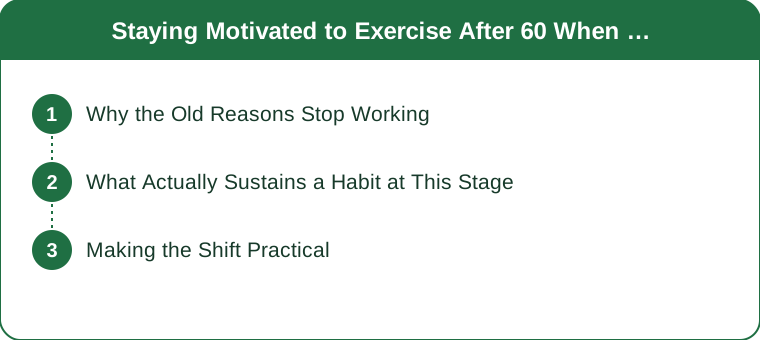
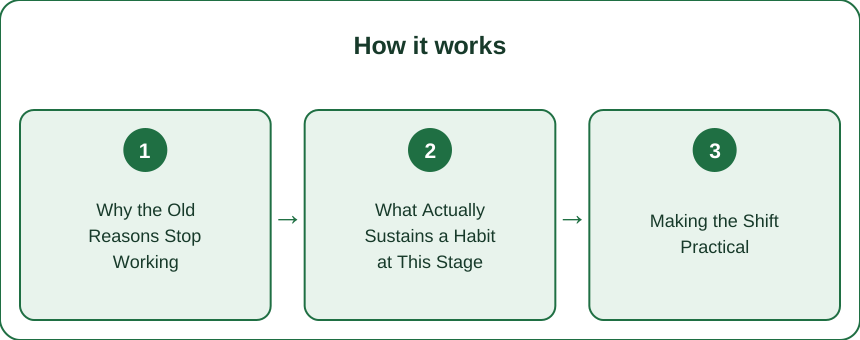
Why Do the Old Reasons Stop Working?
Three things happen at roughly the same time, and together they hollow out the motivations that used to be automatic.
Appearance loses its urgency. The aesthetic goals that drove decades of exercise start to feel abstract. That’s not resignation — for many people it’s a genuine shift in what registers as important, and it happens whether or not you approve of it.
Competing with a younger self becomes discouraging. Comparing today’s numbers to a personal best from age 40 turns a motivating comparison into a demoralizing one. The comparison point needs to change; it doesn’t need to disappear.
The actual stakes moved. There is a real, felt difference between being able to get up off the floor unassisted and not being able to. Between carrying groceries in one trip and making three. Weight loss never carried stakes like that, which is precisely why it stopped being enough.
Research on aging and motivation describes a broad shift away from achievement and appearance goals toward autonomy, connection, and meaning. So this is the normal trajectory, not a personal failure — motivation relocated to a more relevant target.
One honest addition: sometimes a fall, a diagnosis, or watching a friend lose independence becomes the most immediate motivator of all. That’s a valid driver. It just works better when it’s converted into a specific goal rather than left as a background worry.

What Actually Sustains the Habit Now?
Four replacements, in rough order of durability.
Independence as the central goal. Frame exercise explicitly around what you want to keep being able to do: travel without help, manage stairs, live in your own home, get down on the floor with a grandchild and back up again. Independence is a motivator that doesn’t fade, because the stakes only become clearer over time.
Social connection. A consistent walking group or a regular class often sticks specifically because of who’s there. When the goal wavers, the people carry the habit — you go on Tuesday because Marge expects you, and the exercise happens as a side effect. Adherence research consistently favors group formats at this stage.
Specific functional targets. “Get fitter” is unmeasurable and therefore unmotivating. “Carry both grocery bags from the car in one trip” is neither. Concrete beats abstract every time.
Capability tracking instead of appearance tracking. Measure what you can do:
- Sit-to-stand: how many times you can rise from a chair without using your hands in 30 seconds
- Single-leg balance: how long you can hold it, eyes open, near a counter
- Stairs: how many flights before you need to pause
- Grip: how long you can carry a loaded bag comfortably
Retest every two to three months. Watching a number go up is motivating in a way that a mirror check-in stopped being years ago.
5 Mistakes Everyone Makes
- Waiting for the old enthusiasm to come back. It’s not coming back in the same form. Build the habit on the new fuel instead of holding out for the old.
- Choosing solo exercise by default. Solo works when motivation is high and collapses when it isn’t. A group format has a built-in backup system.
- Reading a hard week as failure. Recovery genuinely takes longer at this stage, so a tougher week is information about rest, not evidence the whole effort is failing.
- Setting goals borrowed from a fitness app. Step counts and calorie targets are designed around a different set of stakes. A functional goal you chose yourself outperforms a default one.
- Not writing the reason down. Motivation is at its clearest on a good day and least accessible on a bad one. Written down, it’s available on the bad days too.
The fifth one sounds trivial and does the most work. Nobody can recall a vague sense of purpose at 6 a.m. in February; anybody can read a sentence off a fridge.
How Do You Make the Shift Practical?
Four steps, doable in an afternoon.
1. Write down the real why. One sentence, specific: “I want to still be climbing the stairs to my daughter’s apartment in ten years.” Put it where you’ll see it. Naming it makes it usable.
2. Choose a format with people in it. A class, a walking group, a standing appointment with a friend. Treat this as a motivation strategy, not a social preference — it’s the single highest-return structural choice available.
3. Set one function-based checkpoint. Pick a test — sit-to-stand reps, balance hold, stairs without stopping — record today’s number, and retest in three months. A real test beats a vague sense of progress.
4. Revisit the why during dips. Low-motivation stretches are exactly when the written reason earns its keep. Read it, do a shortened version of your session, and let that count.
Removing small friction helps too. Comfortable, easy-to-move-in clothes you don’t have to think about make the difference on the days you’re on the fence — a high waist legging with a stay-put waistband or a pair of supportive walking shoes by the door is a small thing that quietly removes a decision.
When to check with a professional: before starting a new program if you have a heart condition, joint replacement, uncontrolled blood pressure, balance problems, or a history of falls. A physical therapist can also design a program around a specific limitation, which is far more useful than pushing through it — and if you’ve had a fall in the past year, that’s worth raising with your doctor regardless.
FAQ
How much exercise is enough after 60?
Most public health guidelines point to around 150 minutes of moderate activity a week plus two strength sessions and regular balance work. But the amount you’ll actually do consistently matters more than hitting a target once.
What if I’m starting from nothing?
Start with walking and chair-based strength work, and build from there. Ten minutes daily is a real starting point — consistency at a low level beats an ambitious program abandoned in three weeks.
Is it too late to build strength at 70 or 80?
No. Research consistently shows that adults well into their eighties and nineties gain strength from resistance training. The rate of gain is slower, and the functional benefit per unit of gain is often larger.
TL;DR:
- Appearance and competition motivations fading after 60 is a documented pattern, not a willpower problem
- Independence goals hold up because the stakes only get clearer with time
- Social formats work because the people carry the habit when the goal doesn’t
- Track capability — sit-to-stand reps, balance time, stairs — not weight or the mirror
- Write the real reason down; it’s the tool for the hard weeks
- Check with a doctor first if you have a relevant condition or a history of falls
Motivation after 60 doesn’t disappear so much as it needs a new target. Name the functional reason it matters now, pick a format with people in it, and track something concrete — fuel that’s built for this decade instead of borrowed from an earlier one.
Keep Reading
This article is for general informational and styling purposes only. Fit, sizing, and product availability may vary.