A Four-Minute Balance Routine for Adults Over 60

Quick Answer: A four-minute balance routine done three to four times a week can noticeably improve steadiness after 60. Use a counter or chair for support at first, hold each position for 20 to 30 seconds, and move to harder versions only when the easy one feels calm. Consistency matters more than intensity.
Most people do not notice their balance until it wobbles. You reach for a shelf in the dark, or you feel a little unsteady stepping off a curb. The good news is that balance responds well to short, repeated practice, even if you start small.

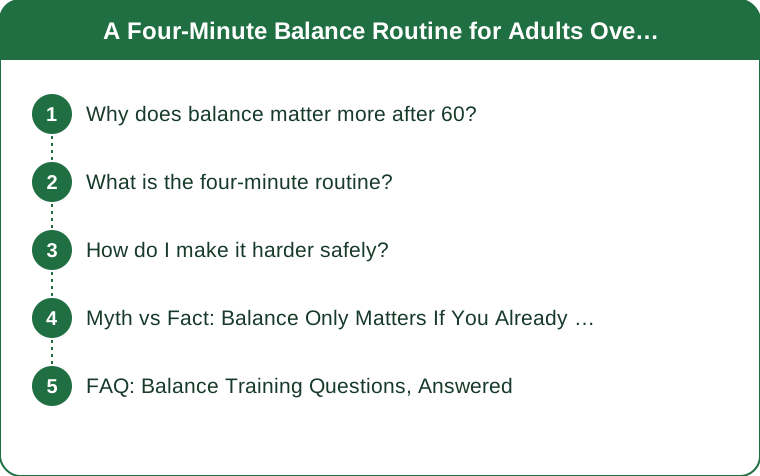
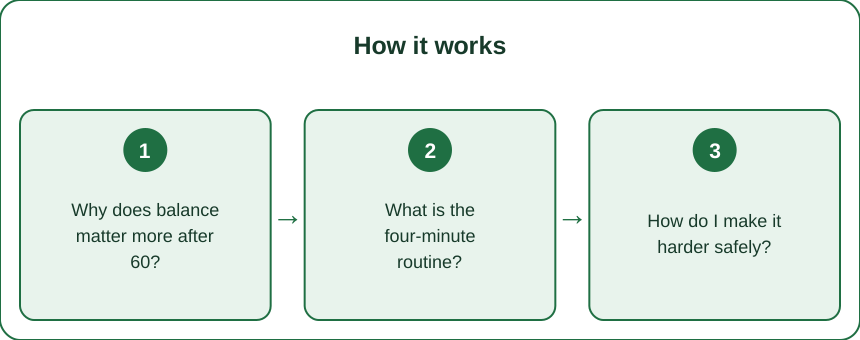
Why does balance matter more after 60?
Balance depends on three systems working together: your inner ear, your eyes, and the sensors in your feet and joints. With age, each system can slow down a bit, and the muscles around the ankles and hips may lose some of their quick response.
Training those systems together is what makes the difference. A short routine gives your nervous system regular practice in staying upright, which is the skill you actually need in daily life.
What is the four-minute routine?
Work through four moves, about one minute each. Stand tall with feet together and hold a counter lightly for 30 seconds. Then shift to a staggered stance, heel to toe, for 30 seconds per side. Next, stand on one leg for 20 seconds per side, using the counter for support. Finish with 10 slow heel-to-toe walking steps along a wall.
Breathe normally and keep your eyes on a fixed point ahead. If you feel wobbly, reach for the counter sooner. Support is part of the practice.

How do I make it harder safely?
Once the easy version feels calm for a full week, reduce how much you hold. Let go of the counter with just the fingertips, then with nothing at all. Try the one-leg stand with your eyes closed for 5 seconds, and build up slowly.
Add two simple strength moves on the same days: 2 sets of 10 chair sit-to-stands and 2 sets of 10 calf raises. Stronger legs help you recover when you do wobble.
Myth vs Fact: Balance Only Matters If You Already Fall
Myth: You only need balance work after you have had a near fall.
Fact: Balance is a skill that fades quietly. Practicing a few minutes a few times a week keeps your reactions sharp before a problem shows up, and most people feel a difference within four to six weeks.
FAQ: Balance Training Questions, Answered
How often should I do this routine?
Three to four times a week is a good target. Rest a day between sessions if your legs feel tired.
Is it safe to do these moves alone?
Yes, if you keep a sturdy counter or chair within reach and clear the area of rugs and cords. If you have dizziness, a recent fall, or a condition that affects your balance, check with your doctor first.
How will I know it is working?
Track how long you can hold the one-leg stand on each side each week. Steady gains of a few seconds are a good sign.
This is general information, not medical advice.
TL;DR:
- Balance is a skill that responds well to short, repeated practice after 60.
- Four moves, about four minutes, three to four times a week is enough to start.
- Use support at first, and only reduce it when the easier version feels calm.
- Track your one-leg hold each week, and check with a doctor if you feel dizzy or unsteady.
Keep Reading
This article is for general informational and styling purposes only. Fit, sizing, and product availability may vary.