Balance Exercises to Prevent Falls (Gentle & Effective)

Quick Answer: Balance is trainable at any age, and 5-10 minutes of daily practice makes a measurable difference. Start with five gentle moves — single-leg stands, heel-to-toe walking, sit-to-stands, weight shifts and marching in place — always within arm’s reach of a counter or sturdy chair. Talk to your doctor if you’ve had a fall or feel unsteady.
Balance is one of those things nobody thinks about until it starts to slip.
Then, quietly, the world reorganizes itself. You start planning routes around handrails. You hesitate on a curb. You turn down an invitation because the parking is uneven — and you tell yourself it’s about the parking.
The genuinely reassuring news is that balance responds remarkably well to practice, at any age. A few minutes a day makes people noticeably steadier, and steadier means confident, and confident means independent.
Here’s a gentle routine to start with.

Why Does Balance Training Matter So Much?
Balance isn’t one thing. It’s your inner ear, your vision, the position sensors in your joints and feet, and the muscles that respond to all three — working together, quickly, without you noticing.
Each of those systems changes with age. Vision shifts, joint position sense gets less precise, and the fast-twitch muscle fibers that catch you when you stumble decline faster than the rest.
The important part: every one of those components responds to training. Regularly challenging your balance strengthens the muscles and sharpens the reflexes that keep you upright. It’s not maintenance of a fixed decline — it’s genuine improvement.
Fall prevention programs built around balance and strength training are recommended by health organizations worldwide precisely because the evidence behind them is solid. A few minutes a day is genuinely protective, and it’s one of the highest-value things you can do for your independence.
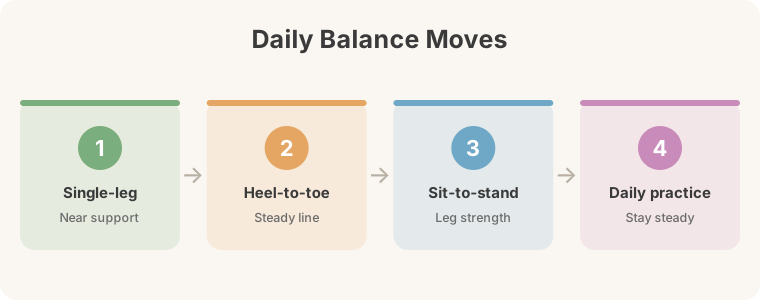
The Five Gentle Balance Exercises
Always practice near a wall, counter, or sturdy chair you can hold. Safety first, every single time. A dining chair with a firm back, or a kitchen counter, is ideal.
1. Single-leg stand
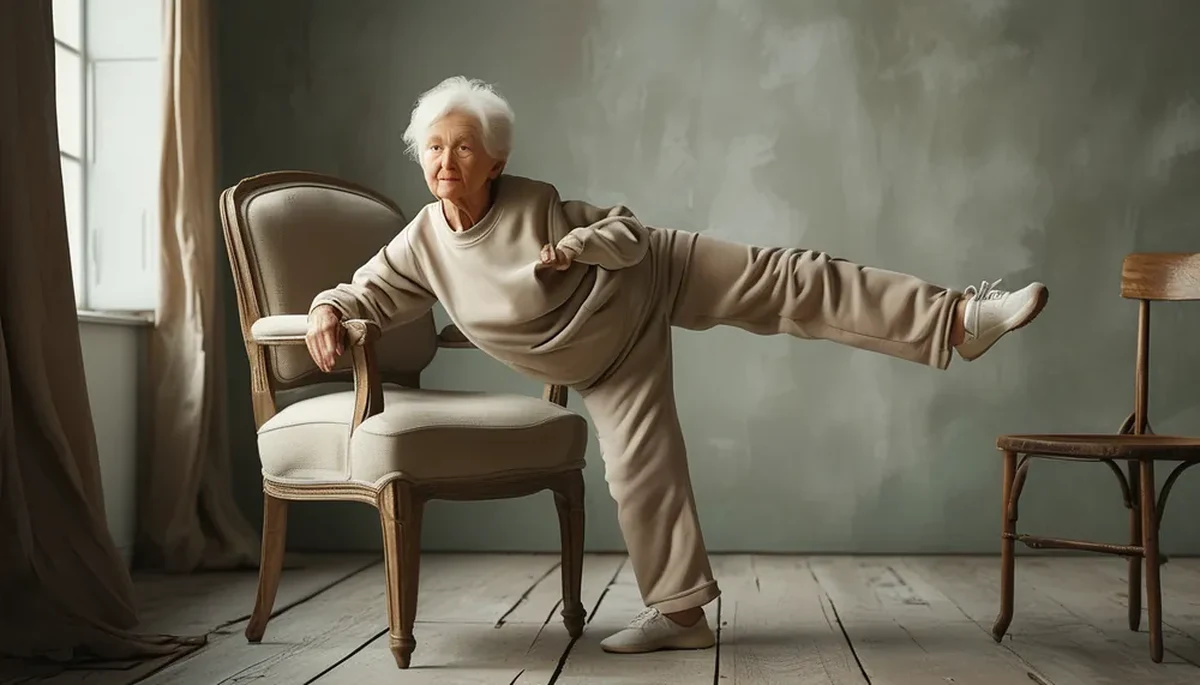
Hold the counter and lift one foot slightly off the floor. Start with 5-10 seconds per leg and build toward 30. When it gets easier, progress to one fingertip on the counter, then hovering your hand nearby. 3 holds per leg.
2. Heel-to-toe walk
Walk in a straight line placing the heel of one foot just in front of the toes of the other, like a gentle tightrope. Run your hand along the counter as you go. 10 steps, twice.
3. Sit-to-stand
Rise from a chair without using your hands if you can, then lower yourself slowly — the slow lowering is where the strength gets built. Use your hands if you need to; it still counts. 5-10 repetitions.
4. Weight shifts
Stand tall and slowly shift your weight side to side, then forward and back, feeling your feet grip the floor. This trains your body to control its center of gravity. 10 shifts each direction.
5. Marching in place
Lift your knees one at a time, holding support. Builds strength and coordination together, and it’s the friendliest starting point if the others feel like too much. 20 marches.
The whole routine takes about five to eight minutes.
What Nobody Tells You About Fall Prevention
Strength matters as much as balance. Balance reflexes only help if there’s enough leg strength to act on them. That’s why the sit-to-stand is in this list — it’s a strength exercise hiding in a balance routine, and it’s the one that most directly predicts whether you can get up from a chair, a bath or the floor.
Fear of falling causes falls. Anxiety makes people move stiffly, take shorter steps and look down instead of ahead — all of which reduce stability. Confidence built through practice isn’t just a nice feeling; it changes how you move.
Most falls happen at home, doing ordinary things. Rugs without grips, poor lighting on the way to the bathroom at night, cords across a doorway, a step you’ve taken ten thousand times. A slow walk around your own home looking for these is worth as much as a week of exercises.
Medication and vision checks are part of the picture. Some medications cause dizziness or lightheadedness, particularly in combination, and out-of-date glasses prescriptions genuinely contribute to falls. Both are worth reviewing annually.
Footwear matters more than people expect. Supportive shoes with a firm sole and a back beat slippers and loose sandals considerably. Bare feet at home give good sensory feedback — but only on a non-slip surface.
The exercises need to keep getting slightly harder. Balance that’s never challenged doesn’t improve. Once a movement feels easy, reduce your support or hold longer, in small steps.
How Do You Practice Safely?
- Always have support within arm’s reach — a wall, a counter, or a sturdy chair. Never a wheeled chair or a wobbly table.
- Wear supportive footwear, or go barefoot on a non-slip surface for better sensory feedback.
- Practice daily. Consistency beats duration by a wide margin here — five minutes every day beats thirty minutes on Sunday.
- Progress slowly. Only reduce your support when the current level feels genuinely steady, not just possible.
- Never push into dizziness. Stop, sit, and rest.
- Have someone nearby for your first few sessions if you’re at all unsure.
- Wear something you can move in that doesn’t catch underfoot. Long, loose trousers are a trip hazard in their own right — a comfortable pair of high waist leggings with a soft waistband stays out of the way and lets you actually see your feet and knee position.
When to see a professional: talk to your doctor if you’ve had a fall in the past year, feel unsteady on your feet, get dizzy when standing up, have noticed your balance changing, or are worried about falling. A physical therapist can assess your specific balance and prescribe a program tailored to you — that’s more effective than any general routine, and in many places it’s covered care. Get prompt medical attention for sudden balance loss, dizziness with headache, vision changes, weakness on one side, or slurred speech, which can indicate something requiring urgent care.
FAQ
How long does it take to improve balance?
Many people notice they feel steadier within 3-4 weeks of daily practice, with more substantial improvement over 8-12 weeks. Because balance declines when it isn’t challenged, the practice needs to continue rather than stop once things feel better.
Is it safe to do balance exercises alone?
Generally yes, provided you always have solid support within arm’s reach and stop at any dizziness. If you’ve fallen before, feel unsteady, or have a condition affecting balance, have someone with you for the first sessions and speak to your doctor or a physical therapist first.
What’s the single best exercise for preventing falls?
There isn’t one — the effective programs combine balance work with leg strength. If you had to choose, the sit-to-stand does double duty: it builds the leg strength that makes every other balance reaction possible, and it directly practices a movement you make dozens of times a day.
TL;DR
- Balance is trainable at any age. The decline isn’t fixed, and improvement is genuine.
- Five moves, 5-8 minutes, daily — single-leg stand, heel-to-toe walk, sit-to-stand, weight shifts, marching.
- Always keep support within arm’s reach, and never push into dizziness.
- Strength matters as much as balance — the sit-to-stand is the highest-value move in the list.
- Check the house too: rugs, lighting, cords, footwear. Most falls happen at home.
- See your doctor if you’ve fallen, feel unsteady, or get dizzy standing. A physical therapist can tailor a program to you.
This article is for general informational purposes only and isn’t medical advice. Consult your doctor if you have concerns about falls or balance.
Keep Reading
This article is for general informational and styling purposes only. Fit, sizing, and product availability may vary.