7 Ways Poor Sleep Quietly Blocks Your Strength Gains After 60

Quick Answer: Sleep is where most of the adaptation to strength training actually happens, and sleep architecture changes meaningfully with age - less deep sleep, more fragmentation, earlier timing. That combination blunts recovery, reduces training quality the next day, increases perceived effort, disrupts appetite signals that govern protein intake, and raises fall risk. If your program is sensible and your progress has stalled, seven specific sleep-related mechanisms are worth checking before you change the program again.
You show up. You do the sets. Somebody told you strength training after 60 works and it does - so when the weights stop going up despite consistent effort, the natural response is to blame the program, or your age, or both. Before either, look at the eight hours nobody counts as training.

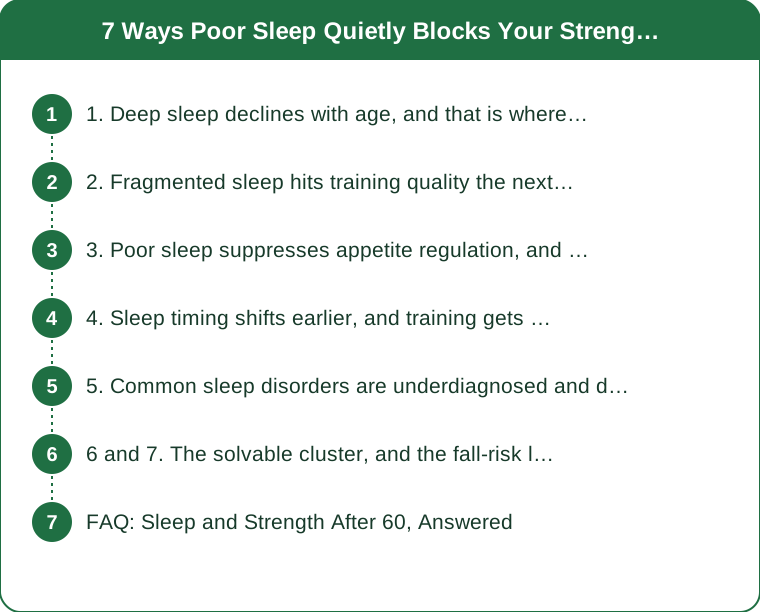
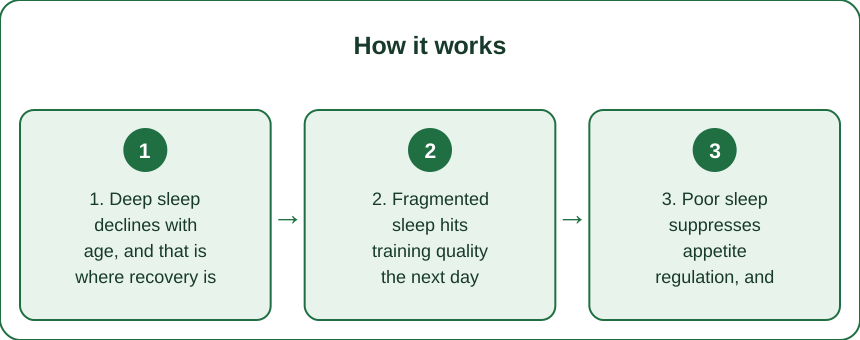
1. Deep sleep declines with age, and that is where recovery is concentrated
Slow-wave sleep - the deepest stage - decreases substantially from young adulthood onward, and it is the stage most associated with physical restoration and growth hormone release. Less deep sleep means the same training session produces less recovery than it would have at 40, which shows up as needing more days between hard sessions rather than as any obvious symptom.
This is why the program that worked at 55 may not work at 65. Not because you cannot get stronger - older adults demonstrably build strength - but because the recovery interval needed between demanding sessions is often longer. Two quality sessions a week with full recovery frequently outperforms four rushed ones.
The practical read: if you feel flat on session day rather than sore, that is a recovery signal. Persistent flatness usually means the interval is too short, not that the effort was too low.
2. Fragmented sleep hits training quality the next day
Waking multiple times a night is extremely common after 60 - from bathroom trips, pain, temperature, or medication - and fragmentation degrades sleep quality even when total time in bed looks fine on paper. Someone in bed for eight hours with five awakenings is not getting eight hours of restorative sleep.
The next-day effect on training is mostly about output and attention. Reduced sleep raises perceived exertion, so the same weight feels heavier, which leads to lighter loading, which leads to less stimulus. The program looks identical in a logbook and delivers less.
It also degrades coordination and reaction time, which matters enormously for anyone doing balance work or free-weight training. A fragmented night is a good day for machines and walking, not for a heavy single-leg session.
3. Poor sleep suppresses appetite regulation, and protein intake falls
Insufficient sleep is associated with disrupted appetite hormones, generally in the direction of more hunger for quick carbohydrates and less structured eating. For older adults, who already face a higher protein requirement to stimulate muscle protein synthesis, that shift matters more than it would at 30.
Age-related anabolic resistance means older muscle needs a larger protein dose per meal to trigger the same building response - which is why spreading intake across meals with a meaningful amount at breakfast is so consistently recommended, and why a poor night that turns breakfast into toast and coffee is a training problem, not just a nutrition one.
A simple check: if your protein intake is much lower on days after bad nights, that pattern alone can explain a stall. Keeping a genuinely easy high-protein breakfast option available - Greek yogurt, eggs, a shake - removes the decision on exactly the mornings you cannot make it.

4. Sleep timing shifts earlier, and training gets pushed into the wrong window
Circadian timing advances with age, meaning many older adults naturally become sleepier earlier in the evening and wake earlier. That is normal. The problem arises when a schedule built around a class time or a partner’s routine puts your demanding session in a window when your alertness and body temperature are declining.
Strength output tends to peak in the late afternoon to early evening for most people, but individual timing varies and an advanced clock moves the useful window earlier. If your sessions consistently feel poor at 7 pm and fine at 10 am, that is worth acting on rather than pushing against.
Late evening training can also delay sleep onset, which then costs you the recovery from the session you just did. If evening is the only option, keeping the intensity moderate and building in a proper wind-down matters more than at younger ages.
5. Common sleep disorders are underdiagnosed and directly affect strength
Obstructive sleep apnea becomes considerably more common with age and is substantially underdiagnosed in women, partly because presentation can differ from the classic pattern. It fragments sleep, reduces oxygen saturation overnight, and produces exactly the daytime fatigue and poor recovery pattern that gets attributed to aging.
Restless legs and periodic limb movements also increase with age and are strongly associated with iron status, which is worth checking.
Signs worth taking to a clinician: loud snoring, witnessed pauses in breathing, waking unrefreshed regardless of hours, morning headaches, and daytime sleepiness that is out of proportion to your schedule. These are treatable conditions, and treatment often produces a larger improvement in training capacity than any program change. This is general information, not medical advice.
6 and 7. The solvable cluster, and the fall-risk loop
6. Pain, medication, and bathroom trips form a solvable cluster
Joint pain that is manageable during the day frequently disrupts sleep, particularly with osteoarthritis, and the resulting fragmentation feeds back into next-day stiffness. Addressing evening pain management with a clinician is often the fastest available sleep intervention for this group.
Many common medications affect sleep, including some blood pressure medications, diuretics taken late in the day, and certain antidepressants. A medication review with a pharmacist or physician - specifically asking about timing rather than changing anything yourself - can resolve nighttime waking that has been assumed to be permanent.
Nocturia is worth mentioning to a clinician rather than accepting. Shifting fluid intake earlier, reviewing diuretic timing, and treating underlying causes all help, and the number of awakenings matters a great deal to sleep quality.
7. Poor sleep raises fall risk, which changes what you can safely train
Sleep problems are associated with increased fall risk in older adults, through effects on reaction time, balance, attention, and daytime sleepiness. This creates a compounding loop: worse sleep means poorer balance, which means less confident training, which means less balance work, which means poorer balance still.
It also changes what a sensible session looks like on a given day. After a badly disrupted night, a heavy free-weight session or challenging single-leg balance work carries more risk than usual. Swapping to seated or supported work is not backing off - it is matching the session to the day’s actual capacity.
The upside is that the loop runs both directions. Regular resistance training and daytime activity are associated with improved sleep quality in older adults, so consistent training tends to make the sleep better, which makes the training better. Getting the first few weeks in is the hardest and highest-value part of the whole cycle.
FAQ: Sleep and Strength After 60, Answered
How much sleep do adults over 60 actually need?
General guidance for older adults is around seven to eight hours, and the need does not drop much with age even though the ability to get consolidated sleep often does. Waking unrefreshed regardless of time in bed is worth investigating rather than accepting as normal aging.
Can poor sleep really stop you gaining strength?
It can meaningfully blunt progress. Reduced deep sleep limits recovery, fragmentation raises next-day perceived effort so you train lighter, and disrupted appetite tends to reduce protein intake - three mechanisms that combine into a visible stall in the logbook.
Should I train if I slept badly?
Usually yes, with adjustments. Keep the session, reduce the technical and balance demands, favor machines or supported movements over heavy free weights, and treat it as a maintenance day. Consistency matters more than any single session’s intensity.
Does exercise improve sleep in older adults?
Regular exercise, including resistance training, is generally associated with better sleep quality in older adults. Timing matters for some people - if late evening sessions delay your sleep onset, moving the demanding work earlier in the day is usually the simplest fix.
TL;DR:
- Less deep sleep with age means recovery between hard sessions takes longer - two well-recovered sessions often beat four rushed ones.
- Fragmented sleep raises perceived effort, so you train lighter without noticing, and it degrades the coordination that balance work depends on.
- Bad nights reliably reduce protein intake the next day, which matters more after 60 because older muscle needs a larger per-meal dose.
- Sleep apnea, restless legs, evening pain, medication timing, and nocturia are all common, treatable, and frequently misattributed to aging.
- Poor sleep raises fall risk, so match the session to the night you had - and know that consistent training generally improves sleep in return.
If the program is sensible and the numbers have stopped moving, the missing variable may not be in the gym at all. This is general information, not medical advice - persistent sleep problems are worth a proper conversation with a clinician.
Keep Reading
This article is for general informational and styling purposes only. Fit, sizing, and product availability may vary.