7 Warm-Up Mistakes That Cause Injuries After 60 (and the Fix for Each)

Quick Answer: The most common warm-up mistakes after 60 are static stretching cold, skipping the warm-up entirely on ‘easy’ days, and rushing through it in under 3 minutes. Fix them with 8-10 minutes of joint-specific dynamic movement before every session, not just the hard ones.
Most injuries after 60 don’t happen during the hard set. They happen in the first five minutes, when a joint that needed more preparation got asked to work at full range before it was ready. The good news: nearly every one of these mistakes has a one-line fix.

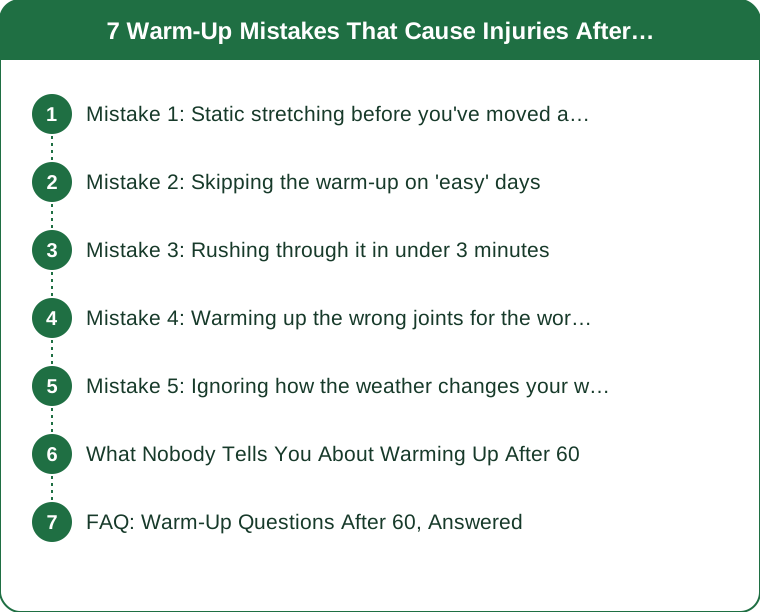
Mistake 1: Static stretching before you’ve moved at all
Holding a cold hamstring stretch for 30 seconds before you’ve done anything else doesn’t prepare the muscle — it can actually reduce the power output you need for the workout ahead. Static stretching is valuable, just not first.
The fix: Save static stretches for after your workout, when tissue is warm. Start your session with movement instead — leg swings, arm circles, bodyweight squats to a comfortable depth.
Mistake 2: Skipping the warm-up on ‘easy’ days
Low-intensity days feel safe, so the warm-up gets cut. But joints over 60 often need more preparation for slow, controlled movement, not less — that’s when stabilizing muscles are asked to do precise work without momentum to help.
The fix: Keep a warm-up on every session, just shorten it. Five minutes of easy movement before a light day is still non-negotiable, even if the workout itself is gentle.
Mistake 3: Rushing through it in under 3 minutes
A warm-up that takes 2 minutes is barely raising your heart rate, let alone preparing joints that take longer to mobilize than they did 20 years ago. Synovial fluid — the natural lubricant in your joints — needs sustained gentle movement to circulate properly.
The fix: Budget 8-10 minutes, not 2-3. If you’re short on time, shorten the workout, not the warm-up — the warm-up is protecting the workout you’re about to do.

Mistake 4: Warming up the wrong joints for the workout
A generic 5-minute walk warms up your cardiovascular system but does little for the shoulder you’re about to load in an overhead press, or the hip you’re about to hinge in a deadlift pattern.
The fix: Match your warm-up to your workout. Upper body day: arm circles, band pull-aparts, shoulder rolls. Lower body day: leg swings, bodyweight squats, hip circles. Match the joint to the movement it’s about to do.
Mistake 5: Ignoring how the weather changes your warm-up needs
Cold mornings — increasingly common as fall sets in — measurably stiffen joints and slow blood flow to muscles before you’ve moved. Skipping this variable is one of the most overlooked injury risks in cooler months.
The fix: Add 2-3 extra minutes to your warm-up on cold days, and consider warming up indoors before heading out for an outdoor walk or run, so your joints aren’t doing double duty against both stiffness and cold air at once.
What Nobody Tells You About Warming Up After 60
Here’s the part most guides skip: a proper warm-up after 60 isn’t really about the muscles — it’s about joint lubrication and nervous system readiness, which both take noticeably longer to activate than they did in your 30s or 40s.
That’s why the same 3-minute warm-up that used to work can now leave you underprepared even though it feels identical to what you always did. The fix isn’t doing more exercises. It’s giving the same handful of movements more time — often just 5 extra minutes makes the difference between feeling ready and feeling stiff through the first third of your workout.
FAQ: Warm-Up Questions After 60, Answered
How long should a warm-up be after 60?
8-10 minutes for most workouts, and up to 12-15 minutes on cold mornings or before higher-intensity sessions. This is roughly double what’s typically recommended for younger exercisers.
Is it ever okay to skip the warm-up entirely?
Not after 60, even for a light day — joints benefit from consistent, gentle preparation more than muscles do, and that benefit doesn’t scale down with workout intensity the way people assume.
What’s the single best warm-up move if I only have 3 minutes?
Bodyweight squats to a comfortable depth, done slowly for 2 minutes. They mobilize hips, knees, and ankles simultaneously, which covers more ground than any single isolated stretch.
TL;DR:
- Static stretching cold, skipping warm-ups on easy days, and rushing through in under 3 minutes are the top 3 mistakes
- Match your warm-up to the joints your workout will actually use, not a generic routine
- Add extra time on cold mornings — stiff joints need more preparation, not the same amount
- Budget 8-10 minutes minimum; if you’re short on time, shorten the workout instead
None of these fixes require new equipment or more workout time — just a few extra minutes spent in the right place.
Keep Reading
This article is for general informational and styling purposes only. Fit, sizing, and product availability may vary.