7 Strength Habits That Matter More After 60 Than at 40

Quick Answer: After 60 the highest-value habits shift toward protein at every meal, training close enough to effort to trigger adaptation, protecting recovery days, adding balance work as a deliberate session, keeping some power work rather than only slow strength, tracking consistency rather than personal bests, and staying honest about pain signals. Frequency and effort matter more than load or novelty.
Nothing about lifting stops working with age. What changes is how expensive a mistake is and how much less forgiving the margins become - so the habits that were merely helpful at 40 become the ones that decide the outcome.

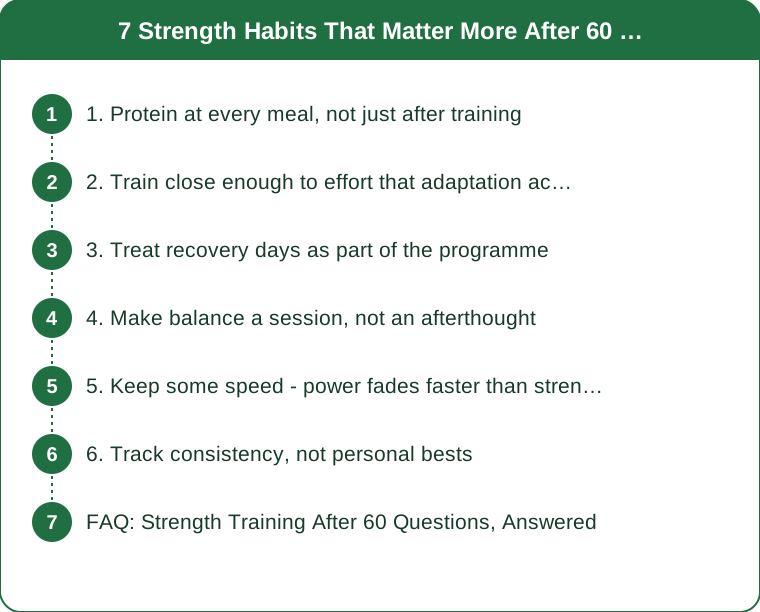
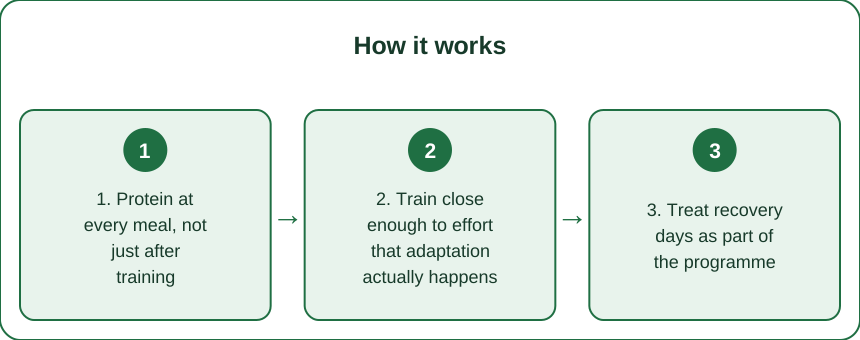
1. Protein at every meal, not just after training
This is the habit with the largest gap between how important it is and how much attention it gets.
Older adults experience anabolic resistance - muscle responds less strongly to a given amount of protein than it did decades earlier. The practical consequence is that a protein amount that was adequate at 40 may be genuinely insufficient at 65 for the same result.
What that looks like in practice: aim for 25 to 35 grams of protein per meal, three times a day, rather than a small breakfast, a modest lunch, and a large dinner. The distribution matters because each meal is a separate stimulus, and a 10-gram breakfast largely does not count as one.
Rough guides: a palm-sized portion of chicken or fish is around 30g, three eggs around 18g, a 200g pot of Greek yoghurt around 20g, and a scoop of whey around 25g.
Total daily target commonly cited for older adults doing resistance training is around 1.2 to 1.6 grams per kilogram of body weight - noticeably higher than general population guidance. For a 65kg person that is roughly 80 to 105 grams a day.
Breakfast is where nearly everyone falls short. Toast and coffee is a zero-protein start, and fixing that single meal often closes most of the daily gap.
2. Train close enough to effort that adaptation actually happens
The most common failure in over-60 training is not overdoing it. It is a decade of comfortable sets that never ask the muscle for anything.
Muscle adapts to effort relative to your capacity, not to absolute weight. Three sets of twelve with a weight you could have done twenty-five times signals nothing, at any age.
A practical target: finish each working set with roughly 2 to 3 reps left in reserve - meaning you genuinely could have done two or three more with good form, but not eight. That is challenging without being risky.
How to find it without maximal testing: pick a weight, do a set, and honestly ask how many more you had. If the answer is more than four, the weight is too light. This self-assessment is imprecise at first and gets accurate within a few weeks.
Safe does not mean easy. Light weights lifted casually carry their own risk - the risk of spending years training without building anything, and arriving at 75 with the strength reserve of someone who never trained. Well-executed challenging sets, on stable movements with good technique, are one of the better investments available at this age.
3. Treat recovery days as part of the programme
Recovery capacity declines gradually with age, and the practical effect is that the same weekly volume needs more space around it.
Muscle protein synthesis response to a training session remains robust in older adults, but the return to baseline takes longer. Training the same muscle group hard on consecutive days is more likely to accumulate fatigue than adaptation.
A workable structure:
- Two to three full-body strength sessions per week, with at least one full day between
- Walking, mobility, or balance work on the days between - active rather than sedentary
- One genuinely easy week every 6 to 8 weeks, at roughly half the usual volume
Signs you need more recovery, not more training: strength dropping across consecutive sessions, joints aching persistently rather than muscles, sleep worsening, or a growing reluctance to start sessions you normally enjoy.
The deload week is the habit people skip and the one that most often separates a training year that ends strong from one that ends with a niggle in November.

4. Make balance a session, not an afterthought
Balance is trainable, it declines without specific practice, and it does not improve much as a side effect of strength work.
The consequences are serious enough to justify treating it as a separate discipline: falls are a leading cause of injury in older adults, and balance training has good evidence for reducing fall risk.
A basic weekly balance block, 10 minutes, twice a week:
- Single-leg stand, 30 seconds each side, near a counter for safety - progress by closing your eyes
- Tandem stance (heel to toe), 30 seconds each side
- Heel-to-toe walking, 10 steps, forward and backward
- Step-downs from a low step, 8 per side, controlled
- Weight shifts onto one leg with a reach, 8 per side
Progression is by reducing support and stability, not by adding weight - eyes closed, softer surface, head turns while balancing.
Do it near something solid to hold, always. The goal is to challenge balance where falling is impossible, which is exactly what a kitchen counter provides.
5. Keep some speed - power fades faster than strength
This is the habit most commonly missing from over-60 programmes, and the one with the clearest link to everyday capability.
Power - force produced quickly - declines faster with age than maximal strength does. It is also what you use to catch yourself when you trip, to stand up quickly, or to cross a road before the lights change. Slow, heavy, controlled lifting builds strength but trains power poorly.
How to add it safely - the speed is in the intent, not in the load:
- Sit-to-stand, fast up, slow down, 3 sets of 6. Stand as quickly as you comfortably can, lower over three seconds.
- Step-ups with a quick drive, 3 sets of 6 per side, moderate step height
- Medicine ball chest push against a wall, 3 sets of 8, using a light ball
- Fast-tempo band rows, 3 sets of 10
Use light to moderate loads with fast intent. This is the opposite of heavy grinding lifts and it is far less joint-stressful than people assume. The load is light precisely because the speed is the point.
Two short power blocks a week, inside your existing sessions, is enough to make a difference.
6. Track consistency, not personal bests
The measure that predicts outcomes at 65 is different from the one that motivated you at 35, and continuing to use the old one leads people to quit.
Sessions completed per month is the number that matters. Twenty-four sessions in three months at moderate effort beats eight excellent sessions and a six-week gap, comprehensively and not marginally.
What to log, in one line per session:
- Date and what you did
- Weight and reps for two or three main movements
- How it felt out of 10
That is enough. Elaborate spreadsheets get abandoned in February.
Why personal bests are the wrong target: progress becomes non-linear with age. Some months you get stronger; some months you maintain through a cold, a holiday, or a stiff shoulder. Maintenance is a genuine success, not a plateau to be frustrated by - what is actually being resisted is age-related decline, and holding steady means winning that comparison.
Look back at the log every three months rather than every session. The trend over a quarter is the honest picture, and it is usually more encouraging than any individual week.
7. Be precise about pain, and act early
Not stoic, not anxious - precise. The habit is distinguishing categories of sensation and responding to each correctly.
Normal and fine:
- Muscle soreness appearing 12 to 48 hours after, easing with gentle movement
- Effort discomfort during a hard set that stops when the set stops
- General stiffness in the morning that clears within 15 minutes of moving
Modify, do not stop entirely:
- Joint discomfort in one specific movement while others feel fine - change the movement, keep training
- Ache that appears at a certain range of motion - work within the comfortable range
Stop and get it assessed:
- Sharp pain during a movement
- Pain that worsens over consecutive sessions rather than settling
- Any pain with swelling, giving way, or numbness
- Chest pain, unusual breathlessness, or dizziness - stop immediately and seek medical attention
Act early. A niggle addressed at week one is usually a two-week adjustment. The same niggle trained through for three months is often a three-month problem. Recovery timelines lengthen with age, which makes early action more valuable, not less.
If you have any existing condition, or you are new to resistance training, speak to your doctor or a physiotherapist before starting. This is general information, not medical advice.
FAQ: Strength Training After 60 Questions, Answered
Is it too late to start lifting at 65 or 70?
No. Studies in adults well into their 80s and 90s show meaningful strength and function gains from resistance training. The relative improvements in previously untrained older adults are often large, and they translate directly into everyday capability.
How heavy is too heavy?
A weight that forces a change in technique is too heavy, at any age. Within good form, challenging loads are appropriate and beneficial. The risk lies in poor technique and abrupt jumps in load, not in the number on the dumbbell.
Should I train differently after menopause?
The principles hold, but the case for resistance training strengthens considerably - bone density and muscle mass both come under more pressure. Adequate protein and challenging resistance work are the two levers with the best evidence, and both are worth discussing with your doctor.
How many days a week is enough?
Two full-body sessions a week produces most of the available benefit, and three is modestly better. Consistency at two beats an ambitious four-day plan that lasts five weeks.
Do machines or free weights suit older adults better?
Both work. Machines are easier to learn and need no spotter, which makes them a good entry point. Free weights train balance and coordination alongside strength. A mix, with more machines early on, is a sensible default.
TL;DR:
- Protein 25 to 35g per meal, three times daily - breakfast is where most people fall short
- Train with 2 to 3 reps in reserve; comfortable sets build very little at any age
- Two to three sessions a week with a day between, and an easy week every 6 to 8 weeks
- Balance deserves its own 10-minute block twice weekly, progressed by reducing support
- Keep fast, light power work - power declines faster than strength and matters for daily life
- Track sessions completed, not personal bests; maintenance is a genuine win
- Categorise pain precisely and act on the concerning kind early, when it is still small
None of these are age-specific techniques - they are the ordinary principles, reordered by how much they now matter. Get protein, effort, recovery, and balance right, and the training does its job quietly for decades.
Keep Reading
This article is for general informational and styling purposes only. Fit, sizing, and product availability may vary.