7 Reasons Your Walking Routine Stopped Building Strength After 60

Quick Answer: Walking builds cardiovascular fitness indefinitely but stops building muscle strength once your body adapts to the load - usually within 8 to 12 weeks at a steady pace. After 60, the muscle you need to protect against falls and frailty responds to load and speed, not to duration. The fix isn’t walking more; it’s adding hills, intervals, load, or two short strength sessions a week alongside the walking you already do.
You walk every day. You’ve walked every day for two years. Your doctor is pleased. And yet standing up from a low chair is harder than it was, and the shopping bags feel heavier. That combination confuses a lot of people, and it has a straightforward explanation.
This is general information, not medical advice. Check with your clinician before adding intensity, especially if you have heart, joint, or balance concerns.

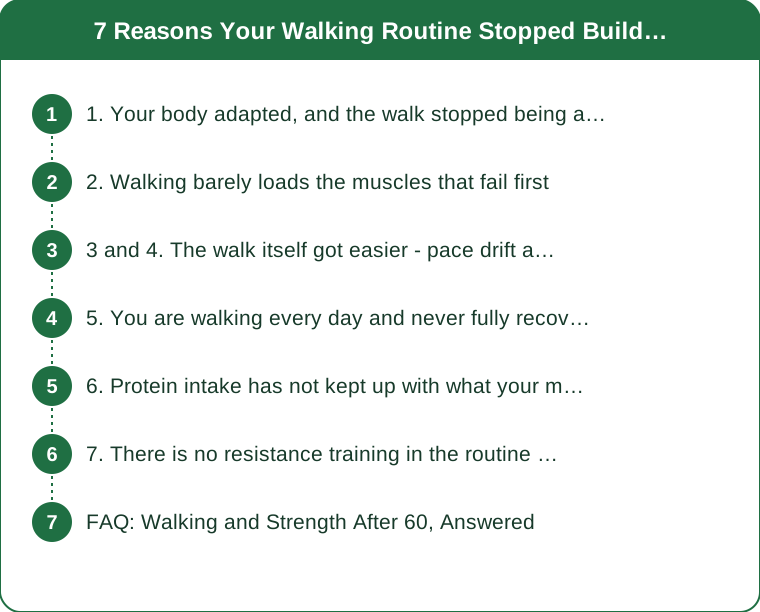
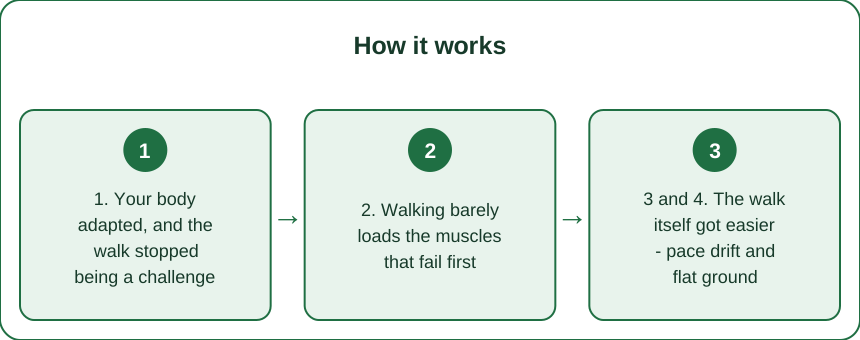
1. Your body adapted, and the walk stopped being a challenge
Muscle adapts to the demand placed on it, then stops changing when the demand stops rising.
A 40-minute walk at a comfortable pace is a substantial challenge in week one. By week ten, your muscles, heart, and lungs have adjusted to exactly that demand. The walk still delivers real benefits - circulation, mood, blood sugar regulation, joint health - but it is no longer a stimulus for strength.
The marker: if you can hold a full conversation comfortably throughout your entire walk, it’s maintenance, not progression. That’s a perfectly legitimate goal. It just isn’t the same goal as getting stronger.
The change: you don’t have to give up the comfortable walk. Add one different walk per week - hills, a faster segment, or added weight - and keep the rest as they are.
2. Walking barely loads the muscles that fail first
The muscles most associated with independence after 60 - quadriceps, glutes, and grip - are only lightly loaded by level walking.
Rising from a chair, climbing stairs, and catching yourself after a stumble all demand force production that a flat walk never asks for. This is why someone can walk 10,000 steps a day and still struggle to get off a low sofa.
Grip strength deserves specific mention because it’s one of the strongest single predictors of future function, and walking does essentially nothing for it - unless you’re carrying something.
The change: carry your shopping rather than wheeling it, for as much of the walk as is comfortable. A loaded carry is one of the few ways to make an ordinary walk build both grip and trunk strength at once. Start with what you can hold for 30 seconds per side.
3 and 4. The walk itself got easier - pace drift and flat ground
3. Your pace has quietly drifted down
Most long-term walkers slow gradually without noticing - often by a substantial margin over a year or two.
The route feels the same, the time taken creeps up, and the effort stays comfortable because the pace fell to match. Walking speed is itself a well-established marker of healthy ageing, so a slow drift downward isn’t merely a training issue.
How to check honestly: time a fixed section of your usual route - a block, a stretch of path between two landmarks - once a month. Same section, same shoes, same direction. Numbers catch drift that feelings don’t.
The change: add six 60-second faster segments into an existing walk, with two minutes of normal pace between them. Faster means brisk enough that talking becomes choppy - not a run. This single change reverses most pace drift within a few weeks.
4. Flat ground gives your legs nothing to push against
Level walking asks very little of the glutes and calves compared to inclines.
An incline of even 4 to 6% substantially increases the demand on the muscles that extend the hip - the exact muscles most involved in standing up and in preventing a fall. It also does this at a lower joint load than running, which matters for anyone managing arthritis.
Where to find incline: a local hill, a car park ramp, a footbridge, or a treadmill set to 5%. Stairs count too, and stair climbing is one of the most functionally relevant activities available.
The change: one hill walk per week. Find a slope that takes 60 to 90 seconds to climb and repeat it four to six times, walking down slowly to recover. Downhill walking loads the quadriceps differently and is worth doing deliberately rather than avoiding - just start with fewer repetitions, because it produces more soreness.

5. You are walking every day and never fully recovering
Daily identical walking is comfortable specifically because it never creates a stimulus large enough to need recovery.
Muscle grows during recovery, not during the session. A routine with no hard days has nothing to recover from - so it produces no adaptation. This is the paradox that catches conscientious people: the very consistency that makes the habit sustainable is what caps its effect.
The change: keep the frequency, vary the intensity. A workable week for most people over 60:
- 2 easy walks - conversational, restorative, exactly what you do now
- 1 hill or interval walk - the hard one
- 1 loaded walk - carrying shopping or wearing a light weighted pack
- 2 short strength sessions - see the next point
- 1 rest or gentle mobility day
That’s the same total time most daily walkers already spend. It’s redistributed, not increased.
6. Protein intake has not kept up with what your muscles need
After roughly 60, muscle becomes less responsive to protein - a phenomenon called anabolic resistance. The same meal that maintained muscle at 40 does less at 65.
Current evidence suggests older adults need more protein per meal, not just more per day, to trigger muscle protein synthesis - commonly cited as roughly 25 to 30 grams in a single sitting, three times a day. Many women over 60 eat most of their protein at dinner and very little at breakfast.
Simple ways to move breakfast toward 25g: two eggs plus a slice of cheese, Greek yoghurt with nuts and seeds, or a protein shake alongside toast. Getting breakfast right is usually the biggest single improvement available.
The change: count protein at breakfast for one week - just breakfast. Most people discover it’s under 10 grams, and correcting that one meal changes how the rest of the training responds.
Kidney conditions change protein recommendations - check with your clinician if that applies to you.
7. There is no resistance training in the routine at all
This is the direct answer to the whole problem, and it’s the one people most want to avoid.
Age-related muscle loss - sarcopenia - accelerates after 60 and responds far better to resistance training than to any amount of walking. Research on strength training in adults well into their eighties and nineties consistently shows meaningful gains in strength, walking speed, and stair-climbing ability.
What it actually takes: two sessions a week, 20 to 30 minutes each. Not a gym membership, not heavy barbells.
A complete starting programme, twice weekly:
- Sit-to-stand from a chair - 3 sets of 8 (add a cushion to raise the seat if needed, remove cushions as you progress)
- Wall or counter push-up - 3 sets of 8
- Step-up onto a low step - 2 sets of 8 per leg, holding a rail
- Heel raise - 3 sets of 12
- Loaded carry - 3 trips of 20 metres holding weight in both hands
- Sit-to-stand from a lower seat - progress here once the first version is easy
Progress by making each exercise harder, not longer. A lower chair, a higher step, a heavier bag. When a set of 8 feels easy, that’s the signal.
What to expect: most people notice stairs and chairs feeling easier within 4 to 6 weeks. That’s not a slow return - it’s one of the fastest, most reliable responses in all of exercise science, and it’s available at any age.
FAQ: Walking and Strength After 60, Answered
Should I stop walking and switch to strength training?
No - keep the walking. It does things strength training doesn’t, including cardiovascular health, mood, and blood sugar regulation. Add two short strength sessions rather than substituting.
Is a weighted vest a good idea?
It can be, starting light - around 4 to 5% of body weight - and only if your back, hips, and knees are comfortable. Carrying weight in the hands builds grip as well, which a vest doesn’t, so start there if you’re choosing one.
How many steps should I aim for?
Benefits accumulate well below 10,000, with meaningful gains often seen around 6,000 to 8,000 for older adults. Step count and strength are separate goals - don’t expect one number to serve both.
What if I have knee arthritis?
Strength training is one of the best-supported interventions for knee osteoarthritis, and sit-to-stands and step-ups are usually well tolerated within a pain-free range. Work with a physiotherapist on range and load rather than avoiding loading altogether - avoidance tends to make it worse over time.
TL;DR:
- Walking stops building strength once you adapt, usually within 8-12 weeks at a steady pace
- It barely loads quads, glutes, and grip - the three things that matter most for independence
- Add hills, 60-second faster segments, and loaded carries to the walks you already do
- Vary intensity across the week instead of repeating the same walk daily
- Aim for 25-30g of protein per meal, and fix breakfast first
- Two 20-minute strength sessions a week is the actual answer - chairs and stairs feel easier in 4-6 weeks
Walking every day is a genuinely excellent habit and it isn’t failing you. It’s just answering a different question than the one you’re now asking. Keep it, and add the small amount of load that makes it build strength again.
Keep Reading
This article is for general informational and styling purposes only. Fit, sizing, and product availability may vary.