7 Reasons Raking Leaves Leaves You Sore for Days After 60 (and How to Rake Without the Payback)

Quick Answer: Raking leaves you sore for days after 60 because it’s two hours of one-sided twisting, bent-over hinging and hard gripping that your body hasn’t done since last fall, and muscle soreness from unaccustomed work peaks 24 to 72 hours later and lasts longer as you age. Rake in 20-minute blocks, switch sides every 10 minutes, hinge from the hips instead of rounding the back, use a lightweight rake, and warm up for 5 minutes first. A little strength work in the weeks before leaf season makes the biggest difference of all.
The yard looked great on Sunday afternoon. On Tuesday morning you couldn’t reach the top shelf.
Raking is the sneakiest workout of the year. It doesn’t feel hard while you’re doing it, there’s no sweat to warn you, and the first twinge doesn’t show up until the next day. By the time it does, the damage is done.
Here are the seven reasons it hits harder after 60, and what to do about each one. The fourth one is the reason the soreness lands on only one side.

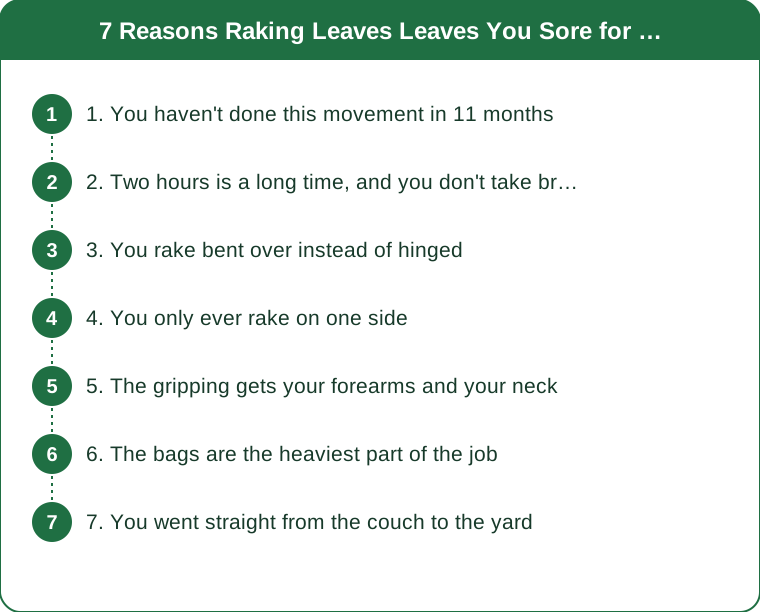
1. You haven’t done this movement in 11 months
Your body is good at what it practices. Raking is a strange combination of pulling, twisting and bending that nothing else in your week looks like, and you do it once a year for two or three weekends in a row.
Muscles asked to do a new pattern for two hours respond with delayed onset muscle soreness, the deep ache that peaks 24 to 72 hours after the work and can hang around for 5 days. After 60, recovery from that kind of soreness tends to take longer than it did at 40, which is why a Sunday rake can still be with you on Thursday.
The fix: treat the first rake of the season like the first day back at anything. 30 to 40 minutes, done. The second weekend you can go longer. Your body adapts remarkably quickly, and the second and third sessions hurt far less than the first.
2. Two hours is a long time, and you don’t take breaks
Nobody rakes for 20 minutes and stops. You rake until the section is done, then the next section, and before you know it it’s been 2 hours of continuous work. For a muscle group that’s not used to the job, that’s the equivalent of doing a single 2-hour set.
The small muscles along the spine and around the shoulder blades tire first. Once they’re fatigued, the bigger muscles and the joints start taking load they shouldn’t, and that’s when the lower back and the neck start to complain.
The fix: set a timer for 20 minutes. When it goes off, put the rake down, walk a lap of the yard, roll your shoulders 10 times and reach overhead. Then go again. Four 20-minute blocks with 3-minute breaks gets the same yard done with a fraction of the soreness. The rest also lets you notice if something’s starting to hurt before it turns into a problem.
3. You rake bent over instead of hinged
Watch most people rake and the back is rounded like a C, head down, arms doing all the work. Two hours in that shape loads the discs and ligaments of the lower back instead of the muscles that are built to carry it.
The shape you want is a hip hinge: knees soft, chest up, bottom pushed back, spine long. Think of the position you’d use to look at something on a low table without bending your back. From there the glutes and hamstrings share the work, and the back muscles are supporting rather than straining.
The fix: before you start, stand side-on to a window and practice 10 slow hinges with your hands on your hips, pushing your bottom back until you feel the backs of your thighs stretch. That’s the position. Keep the rake head close to your feet rather than reaching far out, and step forward to the leaves instead of leaning to them. Standing taller also means the rake handle should be long enough that you’re not stooping. Many handles are too short for anyone over about 5 foot 6.

4. You only ever rake on one side
This is the reason the soreness is lopsided. Almost everyone has a raking side. Right hand low on the handle, left hand high, pull toward the right hip, twist to the right. Repeat 400 times.
That’s 400 twists in one direction, loading one set of oblique muscles, one shoulder and one side of the lower back, while the other side does almost nothing. The next morning the right side of your back and your left shoulder are on fire, and the other side feels fine.
The fix: switch sides every 10 minutes. It feels clumsy for the first minute, and it halves the load on each side. If switching is too awkward, at least turn your whole body to face the leaves and rake straight toward you rather than twisting across your trunk. The twist is what gets the lower back. Facing square to the work takes most of it out.
5. The gripping gets your forearms and your neck
A rake handle is thin, and you grip it hard for 2 hours. That’s a long static hold for the forearm muscles, and after 60, when grip strength is naturally lower than it was, it’s a bigger share of your capacity than you’d expect.
Here’s the part that surprises people: tight gripping travels up the arm. When the hands clench, the shoulders creep up toward the ears, the upper traps lock on, and by the end of the session the neck is as tight as the forearms. That stiff neck on Tuesday started in your hands on Sunday.
The fix: choose a rake with a padded or thicker handle, or wrap the grip area with foam tape from the hardware store. Hold it firmly, not tightly. Every break, shake your hands out for 20 seconds and let the shoulders drop. And consider a lightweight rake. A 3-pound plastic leaf rake with a wide head moves more leaves per stroke than a heavy metal garden rake and asks far less of your grip.
6. The bags are the heaviest part of the job
Raking gets the blame, but the lifting is often what actually hurts. A full bag of damp leaves can weigh 30 to 40 pounds, and the natural way to lift it is to bend over, grab it, and twist to drop it in the bin or the trailer. That’s a bent-over twisting lift of 40 pounds, repeated 10 or 15 times, at the end of the session when you’re already tired.
The fix: fill bags only two-thirds full. Stand the bag up and crouch to it rather than bending from the waist. Hug it to your body, exhale as you stand, and turn with your feet instead of twisting your trunk to put it down. Better still, rake leaves onto a tarp and drag the tarp to the curb or compost. Dragging 60 pounds on a tarp is far easier on the back than lifting it in bags. For a big yard, it’s worth leaving the leaves under trees and shrubs where they help the soil, and only clearing the lawn and paths.
7. You went straight from the couch to the yard
Cold, stiff muscles on a 45-degree October morning are not ready to twist and pull. Starting at full pace with no warm-up is the fastest way to tweak something, and a back that’s tweaked in the first 10 minutes stays tweaked for a week.
The fix: 5 minutes before you touch the rake. Walk briskly around the yard for 2 minutes. Then 10 arm circles each way, 10 gentle trunk rotations, 10 hip hinges, and 10 side bends. Dress in layers you can remove. Start at an easy pace for the first 10 minutes and build up.
And the biggest fix of all: don’t wait for leaf season to get strong. Three times a week in September and October, do 2 sets of 10 of each of these: sit-to-stands from a chair, standing rows with a resistance band, farmer carries with two grocery bags for 30 seconds, and standing wood chops with a light weight, 10 each direction. Fifteen minutes a session. That’s the exact pattern raking uses, and the yard will feel like a walk when the leaves come down.
Myth vs Fact: raking and your back
Myth: soreness after raking means you’ve injured yourself. Fact: general muscle ache that peaks at 1 to 3 days and fades is normal soreness from unaccustomed work. Sharp pain that started during the raking, pain that shoots into a leg, or pain that doesn’t ease after a week is different and worth a doctor’s visit.
Myth: a leaf blower is always easier on the body. Fact: a backpack or handheld blower weighs 8 to 12 pounds and is held on one side for an hour. It cuts the twisting but adds a long one-sided carry. If you use one, swap sides and take the same breaks.
TL;DR:
- Raking hurts after 60 because it’s 2 hours of unpracticed twisting, bending and gripping, and soreness from new work peaks at 24 to 72 hours and lasts longer with age.
- Rake in 20-minute blocks, switch sides every 10 minutes, hinge from the hips, and keep the rake close to your feet.
- Use a light, wide rake with a padded grip, fill bags two-thirds, and drag a tarp instead of lifting.
- Warm up for 5 minutes, and do 15 minutes of rows, carries and wood chops three times a week in the weeks before leaf season.
The yard still gets done. You just get to enjoy Tuesday as well. This is general information, not medical advice. If raking causes sharp pain, pain into a leg, or pain that lasts beyond a week, see your doctor.
Keep Reading
This article is for general informational and styling purposes only. Fit, sizing, and product availability may vary.