7 Reasons Night Bathroom Trips Raise Fall Risk After 60

Quick Answer: Night bathroom trips raise fall risk after 60 because you’re standing up fast from lying down, moving while half asleep, in poor light, often in a hurry and in bare feet or socks. Each of those is manageable. Sit on the edge of the bed for 30 seconds before you stand, light the path with low amber night lights, clear the floor, wear slippers with a back and a rubber sole, and review evening drinks and medications with your doctor or pharmacist.
It’s 3am. You wake up, you need to go, and you’re on your feet before you’ve really opened your eyes.
It’s a walk of maybe 15 steps, and you’ve done it thousands of times. It’s also one of the riskiest trips you take all day, and most of the reasons are easy to fix.

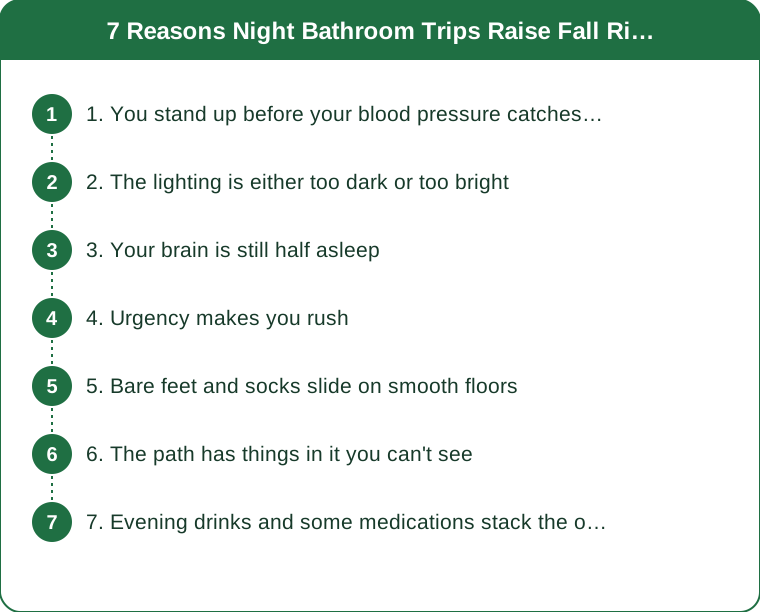
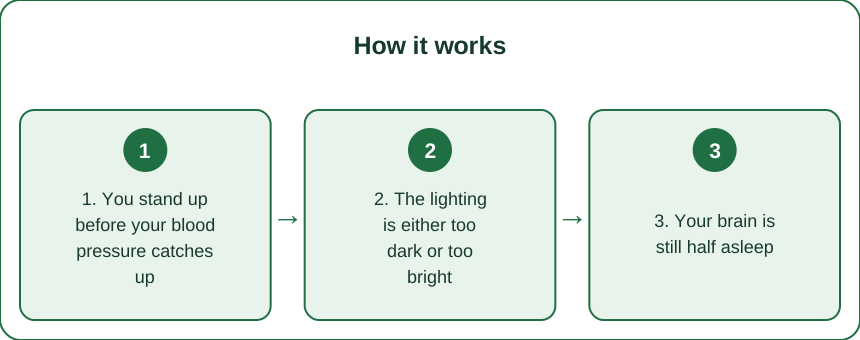
1. You stand up before your blood pressure catches up
When you go from lying down to standing, gravity pulls blood toward your legs. Your body normally corrects for that within a few seconds. After 60 that correction can be slower, and the result is a brief drop in blood pressure that leaves you light-headed or unsteady.
It’s most likely in the first minute after you stand, which is exactly when you’re walking across a dark room.
The fix: sit on the edge of the bed with your feet flat on the floor for a slow count of 30. Pump your ankles up and down 10 times. Then stand, pause for 5 seconds with a hand on the bed or nightstand, and only then start walking.
If you often feel dizzy on standing, tell your doctor. It’s a common finding and it’s worth checking.
2. The lighting is either too dark or too bright
Most people pick one of two bad options. They walk in the dark so they don’t wake up fully, or they flip on the overhead light and get dazzled.
Eyes need more light with age to see edges and contrast, and they take longer to adjust when the brightness changes. Either way, for several seconds you can’t see the floor properly.
The fix: put plug-in night lights low on the wall, at about ankle to knee height, along the whole route from bed to toilet. Choose a warm amber or red tone, since it’s easier on sleepy eyes than white or blue light. Motion-sensor versions cost a few dollars each, and 3 or 4 usually cover the path.
Keep a small flashlight on the nightstand as a backup for power cuts and nights away from home.
3. Your brain is still half asleep
For the first few minutes after waking, reaction time, balance and judgment are all measurably worse. Sleep researchers call it sleep inertia. It’s the fog that makes you put the milk in the cupboard on an early morning.
At 3am it’s at its strongest, because you’ve usually been pulled out of deep sleep.
A foggy brain is slower to notice a slipper in the way and slower to catch you if you trip. This is one more reason the 30-second sit matters. It gives your head time to come online along with your blood pressure.
The fix: while you’re sitting on the edge of the bed, look around the room and find the doorway before you stand. Make it a rule that you don’t walk until you can see where you’re going.

4. Urgency makes you rush
A strong urge to go changes how you walk. Studies of older adults have found that urgency shortens stride and pulls attention away from balance. You hurry, you look at the bathroom door and not the floor, and you take corners too tightly.
Waking twice or more a night to urinate has been linked with a higher rate of falls in several studies, and rushing is thought to be a big part of why.
The fix: go when you first notice the urge and not at the last minute. If urgency or frequency is new, or you’re up more than twice most nights, mention it to your doctor. It’s often treatable, and pelvic floor training helps many women.
If the bathroom is a long way off, a bedside commode is a practical choice, and nobody else needs to know it’s there.
5. Bare feet and socks slide on smooth floors
Socks on wood, tile or vinyl have very little grip. Bare feet are better, though a damp bathroom floor changes that quickly. Backless slippers bring their own problem, because your foot can slide out of them mid-step.
The fix: keep a pair of slippers right where your feet land when you sit up. Look for 3 things: a closed back, a rubber sole with some tread, and a snug fit that doesn’t require gripping with your toes.
If you really dislike slippers, non-slip socks with rubber grips on the sole are a reasonable second choice. Replace them once the grips wear smooth, usually after a few months of washing.
Put a non-slip mat or grip strips on the bathroom floor in front of the toilet and the sink as well.
6. The path has things in it you can’t see
A route that’s perfectly safe at noon can be a different place at night. The usual suspects are throw rugs with curling edges, a phone charger cord, shoes kicked off beside the bed, a laundry basket, and a pet that likes to sleep in the doorway.
The fix: walk the route once in daylight and look at it as a stranger would. Then do the following.
- Remove loose rugs from the path, or tape every edge down with double-sided rug tape.
- Move cords so they run along the wall.
- Leave a clear lane about 3 feet wide from the bed to the bathroom.
- Give shoes and baskets a home that’s off the route.
- If a pet sleeps in your room, a small bell on the collar tells you where they are.
Consider a grab bar next to the toilet. Towel rails aren’t built to hold body weight, and they’re what most people reach for.
7. Evening drinks and some medications stack the odds
What you take in the evening affects both how often you get up and how steady you are when you do.
Fluids: a large drink in the last 2 hours before bed often means an extra trip. Try having most of your fluids earlier in the day and tapering after dinner. Don’t cut your total intake, since dehydration causes dizziness too.
Alcohol and caffeine: both increase urine production, and alcohol also affects balance for hours.
Medications: sleep aids, some blood pressure tablets, water pills taken late in the day, certain antidepressants and some allergy medicines can all make you drowsier or dizzier at night.
The fix: ask your doctor or pharmacist to review everything you take, including over-the-counter products, with falls in mind. Sometimes changing the time of day is enough. Never stop or change a prescription on your own.
Myth vs Fact: falling at night is just part of getting older
Myth: falls are bound to happen after a certain age, so there’s not much point worrying about them.
Fact: more than 1 in 4 adults aged 65 and over falls each year, according to the CDC, so they’re common. They’re also among the most preventable health problems of later life. Strength and balance training lowers the risk, and so do home changes like the ones above.
Myth: staying in bed and holding on is safer than getting up.
Fact: lying awake with a full bladder costs you sleep, and poor sleep makes balance worse the next day. A well-lit, well-practiced trip is the better choice.
Myth: strong legs don’t matter for a 15-step walk.
Fact: getting off a low bed and a toilet seat are both squats. Practicing 2 sets of 10 chair stands most days makes every night trip steadier.
FAQ: Night-Time Falls Questions, Answered
How many times is it normal to get up at night after 60?
Once a night is very common after 60 and usually isn’t a concern. Twice or more on most nights is worth raising with your doctor, especially if it’s a recent change. There are many possible causes, including medication timing, sleep apnea, bladder changes and blood sugar, and most can be improved.
What’s the best night light color for older adults?
Warm amber or red light is generally the best choice for night trips. It gives enough contrast to see the floor without the glare of white light, and it’s less likely to wake you fully. Place the lights low, near the baseboard, so they light the floor and don’t shine in your eyes.
Should I keep a walker or cane by the bed?
If you use one during the day, yes, and keep it within arm’s reach of where you sit up. Night is when you need it most. Make sure the route is wide enough to use it properly, about 3 feet, and that the rubber tips are in good condition.
TL;DR:
- The night walk to the bathroom combines a fast change of position, a sleepy brain, poor light, hurry and slippery feet, and each one raises fall risk after 60.
- Sit for 30 seconds before standing, pump your ankles 10 times, and pause for 5 seconds once you’re up.
- Light the route with low amber night lights, clear a 3-foot lane, and wear closed-back slippers with rubber soles.
- Taper evening fluids, and ask a doctor or pharmacist to review your medications and any urgency or dizziness.
Set up the lights and slippers this week, and practice the 30-second sit tonight. After a few nights it becomes automatic, and those 15 steps go back to being an ordinary walk. This is general information, not medical advice. If you’ve already had a fall or a near miss, ask your doctor about a fall risk assessment.
Keep Reading
This article is for general informational and styling purposes only. Fit, sizing, and product availability may vary.