7 Reasons Grip Strength Matters More Than Your Leg Press After 60

Quick Answer: Grip strength is the single most useful strength number to track after 60, because it correlates with whole-body strength, mobility, and independence far better than any single machine number. It is also the one most people never train directly. Adding two or three minutes of dedicated grip work to sessions you already do - hangs, carries, and slow towel work - typically produces a measurable change within six to eight weeks, and needs no equipment beyond a bag and a doorway.
The leg press feels like the serious exercise. It has a number, it has plates, it makes you sweat. But if you had to keep one measure of how well the next decade is going to go, it would not be that one.

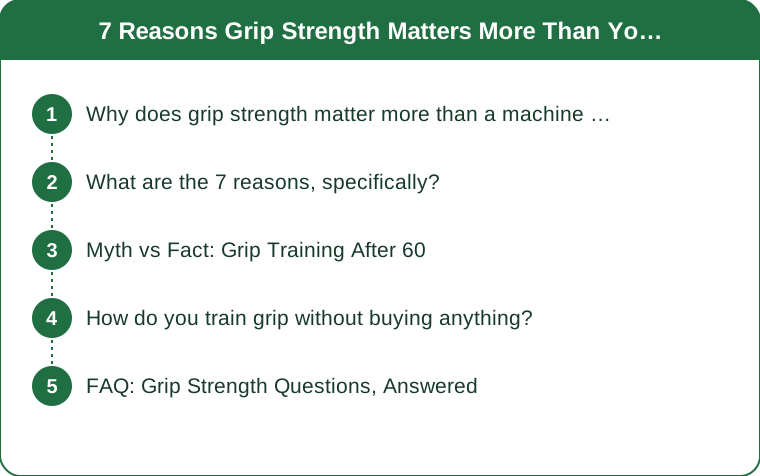
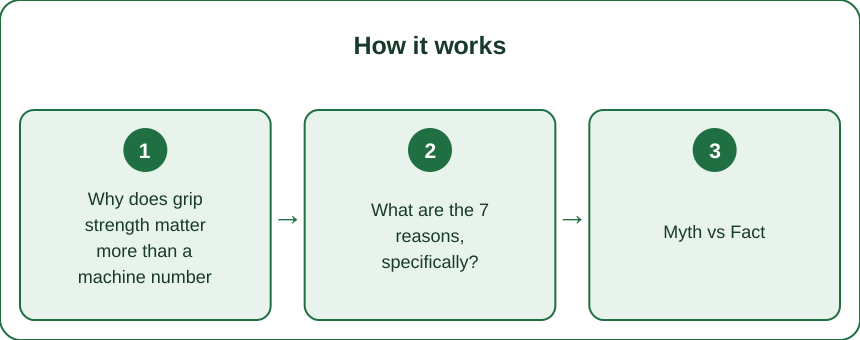
Why does grip strength matter more than a machine number after 60?
Because grip is a proxy for the whole system, and the leg press is a proxy for the leg press. A machine supports your torso, fixes your joint path, and removes balance from the equation. That is exactly what makes it comfortable and exactly what makes it a poor read on how you function outside the gym.
Grip has none of that scaffolding. To squeeze hard you need forearm and hand strength, but you also need shoulder stability to anchor the arm, trunk stiffness to anchor the shoulder, and enough nervous system drive to recruit all of it at once. A weak grip is often the first place a decline in any of those shows up.
That is why grip appears in so much of the research on ageing - not because hands are magical, but because they are honest.
What are the 7 reasons, specifically?
1. It tracks total body strength
Across large studies, grip correlates with overall muscular strength better than most isolated measures. If grip is climbing, the rest of the system is usually climbing with it.
2. It predicts how well you recover from illness
People with stronger grip going into a hospital stay or a bad flu tend to lose less function and regain it faster. Reserve matters most exactly when you cannot train.
3. It is what actually fails in daily life
Nobody is stopped by an inability to leg press. People are stopped by jars, shopping bags, handrails, and a suitcase into an overhead locker. Grip is the limiting factor in almost every one.
4. It protects you in a fall
The ability to catch and hold a rail or a counter edge for two seconds is a grip task, and it is often the difference between a stumble and a fracture.
5. It declines earlier than you notice
Grip typically peaks in the thirties and declines slowly, then faster after 65. Because it fades gradually, most people adapt around it - two hands on the kettle, asking someone else to open the jar - and never register the loss.
6. It is easy to measure honestly
A hang, a carry, or a cheap dynamometer gives you a number you cannot fudge with momentum or a better machine setting.
7. It responds quickly
Grip is heavily neural, which means it improves fast. Six to eight weeks of two or three short sessions a week usually produces a change you can feel on the stairs with the shopping.

Myth vs Fact: Grip Training After 60
Myth: grip work will aggravate arthritic hands. Fact: for most people with osteoarthritis, gentle progressive loading improves symptoms rather than worsening them. What tends to aggravate is sudden high-force gripping without warm-up, and long static holds at maximum effort. Start with carries, which load the hand through a mid-range, rather than crushing work.
Myth: you need grip trainers or those spring-loaded devices. Fact: the spring grippers train a narrow crushing action that transfers poorly. A loaded shopping bag trains the grip you actually use.
Myth: grip is a hand thing. Fact: a large share of the muscle that closes your fingers sits in the forearm, and the strength you can express depends on shoulder and trunk stability. Which is why carries work so well - they train the whole chain at once.
Myth: if it hurts, stop training it. Fact: worth separating. Sharp joint pain, stop. A working ache in the forearm that settles within a day is the normal signal of adaptation.
How do you train grip without buying anything?
Three exercises, two or three times a week, about three minutes total.
Farmer carries. Two shopping bags, loaded with anything heavy - tins, books, bottles of water. Walk 20 to 30 metres, set down, rest a minute, repeat 3 times. Keep shoulders down and back, and do not let the bags swing. Add weight when 30 metres feels like a 6 out of 10.
Towel hangs or bar holds. If you have a sturdy bar or a solid door frame edge, hold on with feet still on the ground taking most of your weight, for 20 to 30 seconds, 3 times. Taking weight through your feet is the point - it lets you scale the load precisely.
Slow towel wring. Roll a damp hand towel, wring it slowly for 10 seconds each direction, 3 rounds. This covers the range that carries miss and is gentle enough for stiff mornings.
Do these after your main session, not before, so grip fatigue does not compromise your other lifts. And track one number - the seconds on your hang, or the weight in the bags - so you can see the six-week change rather than guess at it.
FAQ: Grip Strength Questions, Answered
What is a reasonable grip target after 60?
With a dynamometer, roughly 20 kg for women and 30 kg for men is often used as a rough functional threshold in the research, with higher being better. Without one, a 30-second supported hang and two comfortable 20 kg shopping bags for 30 metres is a solid practical benchmark.
How long until I notice a difference?
Most people feel it in daily tasks - jars, bags, handrails - at around four to six weeks, and measurable change lands by eight. Grip improves faster than leg strength because so much of the early gain is neural.
Should I stop leg pressing then?
No. Leg strength matters enormously for stairs and for getting out of a chair. The argument is not to drop it but to stop treating it as the headline number, and to make room for three minutes of grip work that has been getting none.
This is general information rather than medical advice. If you have significant hand pain, rheumatoid arthritis, or a recent injury, get an assessment before adding load.
TL;DR:
- Grip predicts whole-body strength, recovery from illness, and day-to-day independence better than any machine number.
- It fails in real life first - jars, bags, handrails, catching yourself on a stumble.
- It declines quietly from the thirties and much faster after 65, so most people adapt around the loss without noticing it.
- It responds fast: six to eight weeks of short sessions produces a felt difference.
- Train it with carries, supported hangs, and slow towel work - about three minutes, two or three times a week, no equipment needed.
Keep leg pressing if you enjoy it. But if you want one number that tells you how the next ten years are likely to go, weigh the shopping bags, not the stack.
Keep Reading
This article is for general informational and styling purposes only. Fit, sizing, and product availability may vary.