7 Reasons Getting Up From the Floor Gets Harder After 60 (and How to Train Each One)

Quick Answer: Getting up from the floor after 60 gets harder because it needs seven things at once: leg strength at deep knee angles, hip mobility, ankle bend, pushing strength in your arms, a core that can rotate under load, knees that tolerate kneeling, and practice. Most people lose the practice first. Training the move in pieces 3 times a week usually makes it noticeably easier within 4 to 6 weeks.
You got down to look under the couch for the remote. Easy. Then you looked around for something to grab, and the coffee table suddenly seemed a long way off.
That pause tells you something useful. Here’s what’s behind it, one piece at a time.

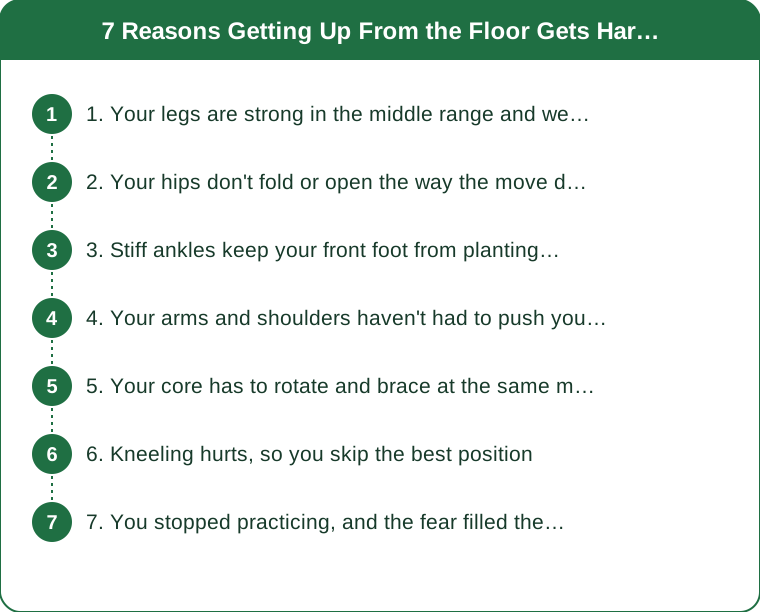
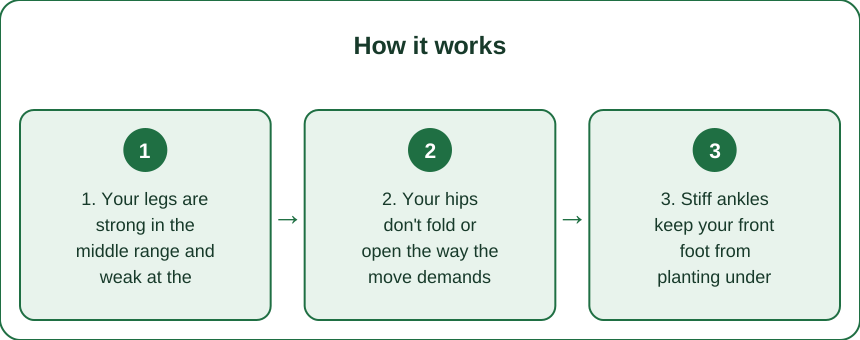
1. Your legs are strong in the middle range and weak at the bottom
Walking, stairs, and standing up from a normal chair all use your legs with the knee bent to about 90 degrees or less. Rising from the floor asks for force with the knee bent far past that, and most adults over 60 haven’t loaded that deep range in years.
Muscle is specific. It gets strong at the angles you use. So you can be a solid walker and still feel stuck in a low position.
Train it: Sit-to-stands from a lower surface each week. Start with a standard chair, then a low sofa, then a sturdy 12-inch step or ottoman. Do 2 sets of 8, arms crossed, lowering for a slow count of 3. When 8 feels smooth, go lower, not faster.
2. Your hips don’t fold or open the way the move demands
To get up, you have to swing one leg forward and plant the foot flat while the other knee stays down. That takes deep hip flexion on the front leg and hip extension on the back leg at the same time.
Years of chair sitting shorten the front of the hips and stiffen the joint capsule. When the front foot can’t land close enough to your body, you end up reaching forward and tipping, and tipping is the part that feels unsafe.
Train it: Half-kneeling hip rock. Kneel on a cushion with one foot forward, hold a chair, and rock your weight gently forward and back 10 times per side. Then, sitting on the edge of a chair, lift one knee toward your chest with your hands and hold 20 seconds. Do both daily; they take under 3 minutes.
3. Stiff ankles keep your front foot from planting under you
This is the reason people least expect. When you step the front foot through, your shin needs to tilt forward over your toes so your weight can move over that foot. If your ankle won’t bend, your heel pops up or your foot lands too far ahead, and you’re suddenly pushing from a much weaker position.
Ankle bend tends to shrink with age and with years in shoes that have a raised heel.
Train it: Knee-to-wall drill. Stand facing a wall with your toes about 3 inches away, heel flat. Bend your knee toward the wall without lifting the heel. Do 10 slow reps per side, twice a day. If you touch easily, move the foot back half an inch. Calf stretches held for 30 seconds after a walk help too.

4. Your arms and shoulders haven’t had to push your body weight in a long time
Almost everyone uses their hands to get up, and that’s a perfectly good strategy. It means your arms have to support a real share of your weight while your legs get organized, from a low, awkward angle.
Pushing strength fades quietly because daily life rarely asks for it. Wrists that dislike being bent back make it harder still.
Train it: Counter push-ups. Hands on the kitchen counter, body in a straight line, lower your chest toward the edge and press away. Do 2 sets of 8 to 10, three days a week. When that’s comfortable, move to a sturdy lower surface like the arm of a sofa. For cranky wrists, make fists and press through your knuckles on a folded towel, or grip the edge of the counter so the wrist stays straight.
5. Your core has to rotate and brace at the same moment
Getting up from your back is a roll, a prop onto an elbow, a turn onto hands and knees, and then a rise. Every stage twists your trunk while it carries load. A trunk that only ever works facing straight ahead finds that sequence clumsy, and clumsy feels like weakness.
This is also where people hold their breath, which makes the effort feel far bigger and can leave you lightheaded when you arrive upright.
Train it: Practice only the first half. Lie on your bed, roll to your side, and push up to sitting on the edge using your arm, 5 times each side. Breathe out during the push. On the floor, try bird dog: on hands and knees, slide one leg straight back, hold 5 seconds, switch. Do 6 per side.
6. Kneeling hurts, so you skip the best position
Half-kneeling is the most efficient route from the floor to standing. One knee down, one foot planted, push up. Many people over 60 avoid it completely because pressing a kneecap into a hard floor is painful, and that leaves only harder options, like trying to stand straight up from a deep squat.
For most people the issue is pressure on the front of the knee, not harm to the joint. The padding there thins with age.
Train it: Pad the knee and build tolerance gradually. Use a folded towel or a 1-inch foam pad. Kneel next to a chair for 10 seconds, stand, and repeat 5 times. Add 5 seconds each week. If you’ve had a knee replacement, ask your surgeon or physical therapist about kneeling first; many people are cleared for it, but it’s worth confirming.
7. You stopped practicing, and the fear filled the gap
This reason sits underneath all the others. At some point, getting on the floor became something you arrange your life to avoid. You sit on the bench to tie your shoes. You let someone else reach the bottom cabinet. Each workaround is sensible, and together they remove every rep you used to get.
Skills you don’t rehearse feel risky, and feeling risky makes you avoid them more.
Train it: One planned floor visit a day, next to a sturdy chair or the sofa. Get down, get up, done. Use this sequence: roll to your side, push up to hands and knees, crawl your hands onto the chair seat, step your stronger foot forward, push through that foot and both hands, stand, and pause for a breath before you walk.
5 Mistakes Everyone Makes Getting Up
- Rushing the last step. Stand, then wait 3 to 5 seconds before walking, so your blood pressure can catch up.
- Pulling on something that moves, like a rolling chair, a towel bar, or a door handle.
- Always leading with the same leg. Alternate, so both get trained.
- Trying to stand straight up from sitting on your bottom. Go through hands and knees first.
- Practicing only when alone and worried. The first few times, do it with someone in the house.
Is it normal to need my hands to get up?
Yes. Using one or two hands is common at every age past midlife and isn’t a sign of failure. Over time, aim to use lighter support, such as fingertips on a chair, instead of none.
How often should I practice getting up from the floor?
Once a day is plenty to rebuild the skill. Add the strength drills above 3 days a week. Most people feel a clear difference in 4 to 6 weeks.
What should I do if I fall and can’t get up?
Stay still for a moment and check for pain. If you’re hurt, call for help and keep warm. If you aren’t, roll to your side, crawl to the sturdiest piece of furniture, and use the chair sequence above. Keeping a phone within reach of the floor in the rooms you use most is a simple backup. Tell your doctor about any fall, even one without injury.
TL;DR:
- Rising from the floor needs deep-angle leg strength, hip and ankle mobility, arm push, a rotating core, tolerance for kneeling, and regular practice
- Practice is usually the first thing lost and the fastest thing to rebuild
- Train the pieces 3 days a week: lower sit-to-stands, hip rocks, knee-to-wall, counter push-ups, bird dog, padded kneeling
- Do one planned get-down-and-get-up every day beside a sturdy chair, and pause before you walk away
Being able to get up from the floor is one of the most practical kinds of strength you can own after 60. It means a dropped remote, a game with a grandchild, or a stumble in the garden stays a small event. Start with the chair beside you and the padded knee, and let the move get ordinary again. If you’ve fallen recently, feel dizzy when you change positions, or have a joint replacement, check with your doctor or a physical therapist before you start. This is general information, not medical advice.
Keep Reading
This article is for general informational and styling purposes only. Fit, sizing, and product availability may vary.