7 Reasons Getting In and Out of the Car Gets Harder After 60 (and the Fix for Each)

Quick Answer: Getting in and out of the car gets harder after 60 because it combines a low seat, a twist, a duck of the head, and a single-leg push in a cramped space. Hip rotation, leg power, and trunk control all decline without practice, and the car tests all three at once. Sit first and swing your legs in together, slide the seat back before you get out, and train sit-to-stands and hip rotation 3 times a week.
You used to drop into the driver’s seat without thinking. Now there’s a small pause, a hand on the door frame, and sometimes a grunt you didn’t plan on.
It’s one of the first everyday movements to feel different, and each of the 7 reasons below has a fix you can start this week.

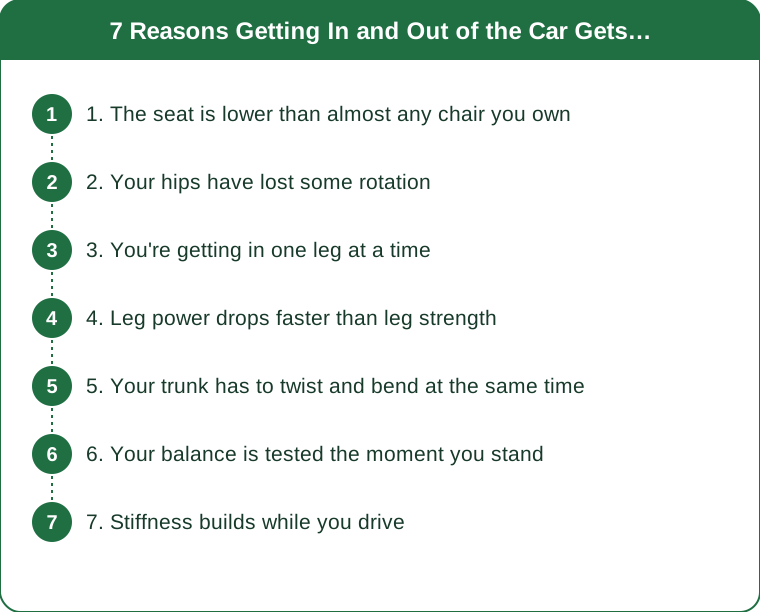
1. The seat is lower than almost any chair you own
Most sedan seats sit 17 to 19 inches off the ground, and a sports model can be lower. A standard dining chair is around 18 inches, but you sit on it with your feet flat under you and nothing in the way.
In a car, your feet are out in front and your hips are often below your knees. Standing from there takes far more thigh and hip strength than standing from a chair.
The fix: practise sit-to-stands from a normal chair, 3 sets of 8, 3 days a week, arms crossed if you can. Once that’s easy, move to a lower surface such as a firm sofa. In the car, raise the seat height if yours adjusts. Even 1 inch helps.
2. Your hips have lost some rotation
Getting in means swinging one leg across and turning your pelvis. That needs the hip to rotate, and hip rotation is one of the first ranges to shrink when it isn’t used.
If your hip won’t turn, your lower back or knee twists to make up the difference. That’s the pinch some people feel on the way in.
The fix: seated hip rotations. Sit tall on a chair, lift one foot, and slowly swing the lower leg in and out like a windscreen wiper for 10 reps each side. Follow with a seated figure-four stretch, ankle on the opposite knee, held for 30 seconds per side. Do both daily.
3. You’re getting in one leg at a time
Stepping in with one foot and then folding the rest of you after it puts your whole weight on a bent, twisted leg while you duck under the roof. It worked at 40 because you had strength to spare.
The fix: change the order. This is the method physical therapists teach.
- Back up to the seat until you feel it against your legs
- Hold the door frame or the seat, never the door itself, which can swing
- Sit down first, facing out
- Swing both legs in together, turning your whole body as one piece
Reverse it to get out: both feet to the ground, then stand. It feels slow for a week and then becomes automatic.

4. Leg power drops faster than leg strength
Strength is how much you can push. Power is how quickly you can push it. After 60, power tends to decline faster than strength, and getting out of a car is a power move. You need one quick, firm drive to clear the seat.
That’s why you might manage a slow chair stand at home and still feel stuck in the car.
The fix: add speed to your sit-to-stands. Stand up as briskly as you safely can, then sit down slowly over 3 seconds. Do 2 sets of 6, twice a week, next to a counter for support. Fast up, slow down is the pattern that rebuilds power.
5. Your trunk has to twist and bend at the same time
Getting out involves turning toward the door, leaning forward, and ducking your head, all together. Combined movements like that depend on the muscles around your waist and spine working in sequence.
When they’re out of practice, the movement feels effortful and a little unsteady, especially on the driver’s side where the steering wheel limits your space.
The fix: seated trunk rotations. Sit tall, cross your arms over your chest, and turn slowly to look over one shoulder, then the other. 10 each way, once a day. Before you get out, slide the seat all the way back. Those extra 3 to 4 inches of room make the turn much easier.
6. Your balance is tested the moment you stand
The second you’re upright, you’re standing on a road edge or a sloped driveway, often with one foot lower than the other, right after a quick change of position. Some people also get a brief lightheaded moment on standing.
That combination is where a lot of car-related stumbles happen. The getting-up went fine, and the wobble came in the first two steps.
The fix: pause for a count of 3 after you stand, hand on the door frame, before you step away. Train single-leg balance at home: hold a counter and stand on one foot for 20 to 30 seconds per side, twice a day. Park where the ground is level when you have the choice. If you often feel dizzy on standing, mention it to your doctor.
7. Stiffness builds while you drive
After 45 minutes of sitting still, hips and knees feel noticeably stiffer than they did when you got in. Cooler autumn weather adds to it. The hardest exit of the day is usually the one after the longest drive.
The fix: move before you get out. With the car parked, do 10 ankle pumps, 5 knee straightens per leg, and 5 gentle pelvic tilts in your seat. It takes under a minute and it primes the joints for the push. On long trips, stop every 60 to 90 minutes and walk for 3 or 4 minutes.
A swivel cushion or a portable grab handle that slots into the door latch can also help on stiff days. Using one is a sensible choice, the same as using reading glasses.
FAQ: Getting In and Out of the Car Questions, Answered
Is a higher car easier to get out of after 60?
Often, yes. A seat roughly level with your hip, as in many crossovers, lets you slide across instead of dropping down or climbing up. Very tall vehicles can be harder, since you have to step up. Try before you buy.
How long does it take for the exercises to make a difference?
Most people notice an easier exit within 3 to 4 weeks of doing sit-to-stands and hip work 3 times a week. Strength and power keep improving for months after that.
When should I talk to a doctor or physical therapist?
See someone if you have sharp hip, knee, or back pain when getting in or out, if a leg gives way, if you’ve had a fall or near fall around the car, or if dizziness on standing is frequent. A physical therapist can assess your movement and tailor a plan. This is general information, not medical advice.
TL;DR:
- A car asks for a low stand, a twist, a duck, and a balance check all at once, which is why it feels harder before other things do
- Sit first, then swing both legs in together, and slide the seat back before getting out
- Train sit-to-stands (fast up, slow down), hip rotations, trunk turns, and single-leg balance about 3 times a week
- Do ankle pumps and knee straightens before you exit after a long drive, and pause for a count of 3 once you’re standing
Getting in and out of the car is a skill, and skills come back with practice. Start with the sit-first technique today and add the chair work this week. A month from now, that small pause at the car door should be a lot shorter.
Keep Reading
This article is for general informational and styling purposes only. Fit, sizing, and product availability may vary.