7 Kitchen Tasks That Secretly Test Your Fall Risk After 60

Quick Answer: You don’t need a clinic to spot early fall risk — 7 ordinary kitchen moments (reaching a high shelf, standing on one leg, stepping over clutter, and others below) reveal balance weak points long before a real fall happens. Struggling with 2 or more is worth a real assessment.
You don’t think of loading the dishwasher as a balance test. But your kitchen runs you through single-leg stances, weight shifts, and quick reaches dozens of times a day — and it’s usually the first place small balance losses show up, long before anyone calls it a ‘fall risk.’

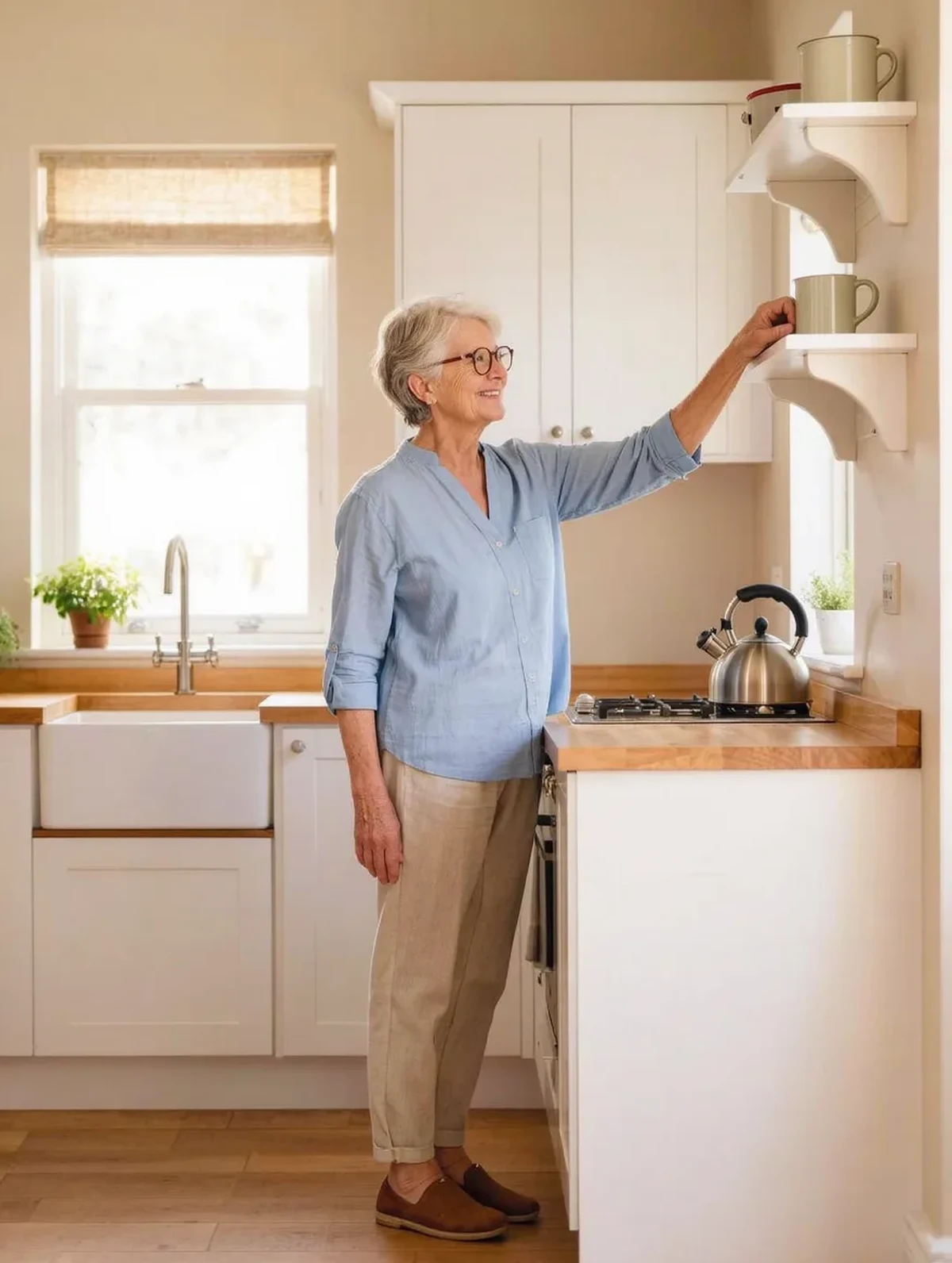
1. Reaching the top shelf without holding the counter
If you instinctively grab the counter edge before reaching up, that’s your body already compensating for reduced single-leg stability — the leg you’re not standing fully on has to hold you steady while the other foot often lifts slightly onto its toes.
Test it deliberately once: reach for something on the top shelf without touching anything else. Wobble is normal in small amounts. A lurch or a step to catch yourself is the signal worth noting.
2. Stepping over the dog bowl or a low stool
This is a single-leg, eyes-forward balance test in disguise. Healthy balance lets you clear a low obstacle without looking down and without a hand on the wall.
If you find yourself glancing down every time or gripping a doorframe to step over the same low object you’ve stepped over for years, that’s a real, trackable change — not just getting ‘more careful.‘
3. Standing on one leg to pull off a sock or shoe
Doing this barefoot, unsupported, for even 5 seconds is one of the most predictive simple balance measures used in fall-risk research. Under 5 seconds on your weaker side is a meaningful flag.
Try both legs by the counter (hand hovering, not gripping) and time it on your phone. Most people are surprised by the gap between their two sides.
4. Turning quickly when the oven timer goes off
Quick rotational turns are where a lot of falls actually happen — not from falling forward, but from a fast pivot that outruns your balance recovery.
If turning fast toward the oven or a ringing phone ever makes you grab something to steady yourself, that’s a sign your righting reflexes have slowed, which is common and very trainable, not a life sentence.
5. Carrying a hot pot across the room
Carrying weight changes your center of gravity and takes both hands out of ‘catch yourself’ position. This is exactly why kitchen falls involving pots and pans are so common — your normal safety net (a free hand near a counter) is gone.
If you find yourself walking unusually slowly or hugging the counter edge while carrying anything hot or heavy, your body already knows something your conscious mind hasn’t flagged yet.
6. 5 Signs You’re Handling These Tasks Just Fine
Not every wobble is a warning. Here’s what normal, healthy kitchen balance looks like: you can reach a mid-height shelf without a counter touch, you clear low obstacles without looking down most of the time, you hold a one-leg sock-removal stance past 8-10 seconds on both sides, quick turns don’t require a grab, and carrying a full pot doesn’t change your walking speed. Two or fewer of these being ‘off’ is worth watching casually. Three or more is worth an actual assessment.
7. FAQ: Kitchen Balance and Fall Risk, Answered
Is it normal for balance to get a little worse after 60?
Some decline is common due to slower reflexes and reduced muscle mass, but ‘common’ doesn’t mean ‘unimportant’ — most balance loss responds well to targeted strength and balance work, so noticing it early is useful, not alarming.
What should I do if I struggle with 3 or more of these?
Start with grip-strength and single-leg standing practice at the counter (safe, holds nearby), and bring the specific pattern you noticed to a doctor or PT — ‘I can’t clear the dog bowl without looking down’ is more useful information than ‘I’m worried about falling.‘
Can fixing kitchen clutter alone lower fall risk?
Clearing obvious hazards (loose mats, poor lighting, cords) helps, but it treats the environment, not the balance itself — pair it with the balance checks above rather than relying on cleanup alone.
TL;DR:
- Your kitchen already runs 7 real balance tests daily — reaching, stepping over, one-leg stances, quick turns, carrying weight
- Struggling with 2 or fewer is normal to watch; 3 or more is worth a real assessment
- A single-leg sock test under 5 seconds on either side is one of the most useful home checks
- Balance decline after 60 is common and highly trainable — noticing it early through daily tasks beats waiting for a fall
You don’t need special equipment to check any of this — just pay attention next time you’re in the kitchen. This is general information, not medical advice.
Keep Reading
This article is for general informational and styling purposes only. Fit, sizing, and product availability may vary.